
Cucamonga Valley Water District Celebrates 70 Years of ‘Service Beyond Expectation’
April 25, 2025
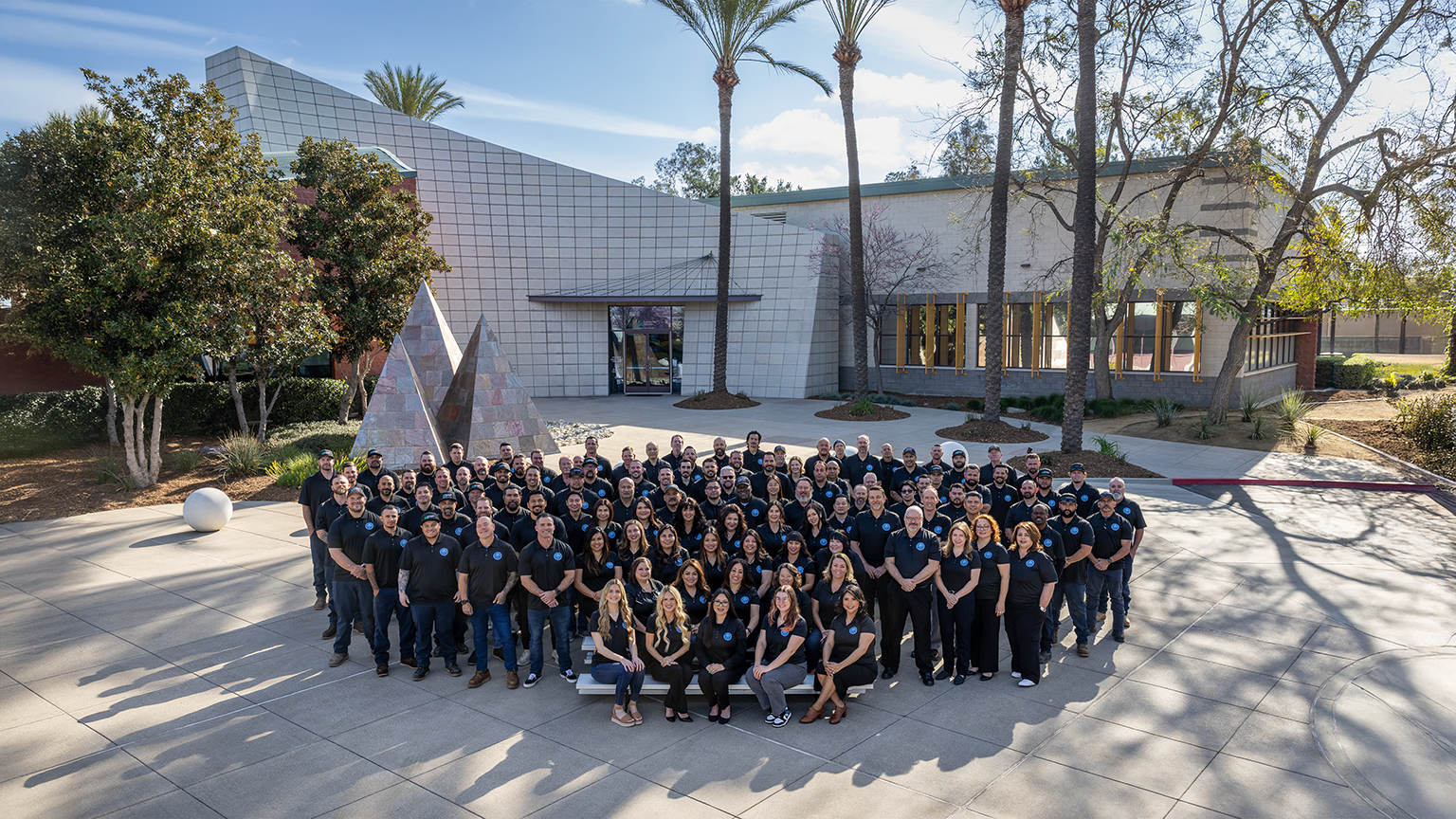
CVWD employees gather for a group photo as part of the district’s celebration of its 70th year in service. Photos courtesy of CVWD
What began as the consolidation of more than a dozen small water companies in 1955 has grown into one of the Inland Empire’s most forward-thinking and community-centered water agencies: the Cucamonga Valley Water District (CVWD), which proudly marked its 70th anniversary this March.
“The 70th anniversary is a testament to the hard work and dedication of our team, past and present,” said Board President Randall Reed. “We take pride in our commitment to providing reliable water services and look forward to continuing our mission for many years to come.”
Since its founding, CVWD has supported a region undergoing dramatic transformation—from a thriving agricultural valley to a growing urban hub with extensive residential, commercial, and industrial development.
Formed during a historic drought in the 1950s, CVWD emerged to address dropping groundwater levels and the need for a sustainable, centralized water system. Approved by voters in March 1955, the district quickly got to work—completing its first water system in 1956, acquiring 14 private water companies by 1957, and building new storage facilities. The 1960s saw further expansion, with service extending into Etiwanda and parts of the City of Fontana, and the development of surface water sources from Deer and Cucamonga canyons.
CVWD’s focus on long-term planning has remained a defining trait. In 1979, CVWD connected to the State Water Project and opened its first water treatment facility — the Royer-Nesbit Water Treatment Plant. A decade later, the district continued to expand its treatment capacity, with the 1989 opening of the Lloyd Michael Water Treatment Plant, now capable of processing up to 90 million gallons per day.
A defining hallmark of CVWD has been its strategic planning and long-term investments in local water sources. Key milestones include securing water rights in 1992 through a partnership with Kaiser Resources and acquiring stock in the Fontana Union Water Company in 2001, adding supply reliability.
Beyond infrastructure, CVWD has also led in environmental stewardship and customer service. In 2014, the district marked a major sustainability milestone by activating its 100th recycled water customer. The same year, the district reopened the Arthur H. Bridge Water Treatment Plant after an extensive upgrade, further reducing reliance on imported water and strengthening local supply resilience.
CVWD has also responded proactively to state and federal water quality regulations. In 2015, it completed a $40 million upgrade to the Lloyd W. Michael Plant, ensuring compliance with the Safe Drinking Water Act while boosting onsite storage.
Technology has played a central role in shaping CVWD’s modern era. From launching a water meter upgrade program in 2016 to completing its Automated Meter Reading Infrastructure (AMI) project in 2019, CVWD has empowered customers to conserve water and detect leaks with real-time data. In recent years, the district has reinforced its commitment to water supply reliability through the construction of Reservoirs 1 and 3A, along with Wells 48 and 49. These efforts, alongside the ongoing expansion of recycled water projects, reflect CVWD’s dedication to building a resilient and sustainable water system.
Under its current General Manager, CVWD has also underscored a commitment to operational excellence and workforce development through cross training programs that invest in the next generation of water professional leaders. One of their current programs, the Comprehensive Operating Training Program, builds on the foundation of regulatory compliance, real-world application, and technical knowledge to strengthen career advancement for their Treatment Plant Operators.
“CVWD’s core value of being good stewards of our natural and financial resources is reflected in the investments we’ve made in both our water supply and our workforce,” said Board Vice President Jim Curatalo.
A key strength of CVWD is its diversified water supply strategy, which enhances drought resilience and reduces dependence on a single source. The district draws from:
- Local Groundwater: (52%): Sourced from 31 wells in the Chino and Cucamonga Basins.
- Imported Water: Delivered through the State Water Project and treated locally at the Lloyd W. Michael Water Treatment Plant before distribution.
- Local Surface Water: Collected from local canyons and tunnels along the San Gabriel Mountains.
- Recycled Water: (3%): Used for irrigation and industrial purposes in order to conserve CVWD’s potable water supply.
CVWD’s leadership has extended beyond the local level. The district joined ACWA in 1958 and has remained an active member. Notably, past CVWD Board Member Kathleen Tiegs served as ACWA Vice President from 2014 to 2015 and President from 2016 to 2017. The ACWA Board of Directors recognized CVWD’s 70th anniversary with a resolution at its April 4 meeting.
In March, CVWD hosted a commemorative event during a special Board of Directors meeting, bringing together past and present leaders, community members, and stakeholders to celebrate the district’s legacy. The event also debuted a video presentation highlighting CVWD’s major achievements and evolution over the decades.
“As we enter our eighth decade, the district remains steadfast in its mission to provide high-quality, safe and reliable water and wastewater services,” said General Manager/CEO John Bosler. “Our partnerships with regional agencies and investments in our diversified water supply will be key as we meet future challenges.”
