
WVWD Secures Over $1 Million in Community Project Funding for Water Resiliency Projects
RIALTO — West Valley Water District (WVWD) is thrilled to announce the approval of $1 million in congressional funding allocated toward crucial water resiliency initiatives that will further WVWD’s mission to provide high quality and reliable water to its 100,000 customers. “We are incredibly grateful to Congressman Aguilar for championing these significant initiatives that will help us safeguard the current and future water needs of our customers,” said West Valley Water District Board President Greg Young. “By investing in these critical projects, West Valley Water District remains dedicated to its core mission of providing sustainable and dependable water resources to the communities it serves.” Representative Aguilar has allocated $959,757 towards the Bunker Hill Wells Project that reflects a shared vision for sustainable water management and community well-being. The project prioritizes collaboration among water providers in the region with the support of San Bernardino Valley Municipal Water District (Valley District) to expand water resources, support additional growth, and meet water needs during extended droughts and emergencies. Through collaboration with Valley District, the project will construct additional groundwater wells and infrastructure similar to a joint venture known as the Base Line Feeder. This joint water supply project will benefit multiple communities including portions of the Cities of Rialto, Fontana, Colton, Jurupa Valley, Bloomington, and other unincorporated areas of San Bernardino and Riverside County. The project ensures a vital resource for regional use during emergencies and droughts. This collaboration underscores the commitment to regional water reliability between WVWD, Valley District, and other regional partners. Additionally, Representative Aguilar has allocated $525,000 to an emergency generator that will enhance water reliability to WVWD communities during emergency situations. Emergency generators are needed to keep WVWD’s pump stations and wells operating during power outages and maintain water pressure and flows necessary to meet community needs, fight fires, and prevent contamination. “Access to clean water is not just a necessity, it’s a right,” said Rep. Aguilar. “I was proud to join West Valley Water District to announce nearly $1.5 million in Community Project Funding to help build a more resilient and sustainable water system.” To learn more about West Valley Water District and its investment in the communities it serves, visit www.wvwd.org/projects.# # #
The West Valley Water District has proudly served the Southern California communities of Bloomington, Colton, Fontana, Rialto, San Bernardino, and Jurupa Valley since 1952. Through name changes and consolidation, the mission has always remained the same: to provide customers with safe, high quality, and reliable water service at a reasonable rate and in a sustainable manner. The District provides water for over 100,000 customers and is overseen by a five-member, publicly elected Board of Directors.ACWA Receives Award for Annual Year in Review Publication
The California Association of Public Information Officials (CAPIO) recently honored ACWA with a prestigious Epic Award, the top prize in the annual publication category, for its “2022 Year in Review.”
CAPIO’s EPIC awards program recognizes the most creative and effective efforts in the areas of communication and marketing campaigns, newsletter production, photography, special events, writing, website development and video production. ACWA’s annual “2022 Year in Review” publication outlines the association’s activity during the previous year, including advocacy wins, service highlights, events and metrics.
The annual report is available on ACWA’s website.
The EPIC Awards honor work that transcends innovation and craft – work that made a lasting impact by providing an equal chance of winning to all entrants, regardless of company or agency size and project budget.
Fact Sheets Make the Case for Supporting Water Supply for Farmers
The California Farm Water Coalition (CFWC) has released three educational fact sheets shedding light on the water needed to produce the food Californians consume daily, and the risk we face from unsustainable foreign food production.
All three fact sheets are available online, and individually they connect water use to food consumption from the following three perspectives.
Where Does Farm Water Go?
California’s population of 39 million requires a staggering 11.3 trillion gallons of water annually to grow enough food and fiber to meet its needs, as described in the first fact sheet, “Where Does Farm Water Go?”. However, current water supplies fall short, leaving a gap of 38% between the water used to grow our food and the demand on food production by the state’s population. Despite a 14% decline in water usage by California farms over the past 35 years, the growing population will require an additional 1 million acre-feet of water annually just to meet this increasing food supply demand. This trend underscores the urgency of managing both water resources and food production in the face of climate uncertainty.
Sample Daily Menu
The second fact sheet, “Sample Daily Menu,” breaks down the water requirements for a selection of menu items for one person over a day, based on the U.S. Department of Agriculture MyPlate recipe guide. For three meals, plus snacks and beverages, the total daily water requirement to produce the menu of items amounts to 810.3 gallons per person for a single day’s meals. Most people think of daily water consumption as water for cooking, cleaning, bathing, and outdoor watering. This insight into the water footprint using a daily menu highlights the significance of nutrition as a significant part of our daily water demand.
Why Local Production Matters
America’s grocery stores may seem brimming with fresh fruits and vegetables year-round, but behind the vibrant displays lies a sobering truth: a significant portion of these products are imported from other countries. The third CFWC fact sheet, “Our Food Supply – Sustainability & Imports,” opens the door to discussions about the policies and regulations that have made Americans more dependent on foreign-produced food.
According to data from the USDA, a staggering 60.9% of the fresh fruit and 38.8% of the fresh vegetables consumed in the United States are sourced from abroad.
That’s a 228% increase of fruit and 479% increase of vegetable imports since 1980. This heavy reliance on imports poses a concerning risk to the security and sustainability of our food supply, particularly given the alarming challenges overseas producers face, from political strife, war, degrading natural resources, and inconsistent food safety standards.
For more background, visit a blog post by CFWC Executive Director Mike Wade on the Northern California Water Association website.
The CFWC is a non-profit, educational organization committed to sharing fact-based information about the important role water plays in the food, fiber, and nursery products grown in California.
Federal Grant Expands Regional Groundwater Storage
BEAUMONT —The United States Bureau of Reclamation awarded San Gorgonio Pass Water Agency (SGPWA) a $400,000 WaterSMART Planning and Project Design Grant in April to support drought resilience and clean water access for disadvantaged communities in the region. The grant funds SGPWA’s Brookside West Recharge Facility and enhances the Agency’s ability to store imported water and serve 80,000 residents. Thanks to another wet year, SGPWA received more than 29,000 acre-feet per year from the State Water Project (SWP) in 2023. While the region’s existing recharge capacity is around 20,000 acre-feet, it acquired 62 acres of land adjacent to its existing Brookside Recharge Facility to overcome this constraint. With the Bureau of Reclamation funding, the Agency can design a new Brookside West Recharge Facility to increase recharge capacity by around 9,000 acre-feet per year and help enable the area to import its full allocation. “This funding enables SGPWA to increase the regional water supply, fortify water levels and prepare the area for the next drought,” Mickey Valdivia, SGPWA Board President said. “Crucially, disadvantaged communities can thrive with improved water quality and long-term sustainability.” Of the tens of thousands of people the Brookside Recharge Facility serves, 39 percent are disadvantaged due to climate change issues, poverty and low-income households, transportation barriers and unemployment. Increasing recharge capacity will replenish local groundwater supplies, providing a stable water source for drinking, agriculture and other essential needs. The new facility also strengthens a drought-prone region with additional storage during wet periods, creating a reserve that can be tapped during dry spells. The WaterSMART Planning and Project Design Grant will help create a final design package for the Brookside West Recharge Facility that SGPWA can use to apply for construction funding. The Agency will leverage partnerships with the Riverside Flood Control District and the local Watermaster to complete the project. This project addresses key challenges for Riverside County, including prolonged drought conditions and climate change effects. Over-extraction of groundwater for urban, agricultural, and industrial use has threatened groundwater resources. With expanded groundwater recharge capabilities, SGPWA can conduct long-term supply planning that bolsters local basins and the greater local use of the SWP. WaterSMART funding opportunities allow the Bureau of Reclamation to work with states, tribes and local entities in the American West as they plan and increase water supply through investments to modernize existing infrastructure. Since January 2021, the Bureau of Reclamation has funded 666 projects with a total of $292.6 million, in conjunction with $2.2 billion in non-Federal funding, across the western states. Learn more at www.sgpwa.com.###
About San Gorgonio Pass Water Agency Formed in 1961, SGPWA is a State Water Contractor that serves a 225-square-mile area of western Riverside County. The service area includes the cities of Calimesa, Beaumont, and Banning, and the communities of Cherry Valley, Cabazon, and the Banning Bench. In addition to importing State Water Project (SWP) water from Northern California to augment local groundwater sources, the Agency builds local system infrastructure, participates in water transfers, partners in statewide water projects and collaborates on regional water reliability and conservation efforts.EVMWD Recognized with Transparency Certificate of Excellence for Fourth Time
Lake Elsinore, CA– Elsinore Valley Municipal Water District (EVMWD) has been honored with the prestigious District Transparency Certificate of Excellence by the Special District Leadership Foundation (SDLF) for the fourth consecutive time. This recognition highlights EVMWD’s commitment to transparency and good governance in serving its community. “This award is a testament to Elsinore Valley Municipal Water District’s commitment to open government,” said General Manager, Greg Thomas. “Our staff is to be commended for their hard work in empowering the public with information and facilitating engagement and oversight.” To receive the award, EVMWD demonstrated its fulfillment of essential governance transparency requirements set forth by SDLF. These include conducting ethics training for all board members, ensuring the proper conduct of open and public meetings, and timely filing of financial transactions and compensation reports to the State Controller. About SDLF SDLF is an independent, non-profit organization that promotes good governance and best practices among California’s special districts through certification, accreditation and other recognition programs. Special districts, such as EVMWD, are crucial in delivering core local services to communities, ranging from utility and wastewater treatment to fire protection and parks and recreation. These districts are established by voters and funded to meet specific needs through focused service. EVMWD’s recognition underscores its commitment to integrity, transparency, and ethical conduct in all facets of its operations. By upholding these values, EVMWD continues to set a standard of excellence in serving its community and fostering trust among stakeholders. Receiving this award for the fourth consecutive time demonstrates our consistent dedication to these principles. For more information about EVMWD and its initiatives, please visit www.evmwd.com.####
EVMWD serves more than 163,000 water and wastewater customers in a 97-square-mile area in Western Riverside County. The EVMWD team delivers total water management that powers the health and vibrancy of its communities so life can flourish.May 24, 2024 ACWA News Available
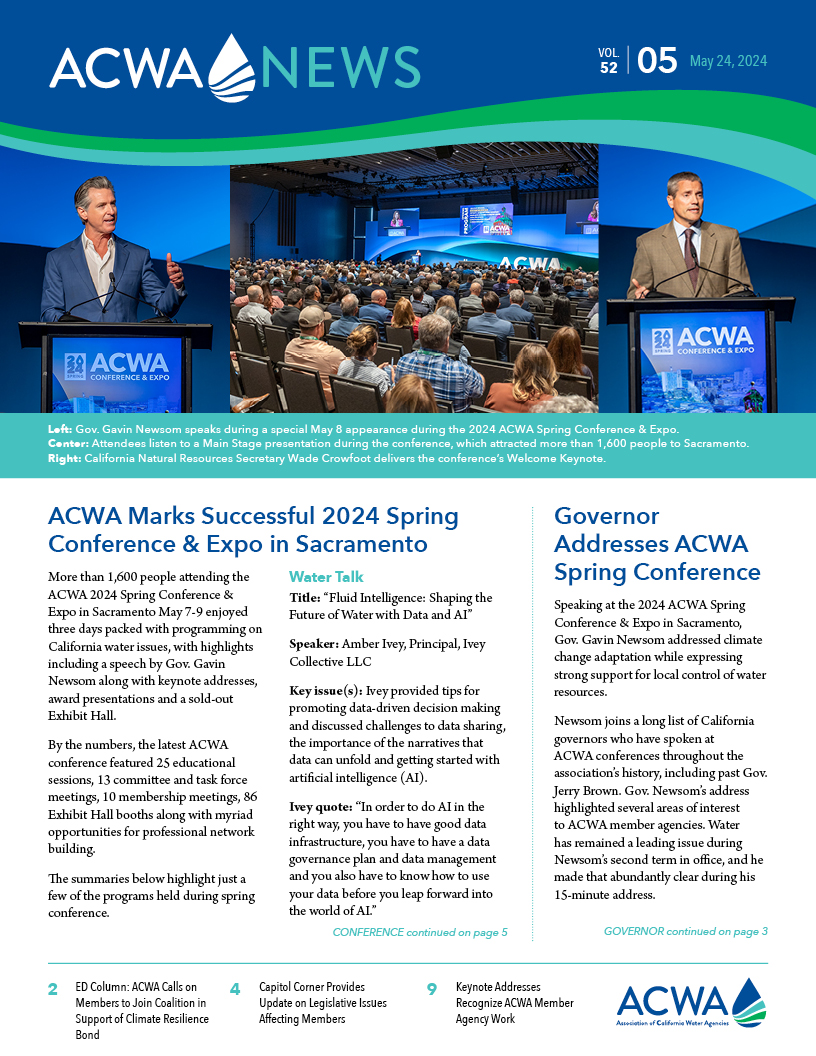 Read the May 24 edition of ACWA News for informative articles about the association and water industry.
Articles include:
- Conference Coverage Includes Governor Address, Keynotes and Programs
- ED Column: ACWA Members Urged to Join Coalition Behind Climate Resilience Bond
- See Snapshots from Conference on Photo Collage Page
- Capitol Corner Provides Update on Legislative Issues Affecting Members
Engage Legislators Now on Climate Resilience Bond
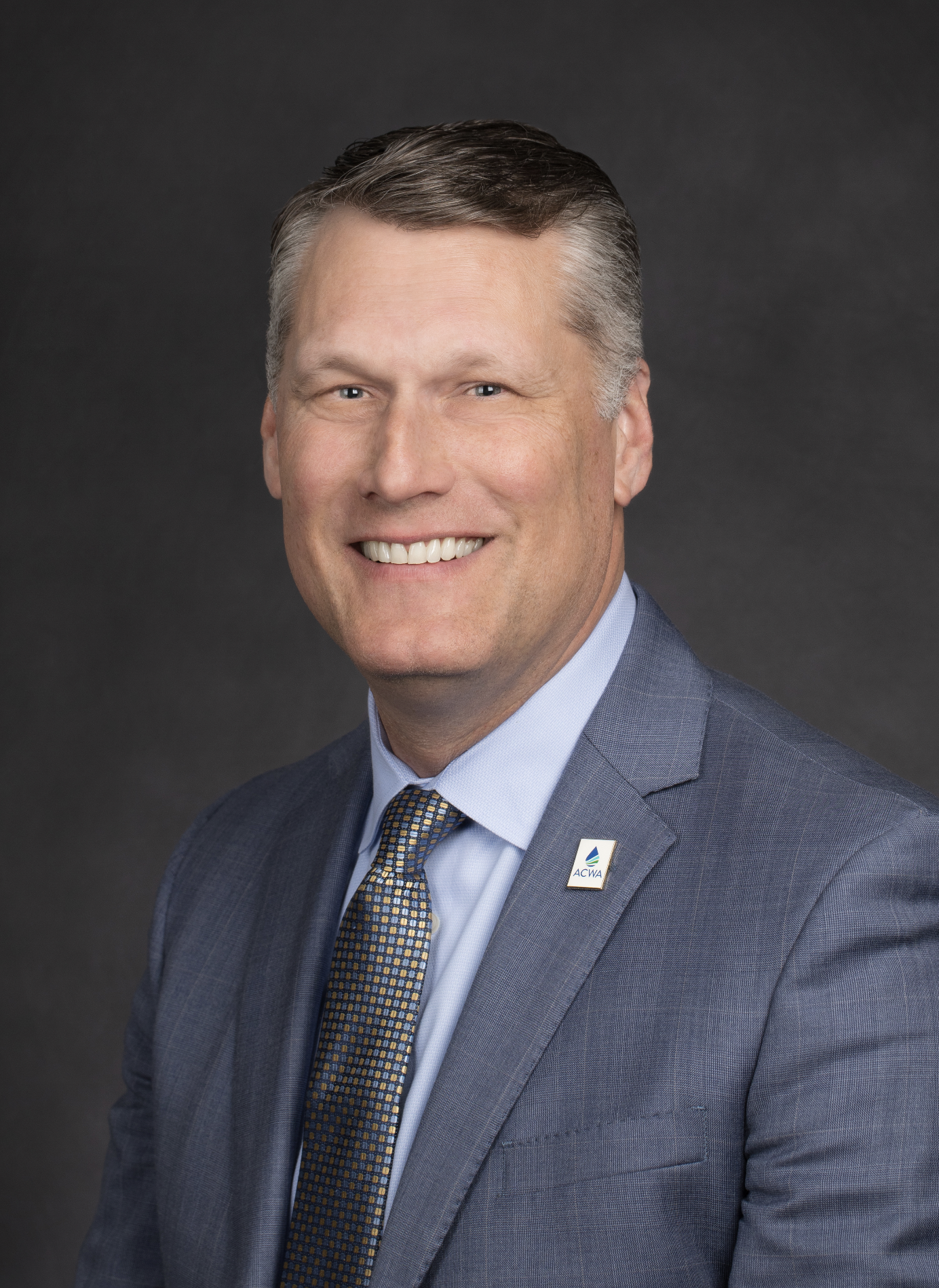 Creating a climate-resilient California is one of our state’s highest priorities. And what is more important to achieving this goal than improving our ability to manage water in response to exceptionally dry and wet times?
California’s water managers are well aware of how to answer this challenge and blunt the impact of weather whiplash. What they need is significant funding at the state level to help them get the job done. Fortunately, a climate resilience bond currently taking shape in the state Legislature could fulfill some of that need, but only if it is focused in large part on water infrastructure needs across the state. To that end, we need ACWA members from all ACWA regions to reach out to their state senators and assembly members.
ACWA is urging the Legislature to include $5.75 billion in water infrastructure funding in an $8.5 billion bond. ACWA’s recommended categories include:
- Dam safety
- Recycling and desalination
- Safe drinking water and clean water
- Ground water management and aquifer recharge
- Flood protection
- Regional water conveyance
- Regional watershed resilience
- Surface water storage
- State Water Project improvements
- Water conservation and water use efficiency
West Basin Municipal Water District Announces New Assistant General Manager
The West Basin Municipal Water District (West Basin) announces Eric Owens as Assistant General Manager. Mr. Owens brings a wealth of experience in water engineering and operations that will advance the District’s mission of providing reliable and high-quality water to its customers.
“West Basin welcomes Eric and his deep knowledge of water treatment technologies, the District and regional partners,” said West Basin General Manager E.J. Caldwell. “In this leadership role, his expertise and insights will be vital in optimizing the use of recycled water and groundwater, and ensuring sustainable water management for the communities we serve.”
Owens comes to West Basin from the Water Replenishment District (WRD) where he served as the Manager of Engineering and Operations. He led the Capital Improvement Program which is crucial for the sustainability of two groundwater basins, including the West Coast Basin, while also managing two advanced water treatment systems and a groundwater desalter.
Prior to his tenure at WRD, Owens worked for West Basin for five years as Technical Resource Manager overseeing the engineering, regulatory compliance, and technical planning divisions. His career spans over 24 years in municipal and private-sector water resources, specializing in membrane technology and advanced water treatment. In his early career, he spent 14 years at Separation Processes Inc. contributing to more than 40 projects by providing specialized engineering consulting services for water and wastewater treatment facilities.
He holds a Bachelor of Science in Chemical Engineering from the University of California, Berkeley, and is a registered professional engineer. Before attending UC Berkeley, Owens served as a Cavalry Scout in the United States Army, where he developed leadership and strategic planning skills.
Ag + Open Space and Sonoma Water Purchase Mark West Wikiup Preserve for Conservation
SANTA ROSA – Today, Ag + Open Space and Sonoma Water are announcing the purchase of the 30-acre Mark West Wikiup Preserve in the Larkfield-Wikiup area of Santa Rosa. Home to half-a-mile of Mark West Creek, oaks, riparian habitat, and grassy open space in a residential neighborhood, conservation of this property will enable Sonoma Water to offer public access to the preserve. Ag + Open Space funded Sonoma Water’s purchase of this property from the Jackson family for $5.1 million and acquired a conservation easement and recreation covenant over the property to ensure that the natural and recreational resource of the preserve will be conserved forever.
“Conserving our natural resources is critical across the county, but uniquely important within our cities and towns,” said Ag + Open Space and Sonoma Water Board of Directors Chair David Rabbitt. “The conservation and restoration of Mark West Wikiup Preserve will help Santa Rosa be more resilient, continue to protect habitat for fish and wildlife, and ensures that the preserve continues to be a place neighbors and visitors alike can enjoy.”
“We are proud to collaborate with Ag + Open Space and Sonoma Water to protect and preserve this critical habitat and watershed within the Mark West Wikiup Preserve,” Katie Jackson said. “When our family purchased this property, we had the best intentions to develop Wikiup in a responsible way that conserved and enhanced the critical habitat, wildlife and ecosystem of that stretch of Mark West Creek. After careful thought and evaluation, our family believed working side-by-side with local conservation agencies was the best approach to ensure it was protected forever and meet the environmental goals of Sonoma Water and the mission of Ag + Open Space.”
Conservation of this preserve has long been dreamed of by neighboring residents, who enjoy visiting the property for its beautiful creekside open space. The conservation easement preserves its oaks, riparian habitat and grasslands. Mark West Creek and riparian vegetation runs along the southern border of the property, providing critical habitat for salmon and steelhead trout.
“Part of our work is honing in on projects that meet several community needs,” said Ag + Open Space General Manager Misti Arias. “The Mark West Wikiup Preserve is a great example of how land conservation can increase the health and resilience of our watersheds, wildlife and communities.”
Mark West Creek is one of five priority stream systems selected as part of the California Water Action Plan effort by the California Department of Fish and Wildlife to focus on the creation of more reliable water supplies, the restoration of important species and habitat, and to build a more resilient sustainable managed water resources system. The watershed supports several threatened or endangered salmonid species including the Central California Coast Coho Salmon and steelhead.
“As one of five streams identified by the State of California, we’re thrilled to be able to help steward this land along Mark West Creek,” Sonoma Water General Manager Grant Davis said. “This project will enable Sonoma Water to create positive outcomes for the neighborhood as well as the threatened and endangered species in the creek.”
Ag + Open Space and Sonoma Water are proud to work together on the creation of this preserve and see it as an illustration of how local agencies can collaborate on projects that have big impacts on the health and resilience of the natural systems that sustain us all.
About Sonoma County Ag + Open Space
Sonoma County Ag + Open Space permanently protects the diverse agricultural, natural resource and scenic open space lands of Sonoma County for future generations. The agency is responsible for the perpetual protection of over 124,000 acres of land throughout our region. These agricultural and open space lands are protected through a quarter-cent sales tax approved by voters in 1990 and reauthorized in 2006. For more information, please visit www.sonomaopenspace.org.
Local District Ranks Highest in the State for its Water Replenishment Efforts
OXNARD – As part of California’s 2024 Semi-Annual Groundwater Conditions Update, the California Department of Water Resources highlighted United Water Conservation District (UWCD)’s Oxnard Basin for its positive contributions to the State’s groundwater supply. The Oxnard groundwater basin spans 57,888 acres, and during the 2023 Water Year (WY 2023) UWCD managed to resupply 111,254 acre-feet of water – or more than 36 billion gallons, resulting in a best-in-State recharge rate per area of 1.92 acre-feet per acre. Despite being a smaller basin, it also managed to rank sixth in the state in total groundwater recharge volume. This was largely due to United’s recharge operations in the Forebay area. “We are honored to be recognized by the Department of Water Resources for our successful year in recharging the Oxnard basin,” said UWCD Board President Sheldon G. Berger. “Our organization remains committed to preserving this precious resource while serving the best interests of our constituents.” 2023 was an exceptionally wet year for California, ranking as the eighth wettest year in the past 50 years. While surface water reservoir levels have mostly recovered, long-term groundwater storage in aquifers is still at a deficit from decades of sustained pumping due to frequent droughts. “Since groundwater accounts for nearly 60 percent of the State’s water supply, it is vital that agencies have a strategy in place to replenish basins when the State experiences higher-than-average wet seasons,” added UWCD General Manager Mauricio Guardado. “Despite facing so many local and external challenges, we continue to stay focused on our mission as environmental stewards for our groundwater-dependent ecosystem.” The Oxnard basin was not the only location within UWCD recognized for its efforts in WY 2023. The Piru basin saw the largest increase in total water storage per area in the State at a rate of 4.65 acre-feet per acre, while the Fillmore basin tied for fifth in the State at a rate of 1.51 acre-feet per acre. Of 99 basins submitting data to the State, 93 reported a positive change in groundwater storage. This is a significant improvement over the previous water year where 76 out of the 97 basins reported a negative annual change in storage. UWCD continues to focus on increasing groundwater storage across all seven of its basins to ensure a sustainable future for its customers throughout the region. It aims to reverse groundwater overdraft by strategically recharging its basins yearly and capitalizing on heavy rainfall seasons.###
About United Water Conservation District Since 1927, United Water Conservation District (District) has served as a leader among water agencies by managing, protecting, enhancing and securing the water resources of the Santa Clara River and Oxnard Coastal Plain. The District works to protect the environment’s natural attributes and conserves runoff from all major tributaries of the Santa Clara River, including Piru, Hopper, Sespe, and Santa Paula Creeks. Committed to managing the area’s water supplies through groundwater replenishment and the construction and operation of efficient water supply and delivery systems, the District serves as the conservator of groundwater resources that are utilized by the cities of Oxnard, Port Hueneme, Ventura, Santa Paula, and Fillmore, as well as Naval Base Ventura County and several mutual water districts, farms, and individual pumpers. The District also provides surface water for agricultural irrigation and treated drinking water to the cities of Oxnard and Port Hueneme. www.unitedwater.org