
Spotlight July 2024: Member Agencies Assist in Boosting Firefighting
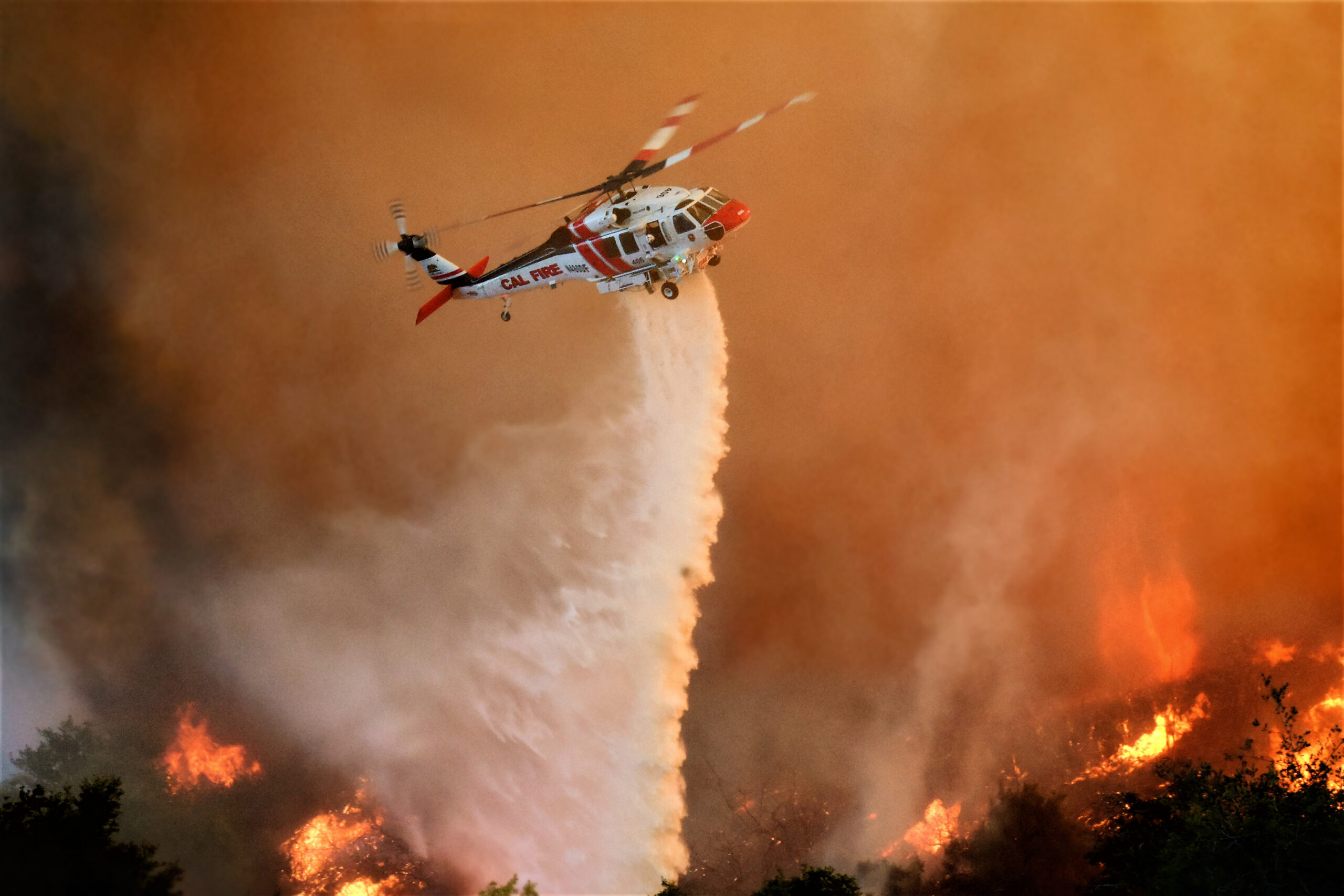
A CAL FIRE helicopter drops water on a wildfire. A number of ACWA member agencies have established and support water sources that can save firefighting helicopter crews precious time when combatting wildfires. Photo courtesy of PumpPodUSA, by Jeremy Ulloa @Surface 2 Air Design
For firefighting helicopters, the fewer minutes between a water source and wildfire is the difference between successful containment and an explosive catastrophe threatening homes and possibly lives. Several ACWA member agencies are helping make that difference an advantage for firefighters by establishing water refill dip sites beside their treatment and storage facilities.
In July, a dip site beside SCV Water’s E. G. “Jerry” Gladbach Water Treatment Plant was the primary source for helicopters fighting a 77-acre wildfire near Santa Clarita. The site employed what’s known as a HeloPod, installed through a partnership between SCV Water and the Los Angeles County Fire Department.
Additionally, Santa Margarita Water District and Moulton Niguel Water District have recently assisted the Orange County Fire Authority in activating HeloPods by extending hydrants to the dip sites.
Manufactured by PumpPodUSA, an ACWA Associate, HeloPods can hold 3,700 up to 8,200 gallons of water and feature fill valves that allow for automatically refilling from a nearby water source, such as a storage tank. Helicopters hover above and lower a snorkel, which can fill their tanks within minutes.
Most HeloPods have been installed for strategic, long-term placement in anticipation of fires. They can also be re-positioned closer to a fire on a trailer. HeloPods can be remotely activated by phone or through the internet.
The concept isn’t new. For years, firefighting helicopters sucked water out of orange and black vinyl “pumpkins.” That solved the problem of getting water sources for helicopters closer to fires, but they frequently became unstable with propwash from heavier duty helicopters, and snorkels occasionally punctured vinyl bottoms. Metal HeloPods evolved as a solution over the past few years, with the true value measured in time saved.
“The closer they are to the communities, the shorter the dip to drop cycle, which means more gallons of water dropped on the flames per hour and best use of fuel. And in rural and remote areas, helping to keep them close by to protect the evacuation routes,” said Bill Ward, Vice President and Co-Owner of PumpPodUSA.
For firefighters, that’s a game changer in wildfire-urban interface areas.
Vallecitos Water District (VWD), the City of San Marcos, and CAL FIRE recently collaborated on placing a HeloPod next to VWD’s water storage tank. The 5,000-gallon HeloPod is controlled through the district’s SCADA system and can be filled within five minutes on average, according to the district. City of San Marcos Fire Department Fire Marshal and Battalion Chief Jason Nailon credits HeloPods as providing a previously unavailable water source within a vulnerable wildfire-urban interface area.
“The joint effort between CAL FIRE, Vallecitos and the San Marcos Fire Department was pivotal in bringing this project to fruition,” Nailon stated via email. “Vallecitos spearheaded the development of the necessary infrastructure to make the HeloPod a reality.”
Similar to HeloPods, Heli-Hydrants serve as stationary, permanent water sources for air attacks on wildfires.
The Rainbow Municipal Water District (RMWD) pioneered this approach through its Rapid Area Water Supply project. Built in 2021, it consists of a 5,000-gallon open-top tank backed up by a five-million-gallon storage tank with inlet and drain valves that can be opened or closed from an in-bound helicopter. It was the first project of its kind in San Diego County. It has yet to be used, but that doesn’t lessen its value.
“Where it’s at, there’s not a lot of water sources. Unfortunately, it’s just a matter of time before it does get used,” said Robert Gutierrez, RMWD Chief Operating Officer.
Yorba Linda Water District (YLWD) supports two Heli-Hydrants. During a 2020 fire in Orange County, the YLWD’s Marc Marcantonio Heli-Hydrant supported firefighters by supplying water to Boeing Chinook CH-47 helitankers that filled up with roughly 2,000 gallons in just under a minute, making drops on spot fires and then returning in four minutes to repeat the process, according to the district’s website.
With the 2024 fire season seriously getting underway, Heli-Hydrants and HeloPods at water districts are positioned to play a critical role. VWD celebrated its HeloPod going online in April.
“It turned out well, and it can do everything we need it to do,” said Ed Pedrazzi, VWD’s Operations and Maintenance Manager. “Knock on wood, hopefully it won’t have to be used any time soon. But the way this summer is shaping up, I wouldn’t be surprised if it will be.”

ACWA Priorities Connect with Water Stewardship and Affordability
 ACWA member agencies are stewards of the communities they serve. In this capacity, they are responsible for the reliability of their communities’ water supplies, the infrastructure required for their delivery on a 24/7/365 basis, the protection of its water quality from the headwaters to the tap, and for cost-effective delivery of these services, particularly to those with fixed incomes or limited means. ACWA must continue to engage and advocate effectively for our members’ interests, especially as new state and federal standards, combined with aging infrastructure and inflationary issues, drive up the cost of service to our ACWA member agency communities.
As laboratory technology advances, enabling the detection of contaminants at ever more minute levels, regulations in turn demand more of water agencies in testing and treating water. As vital to the protection of public health as the standard-setting process is, it often results in significantly increased costs to water agencies to design, build, operate and maintain treatment technologies to keep pace with new regulations. That in turn can drive increases in water rates, which works against our goal of keeping water affordable.
Keeping our water in compliance with drinking water standards is paramount to protecting public health. However, there is a balance that can be achieved. When developing new water quality standards, the law requires regulators to consider economic and technical feasibility. Regulators need to consider that treatment costs will ultimately affect customer water affordability. That is why ACWA strongly supports both scientific decisions that are based on sound, peer-reviewed science and standard-setting that is based on rigorous analyses, including cost analyses as part of economic feasibility determinations. Additionally, public processes that allow for meaningful input into these actions are critical.
A well-designed low-income rate assistance (LIRA) program could help low-income households with water affordability, but the details matter. The program needs to be reasonable and efficient. SB 1255 (Durazo, D-Los Angeles) was initially a study bill, but it was amended on June 3 in the Assembly to propose a LIRA program that would be funded with voluntary contributions. ACWA members have strong concerns that the bill, as currently drafted, would not work. For example, if customers did not see a notice and affirmatively opt out, they would be charged a “voluntary” contribution. ACWA is suggesting an “opt-in” approach, along with other amendments, and the work on this bill continues.
In the bigger picture, public water agencies are managing aging infrastructure that requires significant investments in the near term to ensure safe and reliable water service in the future. A long-term approach on water affordability will require continued advocacy by ACWA regarding standard-setting, water infrastructure and low-income rate assistance.
As water leaders, managers and stewards, ours is a job that never gets easier. But we always discover innovative strategies that produce solutions. I am confident that will prove the case with addressing water affordability and reliability.
Zone 7 Water Agency Announces New Board Leadership
LIVERMORE – The Zone 7 Water Agency Board of Directors unanimously elected Vice-President Dennis Gambs to serve as president during its annual board reorganization at the regular board meeting in July. As president, Gambs will oversee the appointment of committees and have the primary responsibility for interpreting the policies, programs, and needs of the Agency to the public. A dedicated Livermore resident, a highly experienced civil engineer, and a former water resources manager at Zone 7 Water Agency, Gambs has been a valued member of the Zone 7 Board of Directors since 2018, with a current term extending until June 30, 2026. Gambs brings a wealth of knowledge and expertise from a 34-year tenure working at Zone 7. A graduate of UC Berkeley and San Jose State University, Gambs has also been an active member and past president of the Rotary Club of Livermore Valley since 1999, demonstrating a longstanding commitment to community service and social causes. “The past several years have tested us with extreme droughts and unprecedented floods, yet our agency has ensured exceptional water quality and reliable services. Amid climate change uncertainties, our focus remains on ensuring water supply and flood protection resilience. Critical projects like Delta Conveyance, Los Vaqueros Reservoir Expansion, and Sites Reservoir are pivotal for securing future water needs. We are committed to building on our strengths and meeting challenges with determination,” said Gambs. “As Board President, I am honored to guide Zone 7’s direction forward.” The board also elected Director Dawn Benson to serve as vice-president. Newly elected to the Board is Catherine Brown, who fills a short-term seat which was vacated by former Director Olivia Sanwong, who resigned from the Board to take a position on the East Bay Regional Parks District’s Board of Directors in early 2023. That seat was filled by the temporary appointment of Kathy Narum until elections could be held to fill the remainder of the term. A longtime Pleasanton resident for over 20 years, Brown is a retired Environmental Scientist with a distinguished career spanning over 30 years at the US Environmental Protection Agency. Brown managed environmental cleanup at five Superfund Sites, including addressing PFAS contamination, showcasing her expertise and dedication to environmental protection and public health. She will serve through June 2026. Three directors were also sworn in for their four-year terms at the meeting: Sandy Figuers, and Laurene Green were re-elected to their seats for an additional term, and 2023 appointee Kathy Narum, was elected for her first term. Zone 7 Water Agency supplies treated drinking water to retailers serving over 260,000 people in Pleasanton, Livermore, Dublin and, through special agreement with the Dublin San Ramon Services District, to the Dougherty Valley area. It also supplies untreated water for irrigation of 3,500 acres, primarily South Livermore Valley vineyards. Zone 7 Water Agency owns and maintains 37 miles of local flood-protection channels, about a third of all the Valley’s channels and creeks. Zone 7 Water Agency is overseen by a seven-member Board of Directors. Its board members are elected by the Tri-Valley community to four-year terms. The board provides strategic guidance and planning for Zone 7’s policies, programs, and finances, and represents the public in an open and transparent process. Community input and participation in board meetings is welcome. The public is encouraged to comment on both agendized items and items not on the agenda. Comments may be submitted through various platforms including mail, email, phone, and via Zoom. For more information on Zone 7’s board and committees, please visit https://www.zone7water.com/board-directors###
About Zone 7 Water Zone 7 Water Agency is one of the 10 active zones of the Alameda County Flood Control and Water Conservation District. The District was established by the State Legislature in October 1949 to solve problems of flooding, drainage, channel erosion and water supply and conservation in Alameda County. In 1957, by popular vote, Zone 7 became a special district governed by a seven-member board of directors. Along with flood protection, Zone 7 supplies water to all of eastern Alameda County and a population of over a quarter million residents. Treated water is sold wholesale to local retailers, including the cities of Livermore and Pleasanton, the Dublin San Ramon Services District, and the California Water Service Company. Zone 7 also distributes untreated water to local agriculture operations and golf courses.
Photo Courtesy Zone 7 Water Agency: Headshot of Board President Dennis GambsLongtime Board Member Randy Record Announces Retirement
PERRIS — After 24 years representing Division 3 of Eastern Municipal Water District’s (EMWD) service area, Board Member Randy Record, announced today that he will not be seeking reelection in November 2024. He will be retiring from service on EMWD’s Board of Directors effective December 6, 2024. Since EMWD’s formation in 1950, there have only been four Division 3 representatives serving San Jacinto and surrounding areas. Record and his father, Clayton Record, Jr., are two of those representatives, collectively serving for 30 of the agency’s nearly 75-year history. Record was elected in January 2001 and served two terms as board president during his tenure. In January 2003, Record was appointed to the Metropolitan Water District of Southern California (Metropolitan) Board of Directors and served as EMWD’s representative there for 20 years, including consecutive terms as Chairman from 2014 to 2018. He retired from the Metropolitan Board in December 2022. Record also served as President of the Association of California Water Agencies from 2012 through 2013. “It’s been an honor to serve on EMWD’s Board for more than two decades,” said Record. “EMWD has always been committed to forward-thinking principles which not only provides its communities with the highest quality and reliable services possible, but also serves as an example of a premier organization for other agencies across the state and nation to emulate. Throughout EMWD’s history, we have looked for opportunities to maximize resources, including the development of local water supplies, to best serve our ratepayers,” continued Record. “It’s one of the things we do best.” During his tenure, Record was a leading voice in bringing together water users from urban and agricultural backgrounds to find common solutions to California’s water challenges. His focus was on building coalitions and advancing long-term solutions such as the California Water Fix and the Regional Recycled Water program. Record added, “I am incredibly proud of continuing the accomplishments made by the EMWD Board. Over the years, my fellow Board members, EMWD staff, and agency partners have created the pathway for a more resilient water supply for generations to come.” “Randy Record is an institution in California water,” said EMWD Board President Phil Paule. “Every person, farmer, watershed manager, and industry that uses water in California can thank Director Record for his service, and EMWD is better for the leadership and vision that he has brought forward over the past 24 years.”# # #
Eastern Municipal Water District is the water, wastewater service and recycled water provider to nearly one million people living and working within a 601-square mile service area in western Riverside County and northern San Diego County. It is California’s sixth-largest retail water agency, and its mission is “To deliver value to our diverse customers and the communities we serve by providing safe, reliable, economical and environmentally sustainable water, wastewater and recycled water services.” More information can be found at www.emwd.org.New Study Reveals Significant Impact of Predation on Native Fish Populations
CENTRAL VALLEY – A groundbreaking five-year study conducted by FISHBIO and a coalition of Central Valley water agencies has uncovered a potential missing link in efforts to protect California’s declining native fish populations: predation by non-native species. A new video released by Banta-Carbona Irrigation District (Banta-Carbona), “A Startling Picture,” takes a closer look at the research that challenges many long-held beliefs about why California’s native fish are in decline. Key Findings:- Non-native fish dominate the lower San Joaquin River, with native species comprising less than 1% of sampled fish
- Juvenile Chinook salmon are being consumed throughout the river
- Population-level impacts to out-migrating salmon appear substantial – greater than 50% – even under ideal conditions
- Data also shows the long-held relationship between flows and salmon populations has broken down. More flows don’t equal more fish.
- Expand long-term research to fully quantify predation’s impact
- Integrate predation analysis into management strategies
- Engage regulators and policymakers with new findings
WVWD Begins New Headquarters Transformation
Walnut Valley Water District (WVWD) proudly announces the start of renovations for its new headquarters, marking a pivotal moment in its efforts to enhance operational efficiency and community engagement. The project includes the transformation of warehouse buildings acquired by WVWD in 2019, located adjacent to the current offices. These upgrades will feature modern board rooms, conference facilities, and enhanced accessibility, solidifying the site as WVWD’s central administrative and operational hub.
“We are thrilled to begin this long-awaited project,” shared Sheryl Shaw, General Manager. “The design features a beautiful entry courtyard, a dynamic lobby gallery, and expansive skylights that will fill our headquarters with natural light.” Crafted by La Cañada Design Group, the plan also incorporates a stunning façade featuring rainscreen panels that reflect wave dynamics. DPR Construction will serve as the general contractor, with construction management services provided by Searock and Stafford Construction Management.
The groundbreaking ceremony on July 15, 2024, marked the official commencement of this project. Attended by WVWD’s Board of Directors and staff, the event represents a major step forward in revitalizing the District’s community-facing infrastructure. The current administrative offices, constructed in 1952, have remained unchanged, raising concerns about ADA accessibility and overall wellness for employees and visitors.
“This initiative underscores our commitment to our motto ‘People First, Mission Always,’ said Manuel Rodriguez, General Services and Procurement Manager. By revitalizing our headquarters, we invite the community to join us in our mission as dedicated water professionals who strive to provide excellence in all that we do.” Rodriguez, a champion of this effort throughout his 20 years of service to WVWD highlighted the importance of creating a space that connects the community with water awareness and sustainability education.
WVWD’s new headquarters is set to be completed by the Fall of 2025. This milestone will be celebrated by a grand opening event in which all Walnut Valley residents will be invited to explore the enhanced facilities and gain insight into the District’s operations. The new building is designed not only to provide a supportive workplace environment with modern amenities, but also to function as a dynamic community center where workshops, educational programs, and public events to strengthen connections with residents will be hosted.
Funded through bonds, this project underscores WVWD’s commitment to responsible financial management and planning for the future. For updates and further details on the project’s progress, please visit the WVWD Headquarters Project webpage.
###
About WVWD
WVWD was formed in 1952, and after seven decades of service to the community, the District operates and maintains a drinking water and recycled water system serving a population of nearly 100,000 residents. The WVWD team is comprised of water professionals dedicated to meeting the water supply needs of the communities it serves (Diamond Bar, Walnut, Rowland Heights, Pomona, Industry, and West Covina). WVWD is committed to leading with integrity and does so through excellence in customer service, communication, accountability, reliability, efficiency, and quality.
ACWA Continues Advocacy on Advanced Clean Fleets Regulation
ACWA continues to advocate for amendments to the California Air Resources Board’s (CARB) Advanced Clean Fleet (ACF) regulation to ensure it reflects the provisions of AB 1594 (Garcia), signed into law last year and which requires greater flexibility for public agencies faced with challenges in upgrading to zero-emission vehicles.
The ACF regulation requires vehicle fleet owners and operators, including all public agencies, to begin purchasing zero-emission vehicles. However, a key issue is allowing flexibility in the purchase of replacements for traditional utility-specialized vehicles that are at the end of their life but are also vital to maintaining reliable service and responding to major foreseeable events.
CARB has also requested that ACWA act as a resource by compiling a list of member agencies’ TRUCRS IDs. More background and a link to submit information is available in an Advisory distributed to ACWA member agencies on July 8. Members can access the Advisory online.
The advisory also contains links to fact sheets, training webinars, reporting guidance documents and additional resources.
July 2024 Priority Issues Update Now Available
The July 2024 Priority Issues Update is now available online to members.
The update is a summary of the latest developments on issues of interest to ACWA members. This issue contains information on water use efficiency, the climate resilience bond, Bay-Delta Plan, Proposition 218 legislation and more.
The new and previous Priority Issues Updates can be found here.
EPA Awards PWD $14 Million Loan to Fund Pure Water AV Demonstration Facility
PALMDALE – Palmdale Water District (PWD) is pleased to announce that it has received a $14.8 million Water Infrastructure Finance and Innovation Act (WIFIA) loan from the U.S. Environmental Protection Agency (EPA) to help pay for the Pure Water Antelope Valley (AV) Demonstration Facility. This loan is expected to save PWD about $4 million in interest over a 20-year period compared to traditional financing. The Demonstration Facility, which will purify recycled water to produce a cost-effective and more reliable high-quality water supply, will cost $24.5 million. Groundbreaking took place on June 20, and construction is expected to take 15 months. “We are grateful to the EPA for awarding this loan for our Pure Water AV Demonstration Facility,” said PWD General Manager Dennis D. LaMoreaux. “It gives us the funds needed to build a project that will enable us to be more drought-proof, have local control of our water, and improve the groundwater quality and quantity.” The master agreement between PWD and EPA calls for a total loan of $145 million to build the Pure Water AV Demonstration Facility and a full-scale facility, estimated to cost $281.3 million. Once operational, Pure Water AV will sustain more than 20 full-time jobs over its 50-year lifespan. “California is no stranger to drought impacts, and we are seeing a need for communities to invest in drought-resilient water supply as they prepare for future climate stress,” said Bruno Pigott, EPA Acting Assistant Administrator for Water. “We are thrilled to help the Palmdale Water District advance their project ensuring a plentiful and resilient water supply through EPA’s low-cost financing. The Biden-Harris Administration has been prioritizing critical water infrastructure projects across the country through the investing in America agenda.” Pure Water AV will have a purification room that will run recycled water through micro-filtration filters, reverse osmosis filters and ultraviolet light with advanced oxidation. The state-of-the art procedure will remove more than 99.99% of bacteria, viruses and ions (like salt). The Demonstration Facility is required by the state before a full-scale project can be built. When the full-scale facility is operational in mid-2029, it will provide an additional 5,000 acre-feet of water per year by using recycled water and treating it for groundwater augmentation. The facility will be the first advanced water treatment plant in California to house “Project Monarch,” a water management and carbon capture equipment supplied by Capture6 that will save PWD costs for brine disposal. For more information about Pure Water AV, visit www.purewaterav.org. Since 1918, the Palmdale Water District has provided high-quality water at a reasonable cost. We pride ourselves on providing great customer care; advocating for local water issues that help our residents; educating the community on water-use efficiency; and leading our region in researching and implementing emerging technologies that increase operational efficiency. For more information about PWD, visit www.palmdalewater.org.###
MWA Family Night Event Brings Water Conveyance To Life
APPLE VALLEY — The Mojave Water Agency (MWA) was filled with the sound of laughter and excitement as families gathered for a “super” night of outreach and education at the Wonders of Water Family Fun Night event on July 9. Mojave Water Agency offers several Wonders of Water workshops per year, with its summer session crafted specifically for families with children. This year, Agency staff taught families how water is conveyed throughout its nearly 5,000-square-mile service area by comparing it to a popular fictional character who saves the world via a kingdom of green pipes and go-karts. “We never want to miss an opportunity to teach children about where their water comes from, how important it is to daily life, and how to conserve it,” said Board President Kimberly Cox. “This event provided a creative way to do that, aligning with the Agency’s vision to achieve water sustainability for generations to come.” Participants were treated to a short presentation on how the Agency’s engineering and operations division works to recharge water basins, after which, the families were encouraged to rotate through activity stations all designed to demonstrate different facets of water delivery or conservation. There were activities for every age level, including a water conveyance simulation using pool noodles and marbles, a picture matching game, coloring and craft stations, a conservation tip “pipes and ladders” game that was created specifically for the event, photo opportunities with a real go-kart, and much more. The next Wonders of Water session is scheduled for Sept. 10. Registration is required and available on the Agency’s website. Registration is also open for the MWA Road Show, an interactive bus tour of Agency facilities on October 17. Online classes teaching soil composting, how to propagate desert tolerant plants and how to prepare your home to conserve water in the winter are also slated in the coming months. All events and activities are free and open to the public. About Mojave Water Agency The Mojave Water Agency was established in 1960 in response to the concerns about the overdraft of the basins in the Mojave Desert region in Southern California. Governed by a seven-member elected board of directors, MWA is one of 29 contractors with rights to take delivery of State Water Project water from the California Aqueduct to replenish the water supply for residents, businesses and agricultural needs in the service area. By promoting water efficiency and implementing innovative solutions, MWA plays a crucial role in safeguarding the water resources of the Mojave Desert for future generations. The Mojave Water Agency Board of Directors meets the second and fourth Thursday of each month at 9:30 a.m. in the board room at 13846 Conference Center Drive in Apple Valley. Public participation is encouraged. For more information, visit the Agency’s website at www.mojavewater.org or follow us on social media @mojavewater.###