
DWR Estimates SWP Water Losses from Climate Crisis
SACRAMENTO — The Department of Water Resources on July 31 released its final 2023 State Water Project Delivery Capability Report, which presents a new and enhanced analysis of current and future expectations for the SWP water supply if no new adaptation actions are taken. According to the report, SWP delivery capability and reliability could be reduced as much as 23 percent in 20 years due to changing flow patterns and extreme weather shifts – underscoring the need for California to continue addressing the impacts of climate change and upgrading infrastructure.
A 23 percent decline would be equivalent to about 496,000 acre-feet a year, enough to supply 1,736,000 homes for a year. This reinforces the serious need for California to boost water supplies to account for any SWP losses in the coming years, including the Delta Conveyance Project, Sites Reservoir, desalination projects, and more.
“The analysis released today underscores the need to modernize and upgrade our aging infrastructure so we can capture water supplies when it’s wet,” said DWR Director Karla Nemeth. “The State Water Project service area amounts to the world’s eighth-largest economy and includes more than 8 million Californians living in disadvantaged communities. Modernizing the State Water Project is critical to delivering on the human right to water in California.”
Built in 1960, the SWP spans more than 700 miles throughout California and consists of canals, dams, reservoirs, pumping plants, and power plants that provide water to 27 million Californians and 750,000 acres of farmland. Several factors impact the SWP’s water delivery capability including California’s population, state legislation, environmental requirements, and potential changing climate resulting in varying hydrologic conditions.
“The SWP was designed for the climate of the 20th century when our precipitation fell as snow more reliably between October and May and we could capture that water effectively for future use,” said SWP Deputy Director John Yarbrough. “We need to continue to adapt and invest in the SWP, so that we can add flexibility and resilience for 21st century conditions and we can avoid these losses in reliability.”
The 2023 Delivery Capability Report introduces two new innovative approaches to characterize current climate change conditions and emphasizes the uncertainty in future climate change projections. The first is an approach to account for changes in operations from the climate change that has already occurred. The second is an approach for developing a range of future climate scenarios. Both additions have undergone independent peer review and are considered significant improvements over previous methods.
The Delivery Capability Report is used widely both within and outside the SWP for water supply planning. The information in these reports is a key component of the drought planning done by the SWP and is fundamental to the drought planning done by the public water agencies that receive SWP and Central Valley Project water. The report provides the information needed by these agencies to develop and manage their own water supply portfolios and is an important input for Sustainable Groundwater Management Plans, Urban Water Management Plans, Agricultural Water Management Plans, and Integrated Regional Water Management Plans.
These decreases in the availability of surface water deliveries can lead to supply shortages, an increase in groundwater demand, and reductions in available supplies to support groundwater replenishment. DWR’s Sustainable Groundwater Management Office will use the information in the report to update its existing climate change data and guidance that many Groundwater Sustainability Agencies used for their initial Plans. Similarly, DWR’s Water Use Efficiency Branch will be advising urban and agricultural water agencies to update their water budget assumptions based on these new assessments.
As part of the State’s long-term planning efforts, the SWP is also proactively developing a Climate Adaption Plan. The Adaptation Plan will incorporate key adaptation strategies, including the Delta Conveyance Project and opportunities for new and expanded storage both above and below ground. It will also build upon the analysis provided in the Delivery Capability Report and will be published later this year.
DWR is committed to supporting the State’s efforts to take an all-of-the-above approach to creating a resilient water supply system in the face of a changing climate. In addition to the Delta Conveyance Project, DWR is supporting efforts to advance Sites Reservoir, groundwater recharge, desalination, water recycling, and promoting continued water conservation.
DWR encourages all SWP water users and local groundwater sustainability agencies to take a collaborative and proactive approach while using the insights from this report for their own planning and adaptation investigations.
For more information, view the report.
SCV Water Awarded a Federal Grant to Update the Agency’s Groundwater Model
SCV Water was recently awarded a $363,374 Federal grant under the Bureau of Reclamation’s (BOR) FY 2023 WaterSMART Applied Science Grant Program. Funds will go towards the Agency’s Groundwater Model Refinement and Calibration Project. In the coming years, SCV Water’s supplies will be subject to a wide variety of known and unknown risks and uncertainties. To ensure a sustainable and resilient water supply for its customers, SCV Water will need to respond to more extreme droughts, floods, rising temperatures, and changing regulatory requirements. In FY 2023/24, the Agency developed a Water Resources Integration Model to evaluate new and refined operating strategies, quantify the reliability of its water supply portfolio, and analyze the tradeoffs between different adaptation strategies. “This grant will assist SCV Water with updating its groundwater flow model to better describe the storage and recharge paths in key aquifers to determine future reliability and recharging needs in the Upper Santa Clara River Valley Groundwater Basin,” said SCV Water Principal Water Resources Planner Najwa Pitois. Pitois added, “The Groundwater Model Refinement and Calibration Project will also be used to evaluate potential operational alternatives for groundwater pumping and how these alternatives may improve the reliability of the Agency’s water supply portfolio in light of climate change impacts and other future uncertainties.” The WaterSMART Applied Science Grant will support SCV Water’s Water Resilience Initiative in the following areas: · Surface water and groundwater. Updated modeling will help SCV Water better understand the interconnection between surface water, groundwater and environmental resources, which will be vital for developing local groundwater resources. · Water resource integration. The updated model will help the Agency to analyze a complex array of alternative groundwater management actions and compare these actions against various other water supply and storage programs to help guide selection of cost-effective investments in new water reliability programs. “Receiving this grant will help SCV Water further its Water Resiliency Initiative by taking actions that will ensure safe and resilient water supplies and healthy ecosystems for our community, economy, and the environment,” said Pitois.###
About SCV Water: The Santa Clarita Valley Water Agency (SCV Water) is a full-service regional water agency located in the Santa Clarita Valley. SCV Water provides water service to approximately 75,000 business and residential customers. It was formed on January 1, 2018, when local water suppliers combined into one integrated, regional water provider. More information can be found at yourSCVwater.com.ACWA JPIA Mourns Klaff
SACRAMENTO — Retired ACWA JPIA CEO Daniel Neal Klaff passed away on July 16. He was 78.
Klaff joined ACWA JPIA in 1991 and advanced to CEO in 1995, leading the organization for 16 years and playing a pivotal role in ensuring ACWA JPIA member agencies throughout California had access to robust coverages and risk management resources. He retired in 2011.
Born in Panama to Daniel David Klaff and Felecia Klaff, he grew up in Clayton, a suburb of St. Louis, Missouri. Following his graduation from Washington University in 1965, Klaff joined the U.S. Air Force during the Vietnam conflict. He served with the Strategic Air Command as a pilot and ended his military career at the rank of captain before beginning a civilian career in business.
Klaff’s life will be celebrated at a funeral service on Aug. 5, at 10 a.m., at Miller Funeral Home, 507 Scott St., in Folsom. For more information, visit Miller Funeral Home online.
In lieu of flowers, the family requests donations to the Wounded Warriors Project, in honor of Klaff’s lifelong commitment to his service and stewardship for those injured in war.
A Five-Year Journey Over 5,000 Miles: MWDOC’s Landmark Leak Detection Program
In 2015, the Municipal Water District of Orange County (MWDOC) embarked on an ambitious journey to combat water loss across the county. This initiative aimed to ensure compliance with Assembly Bill 1440 and Senate Bill 555, mandating strict water loss control measures for local water suppliers. Fast forward to today, and the results speak volumes about the program’s effectiveness and the impact of proactive water management.
Since August 2019, MWDOC’s dedicated leak detection crew have been diligently working in the field, surveying over 5,100 miles of water mains. Acting as leak detectives, MWDOC’s highly skilled technicians use tried-and-true acoustic equipment—a method that has been around for centuries—combined with modern digital filtering and geographic information systems (GIS) to pinpoint underground leaks. This approach allows them to quantify water loss and collaborate with local water retailers to repair the leaks before they cause significant damage. Their efforts have uncovered more than 2,480 hidden leaks, leading to significant water savings and operational efficiencies for 24 Orange County water providers.
Utilizing advanced acoustic leak detection equipment, MWDOC technicians can locate leaks before they surface. This technology has been instrumental in saving 746 acre-feet (AF) of water annually, which is enough to serve approximately 2,500 households in Orange County each year. By identifying and repairing these leaks, local water retailers have optimized their distribution systems and enhanced water supply resiliency. The leak detection surveys have achieved remarkable results, with 6,383.8 AF of avoided water loss over the lifetime of the leaks found and a cost savings of $4,859,662.
The benefits of MWDOC’s proactive leak detection program extend beyond immediate water savings. Better repair planning reduces the need for emergency repairs and after-hours work, increasing operational efficiency and minimizing service interruptions for customers. Moreover, understanding the distribution system in greater detail has enabled more strategic infrastructure maintenance, reducing damage to roadways and customer properties.
MWDOC’s water loss program is a testament to the power of innovation and collaboration. By leveraging technology and fostering strong partnerships with local water retailers, MWDOC is ensuring a sustainable water future for Orange County. The Leak Detection Program is also an example of the many rewarding career opportunities available to those looking to enter the water industry. MWDOC’s technicians receive competitive salaries, retirement benefits, and job security, while leaving a lasting impact on the Orange County community and contributing to the health of people, the environment, and the economy. Visit www.mwdoc.com/watercareers to learn more.
WVWD Recognized for Achievement in Financial Reporting
WALNUT – Walnut Valley Water District’s (WVWD) Department of Finance has been awarded the Certificate of Achievement for Excellence in Financial Reporting for its exceptional performance in the fiscal year spanning July 1, 2022, to June 30, 2023. This prestigious accolade, presented by the Government Finance Officers Association of the United States and Canada (GFOA), marks the fourth consecutive time the District has received this honor.
The Certificate of Achievement represents the highest form of recognition in governmental accounting and financial reporting, underscoring WVWD’s commitment to transparency and exemplary financial management. Founded in 1906, the GFOA supports over 20,000 government finance professionals across North America. WVWD joins approximately 1,800 governments recognized for their excellence in budgeting and financial reporting.
In addition to this honor, the District continued to uphold its AA+ S&P rating, the highest attainable for districts of its size. “We are proud to receive the AA+ rating from S&P Global Ratings,” said Director of Finance, Joshua Byerrum. “It reflects the dedication of our staff and Board of Directors to efficient operations, a thoughtful capital improvement program, and responsible fiscal policies and practices.”
The S&P Global rating enables WVWD to secure lower interest rates on loans and bonds, translating into significant cost savings for customers over the long term. This accomplishment reinforces WVWD’s commitment to maintaining fiscal health while reliably and affordably serving the community.
For more information about the Excellence in Financial Reporting award or the Government Finance Officers Association, please visit the GFOA website.
###
About WVWD
WVWD was formed in 1952, and after seven decades of service to the community, the District operates and maintains a drinking water and recycled water system serving a population of nearly 100,000 residents. The WVWD team is comprised of water professionals dedicated to meeting the water supply needs of the communities it serves (Diamond Bar, Walnut, Rowland Heights, Pomona, Industry, and West Covina). WVWD is committed to leading with integrity and does so through excellence in customer service, communication, accountability, reliability, efficiency, and quality.
Apply for ACWA’s Fall Awards by Sept. 3
ACWA is now accepting applications and nominations for the following awards that will be announced during ACWA’s 2024 Fall Conference & Expo in Palm Desert, being held Dec. 3-5. The deadline to apply for three of the awards is approaching.- The Excellence in Innovation Award recognizes successful innovations by member agencies that continue to support and drive California toward long-term water resilience. Sponsored by CDM Smith, the award recognizes groundbreaking and unique programs, projects, practices and/or technologies implemented by ACWA member agencies. Submission deadline is Tuesday, Sept. 3.
- Huell Howser Excellence in Communication Award honors outstanding public water agency efforts in communicating important information to customers, legislators, media, the public and others. The award focuses on projects and programs that quantifiably meet an agency’s public information, communications or outreach goals in an innovative way while making effective use of available resources. Submission deadline is Tuesday, Sept. 3.
- John P. Fraser Emissary Award honors individual ACWA member volunteers who have made remarkable and visible contributions to the enhancement, protection or development of water resources in California by participating in, supporting and advancing ACWA’s mission and goals. Submission deadline is Tuesday, Sept. 3.
- Outreach Awards acknowledge members for their advocacy on issues critical to our industry. The awards for most active member agencies in each region are based on outreach interactions – including letters, faxes, emails, telephone calls or in-person contacts – consistent with ACWA’s positions or stated policies. There are also three special recognition categories. Submission deadline is Tuesday, Oct. 1.
40,000 Riverside County Residents Gain Access to State Water Supply Via New Partnership
A new partnership between five water agencies gives Rubidoux Community Services District (RCSD) access to high-quality, imported drinking water to meet growing demand. Over the past 50 years, the population in RCSD, a Western Municipal Water District (Western Water) wholesale customer, has increased from 4,000 to 40,000. RCSD previously relied on only local groundwater and needed a new way to bolster water supplies to serve its growing community.
Now, four water agencies have joined forces with RCSD to ensure they have enough safe, reliable drinking water for every customer. Through a new agreement with the Metropolitan Water District of Southern California (Metropolitan), San Bernardino Valley Water District (San Bernardino Valley), West Valley Water District (WVWD), and Western Water, up to 2,000 acre-feet of water imported through the State Water Project will soon flow to RCSD customers’ taps every year.
“This agreement is a shining example of the power that water agencies have to come together to serve customers reliably and affordably,” said Western Water General Manager Craig Miller.
“We appreciate our partners’ time and efforts in helping RCSD secure this much-needed imported water supply,” said RCSD General Manager Brian R. Laddusaw.
Effective partnership to deliver water
The five districts developed a multi-agency agreement that successfully navigates the complexities of moving and treating water from northern California, including rules that prohibit state water contractors from selling water into each other’s service areas.
The agreement outlines an efficient, cost-effective partnership that will enable RCSD to purchase imported water supplies. In short, RCSD will purchase imported water supplies from Western Water, which is an MWD member agency and a state water contractor.
San Bernardino Valley is also a state water contractor that has pipeline connections to Metropolitan and WVWD. WVWD would treat the imported water supplies at its surface water treatment plant, the Oliver P. Roemer Water Filtration Facility, and deliver the treated water to RCSD.
As shown in the map of proposed service connections below, RCSD will need to build a short pipeline to connect to WVWD’s system, which will then be able to deliver water through the existing infrastructure.
Western Water’s agreement to purchase imported water from Metropolitan includes bandwidth to support RCSD, as Western Water currently purchases approximately 80,000 out of its 102,000 acre-feet allocation. The new five-party partnership agreement extends through 2035 with the option to renew.
More information
The Rubidoux Community Services District provides water, wastewater, and fire protection services to a community that has grown from 4,000 to over 35,000 over the past 50 plus years. Additional services include trash collection and disposal, street lighting, weed abatement, and fire prevention programs. Learn more: RCSD.org.
Western Municipal Water District is one of the largest public agencies in Riverside County, providing water and wastewater (sewer) services to nearly 1 million people, both retail and wholesale customers who live, work, and play within 527 square miles in one of California’s most populous regions. Learn more: WesternWaterCA.gov.
Western Water Receives Nearly $1 million to Upgrade Water Infrastructure
RIVERSIDE – Western Municipal Water District (Western Water) has been awarded a $960,000 grant to replace and upgrade backflow devices as part of the Fiscal Year 2024 Congressionally Directed Spending (CDS) process. Western Water will use these federal funds further to maintain the safety and reliability of its water supply.
Backflow devices safeguard water quality
Backflow devices, used primarily by commercial customers, are essential to maintain water reliability and safeguard public health. They are installed on pipes to prevent water contamination by ensuring water flows only in one direction.
State law requires Western Water commercial customers to replace single-check backflow devices with double-check backflow devices. The double-check devices create a physical barrier between each customer’s water system and Western’s water supply, preventing any potential backflow that could compromise water quality.
“Replacing backflow devices is key to fortifying our water system and protecting the health of our community,” said Craig Miller, General Manager of Western Water. “We are thrilled to receive this grant, which will provide much-needed support for this vital infrastructure upgrade program.”
Western Water staff recognized that replacing the devices could be significant for some customers and sought grant funding to offset the costs. Western Water plans to complete the backflow device replacement project over the next two years. Eligible customers will be notified when further details become available.
“We extend our gratitude to our congressional delegation for their support of this critical project,” Western Water Board President Mike Gardner said. “This grant will make a tangible difference in the lives of our customers and will help us protect public health while continuing to provide exceptional water service for generations to come.”
The CDS program provides grant funding for projects nationwide that promote economic development, education, healthcare initiatives, or other worthy community investments.
###
Calleguas MWD Vital for Ventura County Firefighting Efforts
Over the past three weeks, southeastern Ventura County has experienced the eruption of several wildfires, including the Knolls, Sentinel, Sequoia, Sharp, and Rockfield Fires. In addition to efforts from on-the-ground local and regional personnel, firefighting agencies from Ventura and Los Angeles Counties have engaged in an aerial approach, deploying specialized aircraft to drop water to extinguish the flames.
But where did that water come from?
The answer is Lake Bard, a 10,500 acre-foot* reservoir located at the Calleguas Municipal Water District headquarters in Thousand Oaks. Lake Bard serves as a backup drinking water source for the 640,000 Ventura County residents in the Calleguas service area—and doubles as an emergency supply to protect the community from fast-moving wildfire.
The firefighting aircraft, which included Coulson’s CH-47 Chinook Very Large Helitanker, two Ventura County Firehawk helicopters, and Firehawk and Bell 412 helicopters from Los Angeles County Fire Department, made multiple “dips” into Lake Bard throughout late June and early July. The aircraft hover a few feet above the lake and use a retractable snorkel to fill their tanks. The Bell 412 can extract up to 360 gallons in under 30 seconds, Firehawks can pull in 1,000 gallons in less than a minute, and the Coulson can draw 3,000 gallons in about 90 seconds, making it an efficient method for quick response. “Our decision to utilize Lake Bard was crucial in controlling the recent brush fires,” noted Ventura County Fire Chief Dustin Gardner. “Its proximity, ample water reserves, and clear flight path allowed us to deploy resources effectively, minimizing the spread and ensuring swift containment.”
This isn’t the first time Calleguas has served an important role in local firefighting. Lake Bard was a key supply source during several major wildfires in recent years, including the Woolsey and Easy Fires. “Calleguas is honored to assist firefighters with their critical work in saving lives and property,” said Kristine McCaffrey, Calleguas General Manager, “and we will always welcome the opportunity to partner with our local firefighting heroes.”
July 19, 2024 ACWA News Available
Read the July 19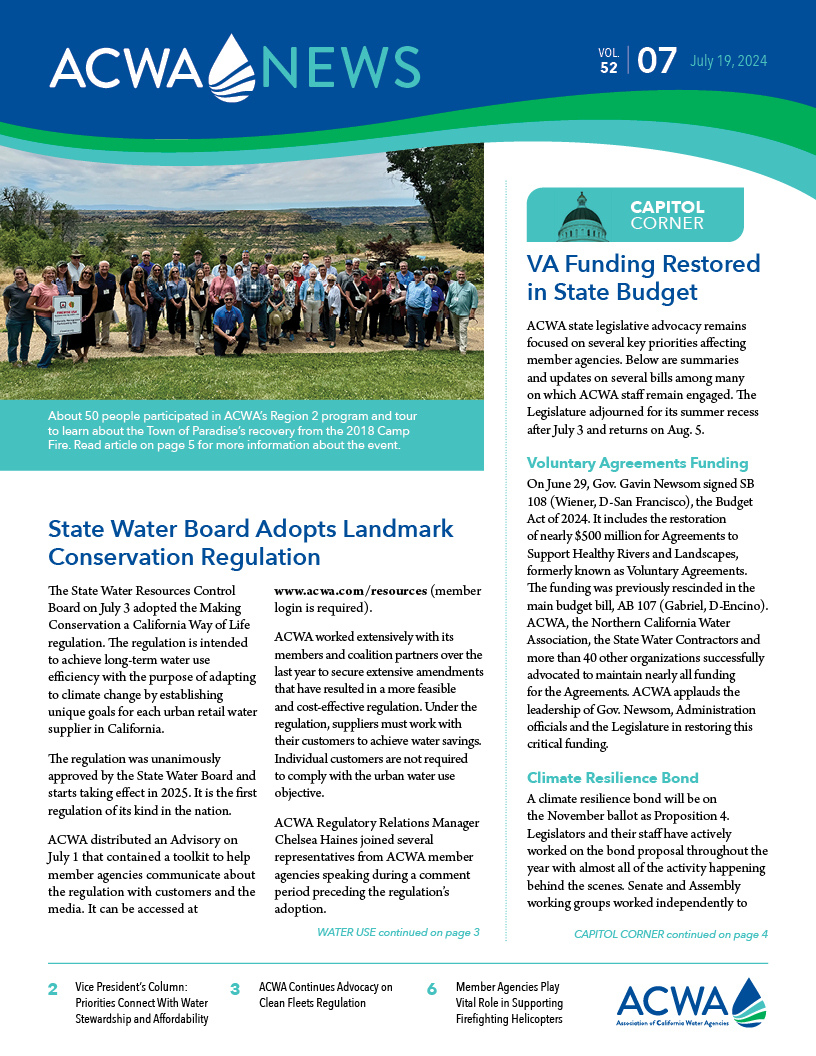 edition of ACWA News for informative articles about the association and water industry.
Articles include:
- Vice President Ernie Avila Discusses Water Stewardship and Affordability
- Capitol Corner Updates ACWA Advocacy on Key Water Issues in Sacramento
- Member Agencies Boost Effectiveness of Firefighting Helicopters
- ACWA Advocates for Flexibility in Advanced Clean Fleets Regulation