
Tuolumne Utilities District Receives CAL FIRE Wildfire Prevention Grant
Tuolumne Utilities District (TUD) is excited to announce that it has been awarded a $166,381 grant from the 2023-2024 CAL FIRE Wildfire Prevention Grant Program. This funding will support the TUD Critical District Facilities Fuels Reduction Phase 3 Project, which will significantly benefit the community by enhancing wildfire safety and resilience.
Following the achievements of earlier wildfire hazard mitigation efforts, this project seeks to enhance additional critical infrastructure within the TUD service area. The project focuses on reducing wildfire risks around three water treatment plants and five water storage tanks that provide service to 15,000 residents in high-risk fire zones. Each of these eight critical infrastructure sites are essential for the provision of water for human health, sanitation, and emergency fire suppression. Don Perkins, General Manager of TUD, states, “This grant represents another pivotal step in our ongoing efforts to safeguard our community against the increasing threats of wildfires.”
Westlands Water District Completes Phase One of Groundwater Recharge Project
FRESNO – Today, joined with federal, state, and local leaders, Westlands Water District (District) held a formal ribbon cutting to celebrate our Pasajero Groundwater Recharge Project (Project). Today’s event celebrated not only the completion of Phase One of the Project but also the partnerships contributing to the success of this project and others like it in the future.
Phase One of the Project features a new 30 cubic feet per second conveyance turnout from the Coalinga Canal and six basins, and results in up to 21,000 acre-feet (af) per year of recharge capacity. The second phase of the Project will include the addition of up to 10 dry wells with a recharge capacity of up to 5,000 acre-feet to convey surface water directly into the aquifer. Last year Westlands was able to recharge nearly 400,000 af of water, and with projects like this and partnerships, the District plans to nearly double that capacity up to 800,000 af.
“The Arroyo Pasajero Groundwater Recharge Project and other similar projects hit a sweet spot in California water,” said John Watts, Senior Counselor to the Commissioner of Reclamation. “Groundwater recharge provides a mechanism to capture the flood flows from atmospheric rivers and other increasingly concentrated winter storms — and then store that much-needed water for use in droughts to allow the San Joaquin Valley to keep supplying food for the nation.”
This landmark project will revolutionize water management for Westlands but also demonstrates the effectiveness of collaborative partnerships between the U.S. Bureau of Reclamation, California Department of Water Resources, and regional water agencies who have worked together towards a reliable and resilient water future for the San Joaquin Valley.
Earlier this year Westlands signed a Memorandum of Understanding (MOU) with Metropolitan Water District and Friant Water Authority, agreeing to work towards solutions to shared interests such as water storage and banking. Westlands is a member of the San Joaquin Blueprint which also entered into an MOU with Metropolitan Water District. In addition to the agreements amongst water districts, Westlands has been actively involved in the creation of the framework for a South-of-Delta Long-Term Drought Plan which culminated in an MOU with the U.S. Bureau of Reclamation and South-of-Delta Central Valley Project contractors. The Plan includes the creation of a “drought pool” where South-of-Delta water users contribute water to be stored for future use in dry years. These MOUs advance collaboration on goals, including water banking and conveyance, and have laid the foundation for the development of pilot programs with both Valley Water and Metropolitan Water District.
The Pasajero Groundwater Recharge Project increases the flexibility for storing water outside of the San Luis Reservoir and will provide groundwater banking and exchange opportunities for the District and partners.
“The Pasajero Groundwater Recharge Project is a great example of what can occur when the state and agricultural communities come together and work towards a common goal,” said Department of Water Resources Director Karla Nemeth. “Increasing groundwater storage is crucial in strengthening our state’s water stability and meeting our water needs. This project will be an effective way to improve groundwater quality in the San Joaquin Valley.”
The Project received nearly $4 million in funding assistance from the California Department of Water Resources’ Sustainable Groundwater Management Proposition 68 Implementation Grant Program and more than $2.6 million from the District. Westlands was recently awarded $25 million from the federal Inflation Reduction Act to fund similar recharge projects that would help advance the implementation of additional collaborative drought resiliency efforts.
“Our changing climate and unpredictable water supply requires Westlands to remain innovative in how we secure and store water, the technologies we offer our landowners, and the partnerships we build,” said Allison Febbo, General Manager, Westlands Water District. “Strengthening water security in California isn’t something that can be done by just one water district, one water agency, or one region. The Pasajero Groundwater Recharge Project demonstrates the importance of prioritizing collaboration to develop comprehensive solutions to advance California’s water goals.”
Phase Two of the project will begin with the construction of the dry wells in the first half of 2027.
###
About Westlands Water District
Westlands Water District is recognized as a world leader in agricultural water conservation and has served the farmers and rural communities on the west side of Fresno and Kings counties for more than five decades. As stewards of one of California’s most precious natural resources, Westlands continually invests in conservation, and champions farmers deploying innovative irrigation methods based on the best available technology.
ACWA Celebrates Membership Appreciation Month
ACWA’s Membership Appreciation Month in August gives our staff and leadership an opportunity to thank our members for all the work that they do. As part of the 12th annual Membership Appreciation Month, ACWA has produced a short video that highlights all the wonderful work our members do for California water and ACWA. Our members truly make ACWA the effective organization that it is today.Register Now for ACWA Fall Conference & Expo in Palm Desert
Registration is now open to attend ACWA’s 2024 Fall Conference & Expo Dec. 3-5 in Palm Desert. The event will draw together California water leaders from throughout the state to learn and connect with experts and decision makers within the water community. Registration is now an all-inclusive experience, giving attendees access to all keynote addresses and programs, ACWA’s networking meal functions and snack stations, the Exhibit Hall and ACWA-hosted receptions.- Conference programming includes informative and insightful panel discussions with industry experts and thought-leaders.
- Solution Spotlights feature 30-minute case studies, product demonstrations and other dynamic looks at how others in the industry are addressing today’s challenges.
- Designated conference programs will be recorded for on-demand access after the event.
- Group savings (register five, get one free) are also available.
State Approves PV Water’s Groundwater Sustainability Plan Update
WATSONVILLE – The California Department of Water Resources (DWR) has notified PV Water that its Groundwater Sustainability Update 2022 (GSU22) is approved. General Manager Brian Lockwood explained “This approval is yet another significant win for the Pajaro Valley as it validates the important work PV Water has been doing to achieve sustainable groundwater resources, and, importantly, the determination keeps PV Water moving forward. In addition, DWR’s approval of PV Water’s GSP Alternative in 2019 was among the first approvals in the state, DWR’s approval of PV Water’s periodic update to its GSP Alternative, GSU22, is also among the first in the state. The GSU22 was prepared under the oversight of the Ad Hoc Sustainable Groundwater Committee, and that Committee deserves to be recognized for this achievement.”
Kirk Schmidt, the Committee Chair, had this to share when he heard the news; “PV Water has progressed since its founding in 1984, managing a water basin that was deemed high risk with critical overdraft, through periods of acrimony, to one of the first basins in the State on a path to achieving full sustainability. Full sustainability means we will achieve this goal, before our neighbors, to reach a balanced aquifer in the next 15 years. PV Water is already close to achieving this goal. A remarkable feat.”
The Sustainable Groundwater Management Act (SGMA) requires that Groundwater Sustainability Agencies (GSAs) prepare periodic updates of their approved plans at least once every five years. PV Water’s next periodic update is due to DWR in December 2026. Staff anticipates that the PV Water Board will establish a new Ad Hoc Committee next year to begin the process to prepare the next update.
“This is wonderful news!” PV Water Board Chair Amy Newell stated during the July Board meeting. “The decision allows our staff to stay focused on implementation of the College Lake Project, the Sloughs project, recycled water and our conservation and recharge programs described in the GSU22,” Amy added.
While DWR’s approval helps to keep PV Water moving forward, some GSA’s elsewhere in the state are facing severe actions, including State Water Resource Control Board led public hearings and being placed into “Probationary Status”. PV Water’s success is helping to maintain local control of the Pajaro Valley’s water resources. While there is much work yet to do, DWR’s approval confirms PV Water is on the right track.
To learn more about the GSU22 visit PV Water’s website https://www.pvwater.org/sgm
ABOUT PV WATER
The Pajaro Valley Water Management Agency (PV Water) is a state-chartered water management district, and a Groundwater Sustainability Agency, formed to efficiently and economically manage existing and supplemental water supplies in order to prevent further increase in, and to accomplish continuing reduction of, long-term overdraft. PV Water works to provide and ensure sufficient water supplies for present and future anticipated needs within its boundaries, generally the greater coastal Pajaro Valley. For more information, visit www.pvwater.org or www.facebook.com/PajaroValleyWater.
CNRA Posts Responses to Questions About Agreements on Bay-Delta
SACRAMENTO — The California Natural Resources Agency has posted a “Common Responses” document that addresses questions and comments about the Agreements to Support Healthy Rivers and Landscapes (Agreements) that were raised by State Water Resources Control Board members, staff, and members of the public during the State Water Board’s three-day April workshop about the Agreements.
The document was developed by the Department of Water Resources, U.S. Bureau of Reclamation, and parties to the Agreements—which include numerous ACWA member agencies and the State Water Contractors, which issued a statement following the release of the “Common Responses.”
The State Water Board is expected to decide by next year on whether to include the Agreements in the Sacramento/Delta update to the Bay-Delta Plan. The other option is a regulatory approach strictly focused on imposing a percentage of unimpaired flows on rivers within the Sacramento River and Delta watershed.
ACWA strongly supports the Agreements as the best available approach within the Bay-Delta watershed for water supply reliability, the environment, communities, agriculture and more.
Westlands Awarded Nearly $2M to Increase Water Management Efficiency
FRESNO – The U.S. Bureau of Reclamation (Reclamation) recently awarded Westlands Water District $1,808,326 in grant funding through the federal WaterSMART program in support of projects designed to increase water management efficiency and conservation. Awarded funds will be used to retrofit Westlands’ buried distribution system that delivers metered water to hundreds of family-owned farms. “Westlands takes pride in investing in innovative distribution system methods and the best available technology to efficiently use every drop of water,” said Allison Febbo, General Manager, Westlands Water District. “This grant will allow the District to track Westlands’ water deliveries more accurately and efficiently – producing sustainable water savings to the tune of 9,600 acre-feet of water per year.” Westlands is the only agricultural water district in the world that distributes water through an entirely enclosed system which is comprised of approximately 1,100 miles of buried pipeline and over 2,400 water meters. Westlands continually invests in and updates this sophisticated system, which measures every drop of water and minimizes losses caused by seepage and evaporation. In 2021, Westlands began the first phase of implementing the Westlands Advanced Metering Infrastructure Project (Project), which included installing approximately 760 groundwater meters with advanced automated metering devices. Grant funds from the WaterSMART grant program will be used to complete phase two of the Project which entails retrofitting 1,603 manually read surface water meters with advanced automated metering devices. The Project will assist the District’s water management activities by increasing data collection frequency, improving real-time data to determine if meters are experiencing inaccuracies that can contribute to overirrigation so corrections can be made more efficiently, dramatically improving the accuracy of lower flow rates often used for blending in years the District receives little allocation, and assisting in timely and reliable meter reads to better identify potential leaks. The Project is expected to conserve 9,600 acre-feet of water, avoid nearly 6,000 vehicle miles traveled, reduce 20,223 kilowatt-hours in energy consumption, and decrease associated greenhouse gas emissions reductions every year. Febbo added, “The District is committed to implementing innovative water conservation technology tactics to help build an even more efficient water future for the hundreds of family-owned farms in the San Joaquin Valley. We thank the U.S. Bureau of Reclamation for this important funding and can’t wait to begin implementing this project in September.”###
About Westlands Water District Westlands Water District is recognized as a world leader in agricultural water conservation and has served the farmers and rural communities on the west side of Fresno and Kings counties for more than five decades. As stewards of one of California’s most precious natural resources, Westlands continually invests in conservation, and champions farmers deploying innovative irrigation methods based on the best available technology.August 16, 2024 ACWA News Available
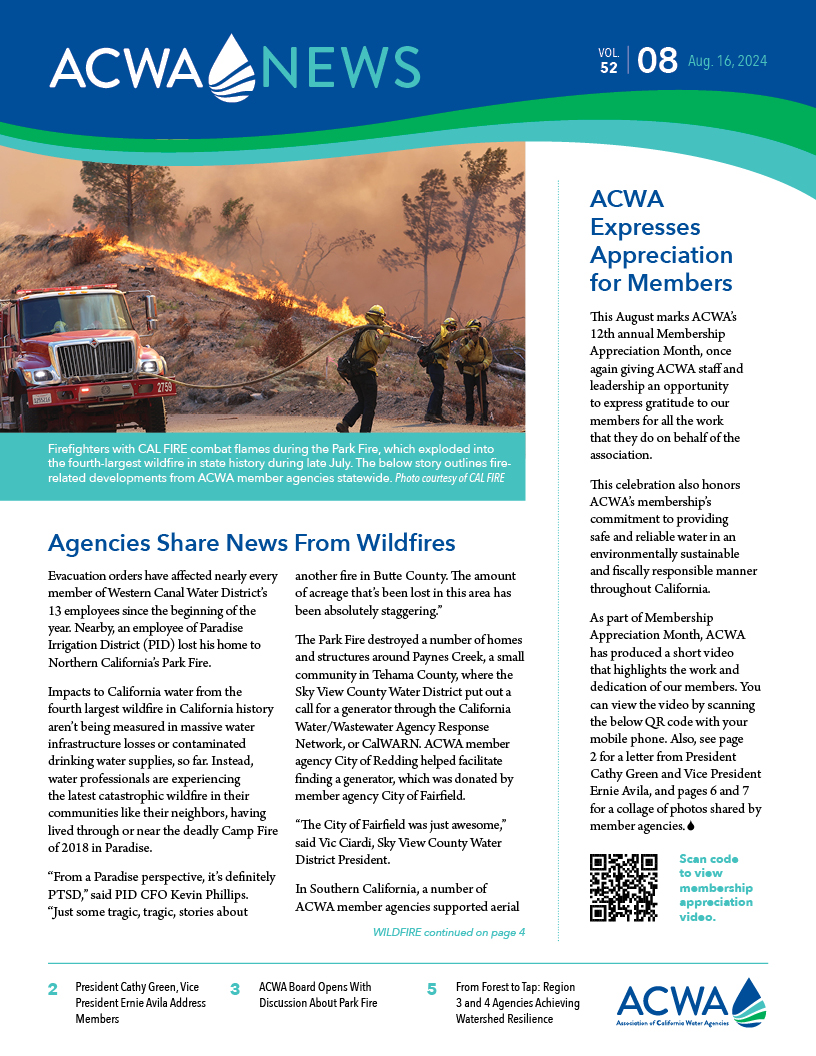 Read the August 16 edition of ACWA News for informative articles about the association and water industry.
Articles include:
- ACWA Celebrates Membership Appreciation Month
- Member Agencies Share Wildfire News
- Capitol Corner Outlines Status of Key Water Bills in Legislature
- Members riff on Olympic Themes in Like, Share & Follow
Leading the Charge: Orange County’s Commitment to Safe, Lead-Free Drinking Water
The Municipal Water District of Orange County (MWDOC) is leading efforts to eliminate lead contamination in drinking water, aligning with the U.S. Environmental Protection Agency’s (USEPA) national goals. MWDOC’s initiatives adhere to the Lead and Copper Rule Revisions (LCRR) released in January 2021, which mandate a comprehensive inventory of all water service lines, regardless of property ownership, by October 16, 2024. MWDOC is pioneering this initiative through our Shared Services Program, which offers collaboration among Orange County agencies, streamlines the inventory process, provides for a high level of accuracy, and leverages collective purchasing power. This approach ensures that all participating retail agencies remain on track to meet the October 2024 federal deadline.
Additionally, MWDOC is working with participating retail agencies to prepare for additional requirements in the pending USEPA Lead and Copper Rule Improvements (LCRI) which are set to be finalized in October 2024. The draft LCRI released in December 2023 indicates the final rule will mandate even more stringent requirements, including the complete replacement of lead service lines within 10 years and enhanced water quality testing protocols. MWDOC’s commitment to these evolving standards highlights the complexity and importance of the task, emphasizing the need for ongoing collaboration and transparency across federal, state, and local levels to protect public health and ensure the safety of drinking water.
Westlands Water District Awarded $1,000,000 by DWR
FRESNO–The California Department of Water Resources (DWR) awarded Westlands Water District (District), a $1,000,000 grant as part of DWR’s Flood Diversion Recharge (FDRE) Initiative. This grant will assist the State’s efforts to reduce flooding by increasing flood flow diversion volumes to recharge areas and expand local capacity to divert future flood waters. These efforts in turn reduce downstream flood impacts and facilitate groundwater recharge. “The District is committed to building a resilient water future for the San Joaquin Valley and our family farms,” said Allison Febbo, General Manager of WestlandsWater District. “This grant will greatly assist us in clearing the way for flood diversion and support our ongoing groundwater recharge efforts as we navigate through climate-driven weather extremes and continued decline in reliable surface water supplies and work towards groundwater sustainability.” The grant will support the removal of 450 acres of orchards from land recently acquired by the District. Located in an area of the District identified as subsidence-prone, adjacent to the San Luis Canal, the cleared land will reduce demand for groundwater near critical infrastructure, improve the availability of surface water and sustainable groundwater allocation(s), provide the District with increased recharge capabilities, and provide a site to temporarily retain diverted floodwater when needed. The subject land is part of 5,340 acres acquired since 2022, including the removal of 1,930 acres of orchards and vines, at a total investment of over $58,000,000. Reducing groundwater demand, increasing surface water, and sustainable groundwater allocation(s) to other productive farmland, land repurposing, and groundwater recharge are all important measures identified in the Westside Subbasin Groundwater Sustainability Plan. Diverting flood flows for groundwater recharge also protects downstream communities and infrastructure.###
About Westlands Water District Westlands Water District is recognized as a world leader in agricultural water conservation and has served the farmers and rural communities on the west side of Fresno and Kings counties for more than five decades. As stewards of one of California’s most precious natural resources, Westlands continually invests in conservation, and champions farmers deploying innovative irrigation methods based on the best available technology.