
CARB Continues to Enforce State and Local Clean Fleets Requirements
The California Air Resources Board (CARB) on Jan. 17 announced it is not enforcing portions of the Advanced Clean Fleets (ACF) regulation that would have required federal authorization, such as the portions that apply to high-priority and drayage fleets. However, CARB will continue to enforce the state and local fleet requirements which were effective as of Jan. 1, 2024.
The announcement came days after CARB withdrew its Clean Air Act Waiver Request to administer the ACF regulation in California from the U.S. Environmental Protection Agency. The original waiver request, which California sought to enable it to require medium- and heavy-duty fleets operating in the state to convert to zero-emission trucks, was submitted to U.S. EPA in November 2023 and resulted in questions about whether CARB retained its ability to enforce ACF.
According to CARB, this withdrawal does not impact ACF enforcement requirements on state and local government fleets in California because CARB was not required to request a waiver for state and local fleets under the Federal Clean Air Act.
ACWA will continue to engage as CARB evaluates next steps. CARB remains committed to working in partnership with interested parties to reduce air pollution to protect public health and encourages affected industries to continue reducing their emissions.
ACWA Helping Lead Support on Congressional Wildfire Legislation
WASHINGTON, D.C. – ACWA staff recently organized a coalition letter supporting legislation aimed at improving forest health and reducing the intensity of catastrophic wildfires. The letter and ACWA’s advocacy urges passage of the Fix Our Forest Act, a bill from last year now being reintroduced in the U.S. House of Representatives and scheduled for a vote Jan. 23.
The bill enjoys strong bipartisan support and is co-authored by U.S. Rep. Scott Peters (D-CA) and U.S. Rep. Bruce Westerman (R-AR), who is Chairman of the House Natural Resources Committee. Signatories on the coalition letter include the American Farm Bureau, The American Forest Resource Council, The California Farm Bureau, the Family Farm Alliance and the National Association of Counties.
“Forest management resources included in the Fix Our Forests Act are crucial to help control and reduce the severity of wildfires to enhance air quality, wildlife habitat, and more,” the coalition letter reads. “For example, this legislation would improve water supply sources such as drinking water and rivers, improve water quality by decreasing runoff, pollutants, and erosion, and save costs by reducing infrastructure repairs to reservoirs, pipelines, and treatment plants.”
ACWA’s advocacy effort supporting the legislation was led by ACWA Director of Federal Relations Ian Lyle. Shaping federal policy in relation to preventing catastrophic wildfires is a major focus in ACWA’s advocacy on headwaters health, which is one of the association’s priority issues. ACWA’s Headwaters Workgroup, in coordination with the Federal Affairs Committee, guides this advocacy. The Headwaters Workgroup was led for many years by Chair Willie Whittlesey, General Manager of Yuba Water Agency. Last month, Joel Metzger, General Manager at Utica Water and Power Authority, was named Chair.
If passed and signed into law, the Fix Our Forests Act would improve forest management activities and increase wildfire resiliency by: improving federal agency collaboration; authorizing targeted environmental streamlining authorities; providing litigation reform; expanding good neighbor authorities; and investing in research and technology aimed at improving forest health.
TUD Announces Completion of Mt. Provo Water Transmission Project
Tuolumne Utilities District (TUD) is proud to announce the completion of the Mt. Provo Water Transmission Project. This crucial infrastructure enhancement signifies a major step forward in TUD’s mission to deliver dependable and high-quality water to its customers while bolstering the region’s fire resilience.
The project was made possible by a $2.84 million grant from the Department of Water Resources (DWR) Urban and Multibenefit Drought Relief Grant program and involved the installation of approximately 14,000 feet of 8-inch water main pipeline along with two pressure reducing valve stations strategically positioned along Mt. Provo Road in the Ponderosa Hills area.
The consolidation of the Ponderosa Water Treatment Plant, four tanks, and five booster stations will reduce future operational and maintenance costs. In addition to improving water reliability and consolidation, the project increases fire and climate resilience by adding 10 new fire hydrants in high fire danger zones. Additionally, as part of the project, TUD regraded Mt. Provo Road, which has led to improved conditions for residents and visitors. Although TUD is not responsible for future maintenance of the road, its condition and accessibility have been enhanced.
The completion of this project is a testament to the successful partnership between TUD and the Tuolumne Band of Me-Wuk Indians. The Ponderosa water system, which serves as the main water supply to the Tuolumne Band of Me-Wuk Indians community, will significantly benefit from these enhancements. “We are committed to ensuring a dependable water supply for residents of the Rancheria, as well as securing adequate and reliable fire flow for use in defending our community from the threat of fire,” said Tuolumne Band of Me-Wuk Indians Chairman Kevin Day. “The collaborative partnership with TUD was integral in completing this important work.”
Don Perkins, General Manager of TUD, stated, “The completion of the Mt. Provo Water Transmission Project ensures that we can deliver reliable, high-quality water to the Ponderosa system from the Upper Basin system in Twain Harte. The successful completion of the Mt. Provo Water Transmission Project marks an essential milestone in water system consolidation and improved water management for the TUD service area.”
The new pipeline will serve as one of the key components of TUD’s water transmission system, originating at the future Sierra Pines Regional Water Treatment and Storage Facility located in Twain Harte, Ca.
Fred Jung Appointed to Orange County Water District Board
The Orange County Water District (OCWD; the District) Board of Directors announces the appointment of Fred Jung to its Division 10 seat, representing the city of Fullerton. Jung was appointed by the Fullerton City Council to serve on the Board through December 2028. He took the oath of office on January 15 before OCWD’s regularly scheduled board meeting.
“I am honored to join the Orange County Water District Board of Directors and represent the city of Fullerton,” said Jung. “Water is one of our most vital resources, and I look forward to working with my fellow board members to ensure its sustainability and reliability for our community and future generations.”
A member of the Fullerton City Council since 2020, Jung currently serves as the city’s mayor. He has a long history of community involvement and brings extensive leadership experience, having served on boards and committees for organizations such as the Metropolitan Water District of Southern California, Southern California Association of Governments and Orange County Transportation Authority. His broad expertise and dedication to public service make him a valuable addition to the OCWD Board of Directors.
Jung replaces Bruce Whitaker, who admirably served on the OCWD Board for three terms: 2012-2014, 2017-2019, and 2021-2024. During Whitaker’s tenure, OCWD launched the nation’s largest PFAS pilot project to determine the most effective method to remove PFAS from groundwater, and expanded the Groundwater Replenishment System (GWRS), the world’s largest system for indirect potable reuse.
“I want to thank Bruce Whitaker for his dedicated service and contributions during his time on the Board,” said Denis R. Bilodeau, P.E., board president. “As we bid him farewell, we are excited to welcome Fred Jung, whose expertise and passion for serving the community will be tremendous assets as we continue our mission of ensuring a reliable and sustainable water supply for north and central Orange County’s 2.5 million people.”
The OCWD Board of Directors, a 10-member body representing various divisions and cities in north and central Orange County, is integral in guiding the District’s strategies and initiatives. Detailed information about the Board and individual director biographies can be found on the District’s website, www.ocwd.com/about/service-area-board-of-directors.
OCWD Secures Major Federal Grant for Nation’s Largest PFAS Treatment Program
The Orange County Water District (OCWD) has been awarded a $30 million grant from the U.S. Bureau of Reclamation (USBR) as part of the WaterSMART: Title XVI WIIN Act. This funding, provided by the Bipartisan Infrastructure Law, is designated for OCWD’s PFAS treatment program to eliminate per- and polyfluoroalkyl substances (PFAS) from local groundwater.
OCWD President Denis R. Bilodeau, P.E., stated, “As a leader in water quality and groundwater management, OCWD is committed to ensuring safe and reliable water for the 2.5 million residents in our service area. This grant aids our ongoing efforts to expand PFAS treatment facilities throughout Orange County.”
The $30 million grant, the largest awarded among the 18 projects by the USBR, follows a competitive evaluation that highlighted OCWD as a top applicant. These funds will advance the District’s efforts to construct treatment facilities for over 100 wells impacted by state and federal regulations. Currently, 45 wells have been restored and are operational.
With an estimated $1.8 billion in PFAS mitigation costs over the next 30 years, OCWD has developed a comprehensive strategy that includes building treatment infrastructure, pursuing legal action against polluters, and advocating for legislation to prevent cleanup costs from affecting ratepayers.
For information about OCWD’s PFAS initiatives, visit the District’s PFAS Education Center. For information on USBR’s water resiliency funding, view their news release.
NID Installs Board President/Vice President for 2025, Swears in New Director
Nevada Irrigation District (NID) Directors welcomed new members and elected officers for next year, during their Dec. 11, 2024, meeting.
Director Ricki Heck will serve as Board President, and Chris Bierwagen will serve as Vice President. Heck (Division I) represents portions of Nevada City and Grass Valley. Bierwagen (Division II) represents the Chicago Park area.
NID welcomes a new member to its Board of Directors. Longtime Rancher Brad Fowler (Division III) was sworn in on Dec. 11. Fowler defeated incumbent Karen Hull in the recent election. Division 3 includes Alta Sierra and Lake of the Pines in Nevada County, as well as a portion of northern Placer County.
In addition, Incumbent Director Rich Johansen (Division V), who ran unopposed in the recent election, was sworn in for his second term. First elected to the seat in 2020, his new term will expire in 2028. Division 5 includes Lake Wildwood and Penn Valley.
NID’s full Board for 2025:
Division I – Ricki Heck – Grass Valley and Nevada City area
Division II – Chris Bierwagen – includes Chicago Park
Division III – Brad Fowler – includes Alta Sierra and Lake of the Pines in Nevada County, as well as a small portion of northern Placer County.
Division IV – Earl Stephens – portions of North Auburn and Lincoln areas
Division V – Rich Johansen – Lake Wildwood and Penn Valley
WVWD Provides Critical Mutual Aid to Water Agencies Impacted by Eaton Fire
In the aftermath of the Eaton Fire, which disrupted vital water services across the region, Walnut Valley Water District (WVWD) stepped up to support neighboring water agencies through its strong commitment to mutual aid partnerships. Leveraging the Public Water Agencies Group (PWAG) Emergency Preparedness Partnership, WVWD provided critical resources and expertise to help restore water service and operational stability. “As part of our mission to ensure reliable water services, we’re proud to collaborate with our neighbors during emergencies,” said Sheryl Shaw, General Manager of Walnut Valley Water District. “The Eaton Fire demonstrated the importance of mutual aid and the strength of regional partnerships in ensuring communities have access to safe and reliable water.” To assist agencies impacted by the fire, Walnut Valley Water District provided the following support:- Emergency Mobile Generators: WVWD deployed two emergency mobile generators to the Kinneloa Irrigation District to aid in restoring water service to their customers. These generators played a critical role in ensuring uninterrupted power for water distribution systems.
- Operational Support: WVWD staff assisted with key operational assignments to support Kinneloa Irrigation District during this challenging time, helping to stabilize water system operations and ensure efficient service restoration.
- Fuel Deliveries: Utilizing the District’s fuel trailers, WVWD delivered diesel fuel to refuel generators at both Kinneloa Irrigation District and Rubio Cañon Land & Water. This effort ensured continued operation of critical infrastructure during the emergency response.
- N95 Masks: WVWD provided 60 N95 masks to Rubio Cañon Land & Water to support staff safety during the emergency response efforts.
LARPD and Zone 7 Celebrate the Opening of the Patterson Ranch Trail
LIVERMORE – The Livermore Area Recreation and Park District (LARPD) and Zone 7 Water Agency are pleased to announce the opening of the Patterson Ranch Trail, a long-awaited project that enhances outdoor access and promotes environmental conservation. This 2.3-mile trail is now officially open to the public, offering stunning vistas and enhanced connectivity between key recreational areas in the Livermore Valley. The Patterson Ranch Trail begins off the connector trail southwest of the Arroyo Road Parking Lot at Sycamore Grove Park just across the Edward R. Campbell Bridge. It reconnects with Sycamore Grove Park at the west gate, just south of the Valley View Loop. Along its route, visitors can enjoy panoramic views of the Tri-Valley, Brushy Peak, Mount Diablo, Lake Del Valle, and Cresta Blanca. On Wednesday, January 15, 2025, a ribbon-cutting ceremony officially celebrated the trail’s opening, with representatives from Zone 7 Water Agency, LARPD, and trail-building volunteers in attendance. “This trail reflects the hard work and teamwork of our community,” said David Furst, LARPD Board Member. “Thanks to the efforts of volunteers, LARPD staff, and our partnership with Zone 7, we’re excited to open it to the public as a place for everyone to enjoy and connect with nature.” In 2013, Zone 7 acquired the Patterson Ranch property comprised of 5,000 acres within the Del Valle watershed, ensuring a reliable and sustainable water supply for the community. This acquisition aligned with the agency’s mission to provide safe and reliable water services while recognizing the importance of environmental stewardship and public access. “Zone 7 has a long history creating partnerships that make its properties accessible for recreation. The opening of the Patterson Ranch Trail, adding 2.3 miles to the existing 19 miles of trails on Zone 7 facilities, exemplifies this commitment,” added Zone 7 Board President Dennis Gambs. “It offers residents more opportunities to connect with nature and appreciate the vital role the watershed plays in sustaining the community.” Over the course of five trail-building days, 121 volunteers came together to help build the trail, contributing hundreds of hours in support of this project. Their efforts were complemented by LARPD Rangers and Zone 7 Water Agency, who completed the finishing work to prepare the trail for public use. To protect the trail’s natural environment and ensure safety, mountain bikes and equestrian use are not allowed. The trail is open to hikers and runners who are encouraged to enjoy its beauty and expansive views. This project underscores the shared commitment of LARPD and Zone 7 Water Agency to enhancing outdoor recreation and fostering community connections through accessible open spaces. For more information on the trail and its features, please visit www.larpd.org/news# # #
About LARPD
Created by a vote of the public in 1947, the Livermore Area Recreation and Park District (LARPD) is a multifaceted agency that encompasses most of the eastern half of Alameda County, a 243.5-square-mile area bounded by Contra Costa County to the north, San Joaquin County to the east, Santa Clara County to the south, and the cities of Pleasanton and Dublin to the west. LARPD provides the people of the Livermore area with outstanding recreation programs and a system of parks, trails, and facilities that enhance the quality of life. For more information, visit www.larpd.org.About Zone 7 Water Agency
Zone 7 Water Agency is one of the 10 active zones of the Alameda County Flood Control and Water Conservation District. The District was established by the State Legislature in October 1949 to solve problems of flooding, drainage, channel erosion and water supply and conservation in Alameda County. In 1957, by popular vote, Zone 7 became a special district governed by a seven-member board of directors. Along with flood protection, Zone 7 supplies water to all of eastern Alameda County and a population of over a quarter million residents. Treated water is sold wholesale to local retailers, including the cities of Livermore and Pleasanton, the Dublin San Ramon Services District, and the California Water Service Company. Zone 7 also distributes untreated water to local agriculture operations and golf courses.January 17, 2025 ACWA News Available
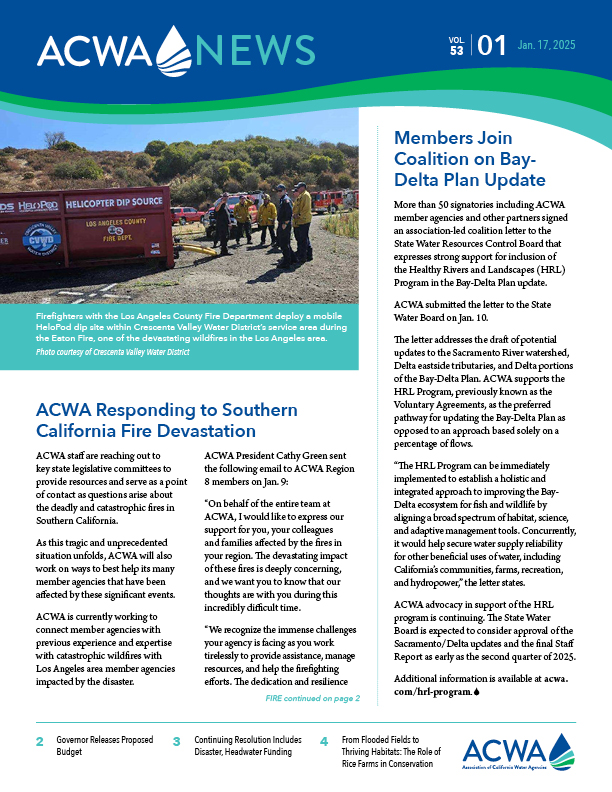 Read the January 17 edition of ACWA News for informative articles about the association and water industry.
Articles include:
- ACWA Responds to Southern California Fires
- Governor Newsom Releases Proposed State Budget
- Irrigation Districts Partner with Rice Farmers for Wildlife Conservation
- ACWA News Profiles Farmer, Podcaster and Water Leader Darcy Villere
From Flooded Fields to Thriving Habitats: The Role of Rice Farms in Conservation
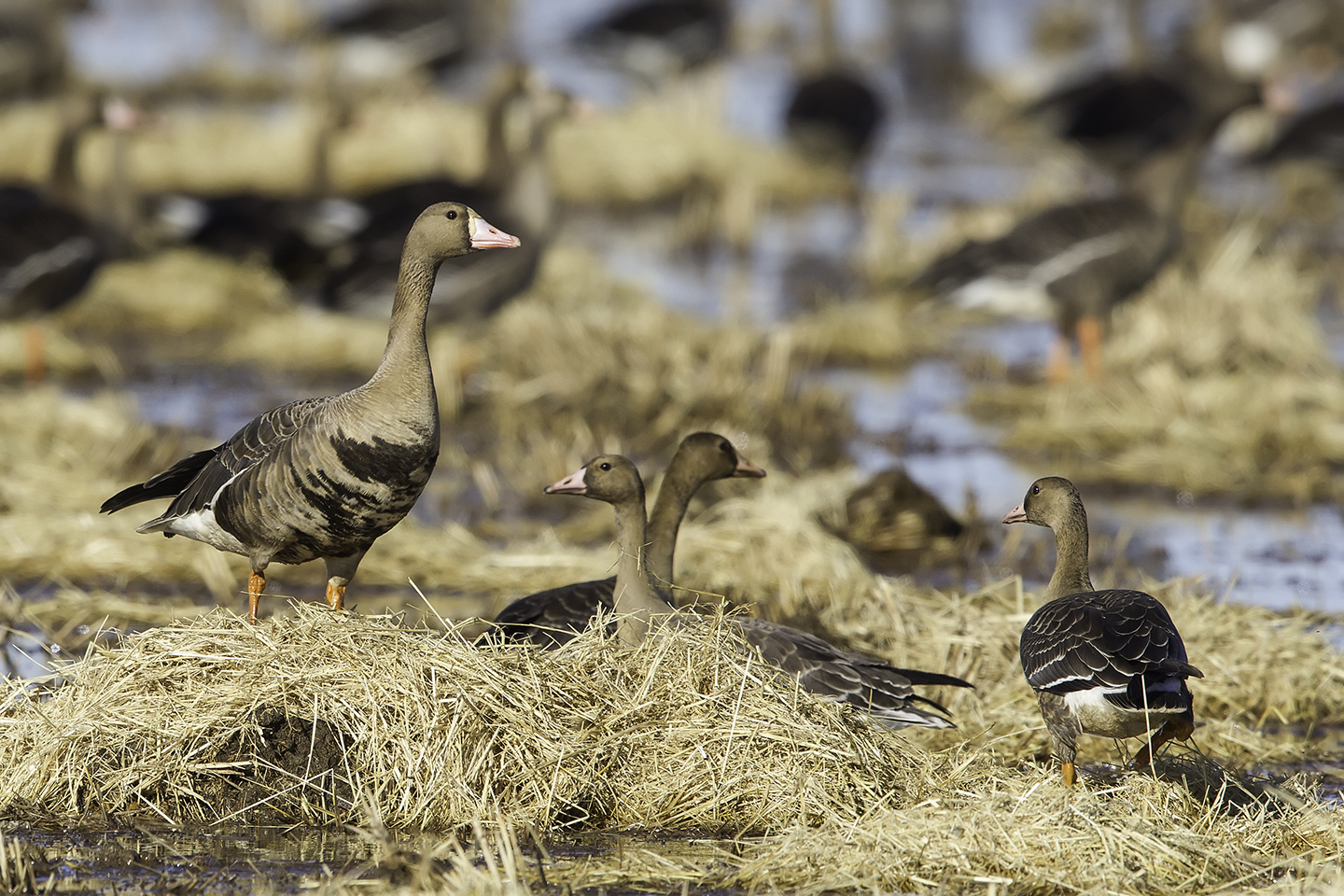
A group of Greater White-fronted Geese find food and habitat in a Sacramento Valley rice field. They are the first of the migratory geese to arrive in the valley each fall.
Winter flooded rice fields in the Sacramento Valley are more than just remnants of America’s sushi rice harvest—they are fields of life. Each winter, these rice fields transform into a critical stopover for snow geese, swans, and countless other birds migrating along the Pacific Flyway. With 95% of California’s historical floodplains now gone, these surrogate wetlands provide vital ecological benefits.
The water districts serving agricultural lands in the Sacramento Valley, such as Western Canal Water District, play a critical role in the conservation work happening on many rice farms during the off-season. For Western Canal, the ability to offer affordable water supplies during the fall and winter has made conservation practices popular in their district.
“Rural water districts are the voice of the growers, looking out for them and making sure that they have access to the water they need to help the environment as well as grow food for people,” said Correen Davis, Board Member of Western Canal Water District. “From the perspective of (our farm) Gorrill Ranch, we have been in business for over one hundred years, and we would not be successful if we weren’t environmental stewards as well as farmers.”
The Sacramento Valley rice fields and neighboring wildlife refuges host approximately one billion birds migrating through the area annually along the Pacific Flyway, with nearly four million wintering waterfowl and 250,000 shorebirds spending time in the rice fields.
“Agronomically, the water on the landscape of a rice system is very helpful to aid in the decomposition of the straw left behind after the fall harvest,” said Josh Sheppard, Board Member of Western Canal Water District and Board Chair of the California Rice Commission. “These shallow flooded fields are also perfectly suited for the needs of migrating birds to find shelter and food as they forage about the region. It’s estimated the waste grain left behind from the rice harvest provides more than two-thirds of the nutritional needs of the ducks, geese and shorebirds that winter in the region.”
Environmental benefits of these rice fields go beyond winter migration. In the spring, the densely planted rice fields and shallow water also create ideal nesting sites for waterfowl and other bird species, boosting breeding success rates. According to the California Rice Commission, there are more than 230 different wildlife species known to be connected to these rice fields, including many state and federally threatened species like the Greater Sandhill Crane, Tri-Colored Blackbird, Bald Eagles, Swainson’s Hawks, Giant Garter Snake and the Western Pond Turtle – who all rely on the habitat these fields provide.
As the rice farmers, water districts and conservation partners began focusing on the needs of the species using these fields, they identified a shortage of habitat during one month in the spring, when farmers are planting their fields, and for two months in the fall, when fields are no longer flooded as they prepare for harvest.
In response, partnerships between conservation groups, the California Rice Commission, and the California Ricelands Waterbird Foundation have developed programs like the Nature Conservancy’s BirdReturns program and the Foundation’s Bid4Birds program. These initiatives offer some cost share revenue to help growers keep water on the fields further into the spring or place water on targeted locations during late spring and early fall to fill the gaps in habitat.
“For decades now, our growers have seen firsthand how much their planted rice fields are used by wildlife all throughout the year,” said Tim Johnson, president and CEO of the California Rice Commission. “Through sizeable research, The Rice Footprint report by the University of California Davis, set to be released late January, details a plan for the next decade to further enhance the value of California ricelands with scientific evidence outlining just how vital California’s planted rice fields are to our ecosystem, in helping waterfowl, shorebirds, reptiles and fish thrive.”
These innovative efforts between rice farmers, conservation groups and water districts have now continued beyond birds, to fish. Initial research shows that juvenile salmon that spend time in winter flooded rice fields grow larger and stronger after just two weeks in a rice field compared to the river. Rice fields provide the right conditions to create nutrient-rich food for young salmon helping them prepare for outmigration to the Pacific Ocean. Ideally, larger juvenile salmon could increase returning adult populations that spawn in local rivers.
The benefits of investing in these conservation efforts go beyond just benefiting the local wildlife, they benefit the community as well. Fishing and hunting provide economic benefits to the region. Ecotourism also contributes to the local economy with events like the upcoming Snow Goose Festival in Butte County bringing out of area visitors and waterbird enthusiasts from around the world to see and celebrate the large amount of wintering birds in the area.
The collaborative efforts in the Sacramento Valley demonstrate what can be achieved when innovation and stewardship converge. As water districts, farmers and others continue to invest in these partnerships, they are safeguarding critical habitat and creating a legacy of resilience and biodiversity for future generations, proving that agriculture can nurture both the land and life that it supports.
