
West Basin Awards Contract for Recycled Water Facilities
West Basin Municipal Water District (West Basin or District) has selected Jacobs Project Management Company to provide operations and maintenance (O&M) services for its recycled water treatment facilities. The O&M contract spans five years, allocating $31.5 million dollars for the first year, and encompasses the District’s five facilities including the Edward C. Little Water Recycling Facility in El Segundo, the Hyperion Pump Station in Playa del Rey and three satellite treatment plants in Carson, Torrance and El Segundo.
West Basin is a recognized industry leader in water recycling and produces approximately 40 million gallons per day and more than 11 billion gallons annually. Through its advanced treatment processes, West Basin provides five types of recycled water for irrigation, industrial and commercial applications within West Basin’s coastal Los Angeles County service area. This water is distributed through more than 100 miles of recycled water pipeline that includes 400 recycled water connections at more than 300 customer sites, including Chevron El Segundo, Los Angeles International Airport, SoFi Stadium, Intuit Dome, Marathon Petroleum Corporation and more. The successful operation and maintenance of West Basin’s facilities plays a vital role in the District’s mission to reduce reliance on imported water supplies and enhances the region’s drought resilience.
“This contract is a critical investment in West Basin’s recycled water facilities and reflects the District’s commitment to ensuring the sustainable continued operation of our recycled water program,” said West Basin Board President and Division II Director Gloria Gray. “With recycled water playing an increasingly vital role in Southern California’s water supply portfolio, ensuring best-in-class operations and maintenance is essential for long-term stability. The contract will also support West Basin’s strategic goals of water supply reliability and sound financial management by optimizing operational efficiency through a performance driven management approach.”
Following a competitive and comprehensive procurement process, Jacobs was chosen for its longstanding high-quality and cost-effective services. The company has more than four decades of experience in operations, maintenance and facility management services for water and wastewater utilities. Their integrated approach combines operations, planning, design, construction services and program management, offering comprehensive solutions.
“Our company brings extensive expertise and innovative approaches that will help West Basin to continue delivering the highest quality recycled water supplies to its customers while optimizing facility performance,” said Greg Fischer, Executive Vice President and General Manager of Design-Build and Operations Management and Facilities Services at Jacobs Project Management Company. “We are honored to have been selected by West Basin to support the operations and maintenance of its world-class recycled water facilities. Our team is committed to delivering exceptional service, leveraging our industry expertise and innovative solutions to provide quality services for the customers West Basin serves.”
Jacobs will begin O&M services for West Basin beginning September 1, 2025.
CVWD Celebrates 70 Years of Service
RANCHO CUCAMONGA — On March 25, 2025, the Cucamonga Valley Water District (CVWD) proudly celebrated its 70th anniversary, marking seven decades of dedicated service to our community. In honor of this milestone, CVWD hosted a special commemorative ceremony during its Board of Directors meeting. On March 25, 1955, the first board meeting of what was then known as the Cucamonga County Water District was held. More than a dozen small water companies came together to form what is now CVWD, with a shared mission of delivering high-quality, safe, and reliable water service to the growing region. While the past 70 years have brought tremendous growth and change, one thing has remained constant—the essential role of water in sustaining our community. From the early Cucamonga settlers to the residents and businesses that call this region home today, CVWD has proudly upheld its commitment to providing Service Beyond Expectation. “The 70th anniversary is a testament to the hard work and dedication of our team, past and present,” commented President Reed. “We take pride in our commitment to providing reliable water services and look forward to continuing our mission for many years to come.” The Board of Directors meeting featured a special video presentation reflecting CVWD’s history and key milestones. Community members, stakeholders, and past board members joined in the celebration to commemorate CVWD’s contributions to the region. CVWD encourages the community to take this opportunity to learn more about the District and to celebrate the heritage of the region. For more information about the March 25th event or CVWD’s history, please visit CVWDwater.com or call (855) 654-2893.###
The Cucamonga Valley Water District provides high quality, reliable water and wastewater service to 200,000 customers within the City of Rancho Cucamonga, portions of Fontana, Ontario, and Upland, and some unincorporated San Bernardino County.Bureau Further Increases CVP Allocations
SACRAMENTO – The Bureau of Reclamation on March 27 announced an increase in Central Valley Project 2025 water supply allocations, adding to initial allocations made in late February.
“While most of the Central Valley Project contractors are at 100% allocation, we are very pleased to announce an increase in allocations for our south-of-Delta and Friant Division contractors,” Acting Bureau Regional Director Adam Nickels stated in a news release. “Consistent with the intent of Executive Order 14181, we are able to increase south-of Delta agriculture to 40% and Friant Division Class 1 to 100%.”
The Friant Water Authority and Westlands Water District issued statements praising the updated allocation.
“We are extremely grateful for the BoR’s continued responsiveness and leadership in delivering a full allocation for Class 1 contractors, which brings certainty and relief to many of our growers and communities in the Friant Division,” a Friant Water Authority news release stated.
“We continue to be encouraged by the state and federal administration’s recent actions to maximize water supply for Californians and look forward to a subsequent allocation update that reflects the totality of recent hydrology,” Westlands Water District General Manager Allison Febbo stated in a news release.
Snowpack Close to Average Near End of Wet Season
SACRAMENTO – The Department of Water Resources (DWR) today conducted the April snow survey at Phillips Station. The manual survey recorded 39.5 inches of snow depth and a snow water equivalent of 17 inches, which is 70 percent of average for this location. The snow water equivalent measures the amount of water contained in the snowpack and is a key component of DWR’s water supply forecast. Statewide, the snowpack is 90 percent of average for this date. Given the forecast for storms early next week, DWR conducted the in-person snow survey ahead of April 1.
While DWR’s Snow Surveys and Water Supply Forecasting Unit strives to conduct measurements as close to the first of the month as possible, DWR must schedule surveys around forecasted storm activity to ensure the safety of DWR staff and invited media. The anticipated storms this weekend and early next week may boost the official April 1 average for statewide snowpack and DWR will provide an update on Tuesday.
The April measurement is a critical marker for water managers across the state, as it is typically the time when the snowpack reaches its maximum volume and begins to melt. DWR’s water supply forecasts use data from the April 1 snowpack to calculate how much snowmelt runoff will eventually make its way into California’s rivers and reservoirs.
While the snowpack has caught up to near normal, broad swaths of Southern California remain exceptionally dry and below average for rainfall. This includes the Los Angeles region, which as of today has only received 45 percent of its average rainfall so far this water year.
“It’s great news that our state’s snowpack has recovered from several weeks of extremely dry conditions in the heart of our winter storm season,” said DWR Director Karla Nemeth. “However, it’s not a wet year across the entire Sierra Nevada. The north has great snowpack, but snowpack is less than average in the central and southern part of the mountain range. That snowpack ultimately flows to the Delta, and the regional disparity affects how much water the State Water Project will be able to deliver.”
Measuring California’s snowpack is a key component that guides how California’s water supplies are managed. On average, California’s snowpack supplies about 30 percent of California’s water needs. Its natural ability to store water is why California’s snowpack is often referred to as California’s “frozen reservoir.”
The data and measurements collected from DWR and its partners with the California Cooperative Snow Surveys Program help inform the water supply and snowmelt runoff forecasts, known as the Bulletin 120, that help water managers plan for how much water will eventually reach state reservoirs in the spring and summer. This information is also a key piece in calculating State Water Project allocation updates each month.
“We are very thankful to be ending March where we are now with more snow in the forecast next week, especially considering the dry start to the year,” said Andy Reising, manager of DWR’s Snow Surveys and Water Supply Forecasting Unit. “From major storms in November and December to a bone-dry January, then back to major storms in February and March, this year is a lesson in why we can never know for certain what our water picture will look like until we get to the end of our traditional wet season.”
Before storms in February and March, California was experiencing an excessively dry January that stalled critical growth of the snowpack and contributed to the dangerous conditions that led to devastating wildfires in Southern California. To prepare for the next drought, DWR and Governor Newsom have taken actions to secure and protect California’s water supply in the face of growing climate extremes while balancing the needs of the environment. In January, Governor Newsom issued an executive order to make it easier for local and regional agencies to maximize groundwater recharge, ensuring California is able to capture and store as much water as possible during high winter flows.
California is also working with the scientific community to adopt the best available science for the state’s water management. A recently released report shows that DWR’s investments in pursuing new strategies known as Forecast Informed Reservoir Operations, which provides flexible water management based on the newest forecasting technologies, can both reduce flood risk for downstream communities and benefit water supplies during dry period.
This fall, the State Water Project received a new operating permit after years of working with the U.S. Bureau of Reclamation and partners at state and federal fish agencies, that will address the dual challenges of climate change impacts and endangered species protections.
Thanks to efforts to capture as much water as possible from this year’s storms, reservoirs across the state are currently 115 percent of average.
DWR conducts four or five snow surveys at Phillips Station each winter near the first of each month, January through April and, if necessary, May.
ACWA Leading Coalition Opposing SB 601 Wastewater Discharge Bill
ACWA is urging members to join a coalition opposing SB 601, which would needlessly complicate the state’s wastewater discharge permitting system, potentially lead to frivolous litigation and likely result in higher water bills for Californians.
The bill was introduced by Sen. Ben Allen (D-Santa Monica) with the intent of safeguarding California’s water quality protection regime from federal rollbacks. However, its approach would go far beyond simply maintaining the status quo, expanding federal permitting requirements and exposing water agencies to significant liability, ultimately impeding progress toward overcoming the state’s severe housing shortage while answering water supply reliability challenges.
ACWA’s State Legislative Committee has adopted an “oppose” position and ACWA is leading a coalition of water, wastewater and other local government entities in opposition to the bill.
Join the coalition by completing an online form. The bill will be heard by the Senate Environmental Quality Committee on April 2. It has also been referred to the Senate Judiciary Committee.
In addition to the ACWA-led coalition, ACWA staff is working closely with a larger coalition led by California Chamber of Commerce that includes business/economic interests and agriculture, as well as water and wastewater utilities.
For more information about SB 601 or the coalition, review the ACWA Legislative Alert distributed March 26.
More Storms Allow Extra Boost to SWP Deliveries
SACRAMENTO – The Department of Water Resources (DWR) announced March 25 that wet and cold storms in March have allowed for another increase to the State Water Project (SWP) allocation forecast for 2025. The allocation has increased to 40 percent of requested water supplies, up from 35 percent last month. The State Water Project provides water to 27 million Californians and 750,000 acres of farmland.
The latest allocation forecast is based on increases in precipitation, snowpack, and reservoir storage in the past month. The allocation increase comes ahead of the April 1 snow surveys next week, when Sierra Nevada snowpack typically peaks.
“As we near the end of the wet season, our focus shifts to snowpack runoff and whether temperatures allow for a slow melt so we can capture as much of that runoff as possible,” said DWR Director Karla Nemeth. “Despite periods of extremely dry conditions this season, water managers have been able to effectively capture, move, and store water for use later this year while also maintaining flood protection.”
The State Water Project was able to increase storage this month at its largest reservoir, Lake Oroville, and nearly fill the State Water Project’s share of storage at San Luis Reservoir in Merced County. That storage will help meet the needs of State Water Project contractors and their customers this year as well as provide some water supply next year in the event that dry conditions return. Lake Oroville storage is now up to 86 percent of capacity and 121 percent of historical average for this time of year. DWR has been releasing water from Lake Oroville in order to maintain enough empty space in the reservoir for flood management. As spring progresses, the need for flood space will diminish and storage may increase.
In the Sacramento-San Joaquin Delta, April and May are ecologically important times and the State Water Project will need to adjust operations accordingly. Pumping rates will likely fall to minimum levels during those months to protect endangered fish species. Releases from Lake Oroville for endangered species and water quality protection also may be necessary, depending upon precipitation and other factors.
These constraints reinforce the need for California to invest in additional water supply infrastructure to provide operational flexibility. The proposed Sites Reservoir and Delta Conveyance Project would have been hugely beneficial to water supply had they been in place this season. The Delta Conveyance Project could have captured more than 750,000 acre-feet of additional water supply this winter, which would have translated to a 20 percent increase in the current State Water Project allocation, on top of the increase announced today.
Rancho Water Promotes Water Industry Leader Dan Ruiz to Assistant General Manager
TEMECULA – Rancho California Water District (Rancho Water/District) is pleased to announce the promotion of Dan Ruiz, P.E., as its new Assistant General Manager – Engineering and Operations. With a distinguished career spanning nearly two decades in the public water sector and over a decade in the private engineering field, Ruiz brings extensive experience and proven leadership to his new role at Rancho Water.
Ruiz has served at Rancho Water since January 2023, as the Director of Engineering and then Senior Director of Engineering. During his time at the District, he has overseen the planning, design, and execution of Rancho Water’s capital improvement program and multiple maintenance projects. Under his leadership, the Engineering Department has prioritized critical infrastructure initiatives, including the new Vail Dam, the Upper Valle de Los Caballos pump station, and well drilling projects. He has also streamlined engineering consultant procurement and enhanced collaboration across departments to improve efficiency and project execution.
“Dan has been an integral part of our team, demonstrating outstanding leadership, technical expertise, and a deep commitment to Rancho Water’s mission. In this expanded role, Dan will oversee critical infrastructure projects, operational enhancements, and strategic initiatives to help drive our continued success. His dedication and expertise will be invaluable as we navigate future challenges and opportunities,” said Jason Martin, General Manager of Rancho Water. “His ability to drive strategic initiatives, secure funding, and collaborate with key stakeholders will be instrumental as we continue to enhance water reliability and sustainability for our customers.”
Prior to joining Rancho Water, Ruiz served as Engineering Manager at Coachella Valley Water District (CVWD), where he managed domestic water infrastructure programs and secured significant state and federal grant funding for critical projects. His expertise in strategic planning, budgeting, and construction oversight has contributed to the successful execution of large-scale capital improvement initiatives throughout his career. He also has extensive experience in the private sector, having held leadership roles at firms where he managed engineering, planning, and environmental teams.
“I am honored to step into this role and continue working with Rancho Water’s talented team to advance critical projects that support our community’s water needs,” said Ruiz. “I look forward to building on our successes and ensuring the long-term reliability and efficiency of our water system.”
Ruiz holds a Bachelor of Science in Engineering from California State University, Fullerton, and is a licensed Professional Civil Engineer in California. For more information about Rancho Water and its executive team, visit RanchoWater.com.
New Strategic Plan Optimizes ACWA’s Value to Members
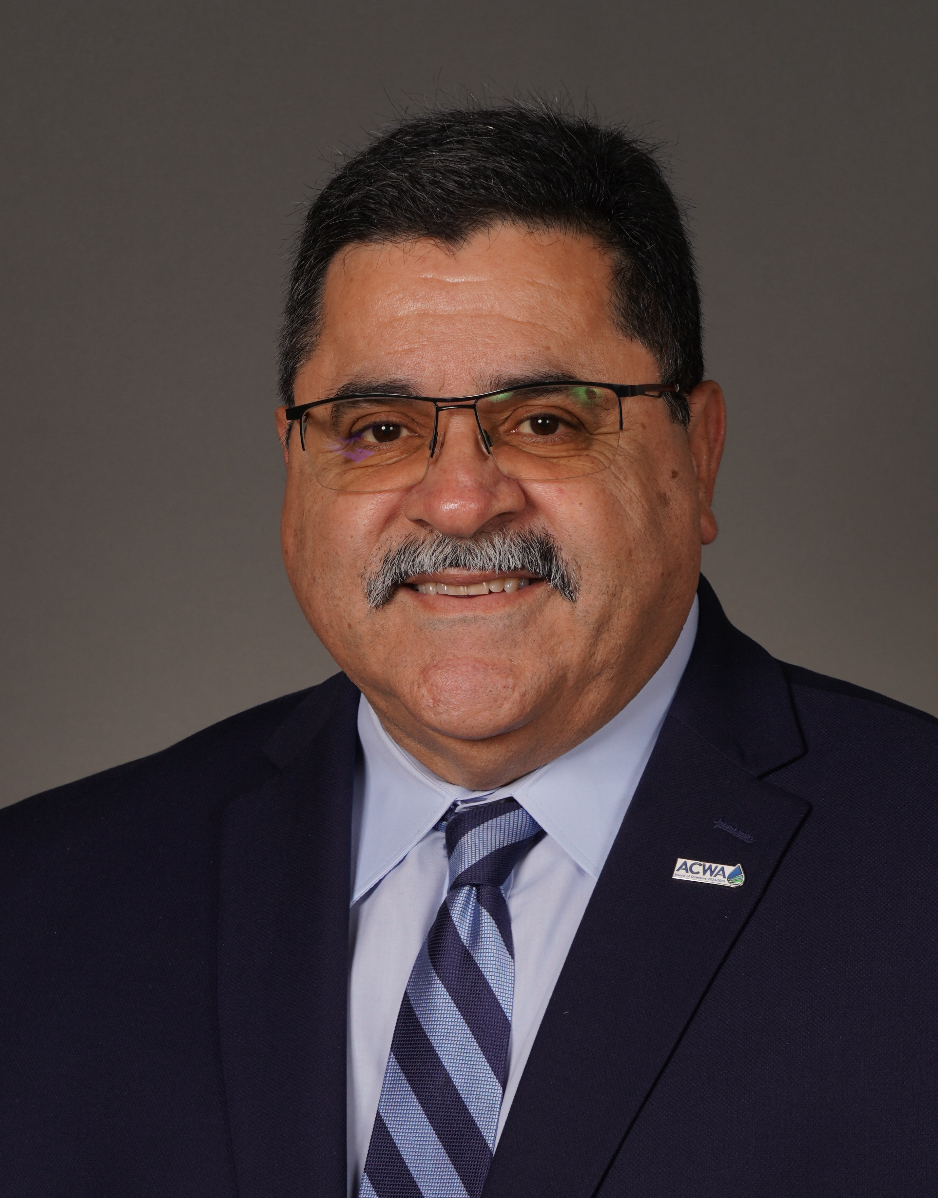 Our members expect ACWA to make their voices heard in Sacramento and Washington D.C. They also want an organization that unites them, fosters collaboration, keeps them informed and creates a unique sense of community among California water professionals. It’s a big job, and we do it well, but fulfilling our value to members requires constant attention to how we can improve and transform ACWA into a true world class organization.
During the next five years, ACWA leadership will utilize the association’s 2025-’29 Strategic Plan as an instrument for translating that attention, this never-ending search for ways to serve you better, into measurable action and demonstrable results.
The plan updates ACWA’s first five-year Strategic Plan with a revised mission, vision and values before identifying four primary goals: Advocacy, Connections, Education and Organizational Effectiveness. Clearly defined strategies and objectives chart a path toward achieving each goal. Progress will be measured by 50 key performance indicators, or KPIs, allowing ACWA leadership at the Board and staff level to gauge progress.
This plan is far more than an aspirational document. Accountability is built into it at every level, with specific responsibilities assigned to ACWA departments and association committees who will often work in tandem.
Looking at the advocacy goal in particular, ACWA has functioned in the same way for quite some time, and it has produced many positive outcomes. Think of the water rights issue, where we stopped incredibly overreaching legislation. Or, take our sponsored legislation that has steadily reformed the Proposition 218 process to prevent agencies from being sandbagged with lawsuits after setting rates. These are two among numerous examples of ACWA advocacy, in collaboration with members, that have directly benefited most, if not all association members.
However, if there was ever a time that we rededicate ourselves to finding new and more ways to benefit our members, that time is now. We just saw a historic surge in newly elected legislators eager to make their name in Sacramento. It is imperative that we engage and educate them about the practical realities of reliable and sustainable water management, as well as educate the communities we serve.
Region 9 Vice Chair Carol Lee Gonzales-Brady and I will also lead a 10-region task force focused on how we develop and approve water policy initiatives and their implementation. This will ensure that our advocacy reflects our members’ key interests as closely as possible and improves the viability of support for these initiatives in Sacramento and Washington, D.C.
Within the ACWA community itself, we are witnessing a generational transition in leadership. Now is the time to elevate networking and knowledge sharing among members to an entirely new level, and in doing so set up a blueprint for the success of the organization for this generation and those that follow.
Meanwhile, our committees and workgroups, the collective brain trust we rely upon for expertise unique within California’s water industry, must be further empowered in developing specific and actionable initiatives and related implementation strategies that advance ACWA’s highest priorities.
We find ourselves in very different and challenging times. Our new Strategic Plan acknowledges the shifting landscape of water policy in Sacramento and Washington, D.C., the internal evolution of ACWA itself, and the critical need to engage the next generation of water leaders. As we stand at a crossroads, this plan provides a framework to unify our collective efforts and better assert ACWA’s leadership in shaping California’s water policy.
March 21, 2025 ACWA News Available
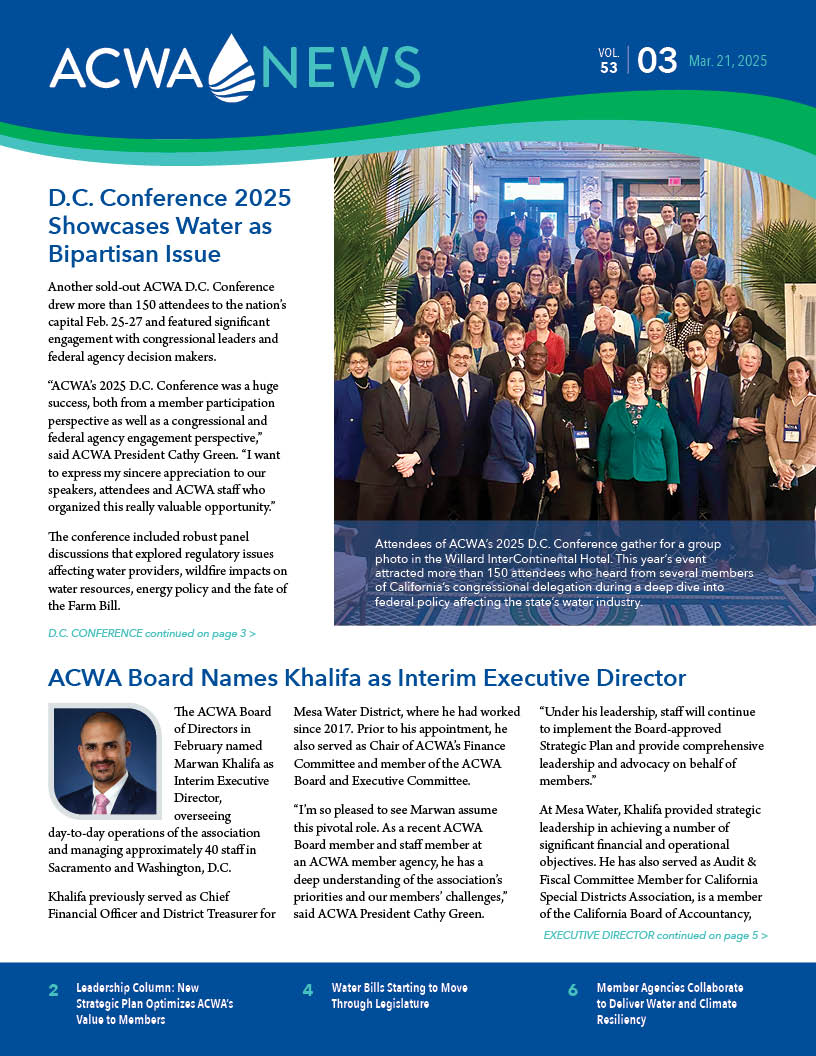 Read the March 21 edition of ACWA News for informative articles about the association and water industry.
Articles include:
- ACWA VP Discusses How Strategic Plan Optimizes Value to Members
- D.C. Conference 2025 Showcases Water as Bipartisan Issue
- ACWA Board Names Khalifa as Interim Executive Director
- Central Valley Members Collaborate to Deliver Water and Climate Resiliency
Fresno Area Agencies Collaborate on Resiliency
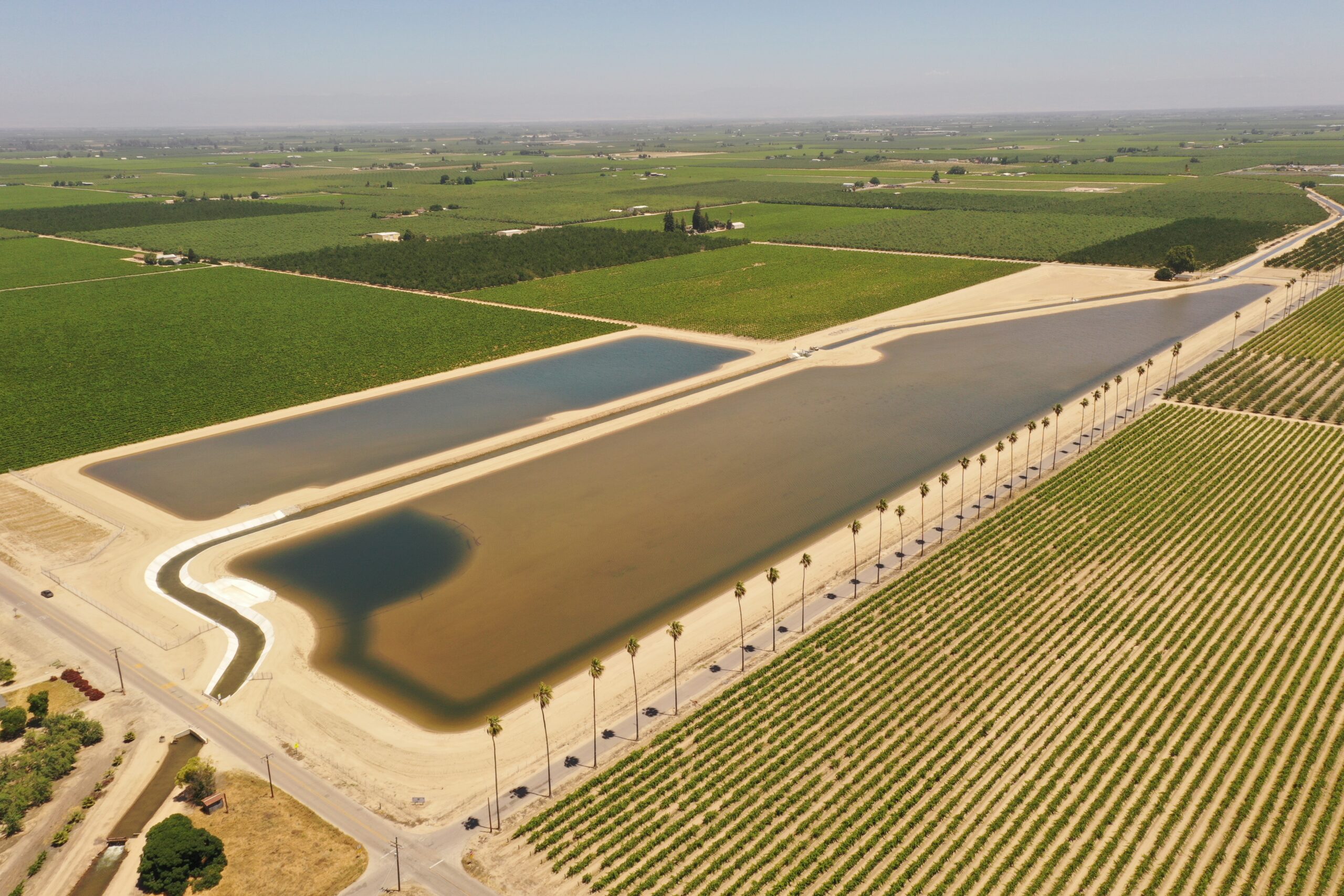
An aerial photograph shows a groundwater recharge basin completed within Fresno Irrigation District as part of the Upper Kings River Community Water and Climate Resiliency Program.
Multi-beneficial use describes the gold standard sought and attained by many ACWA member agency projects, and one currently taking shape in the Central Valley exemplifies the concept on several levels.
In a coordinated effort to secure water supplies amid sporadic drought conditions and groundwater declines, the Alta, Consolidated and Fresno irrigation districts launched the Upper Kings River Community Water and Climate Resiliency Program. The initiative, covering more than 650,000 acres, is designed to capture surface water in wet years and recharge critical groundwater supplies for use during dry periods — benefiting over 733,000 people in an area that also includes 79 disadvantaged communities potentially impacted by water quality and quantity challenges, including dry wells.
The program will create 3,300 acres of recharge basins across the region in two phases. Phase one, already underway, covers 1,800 acres at a projected cost of $180 million and is expected to provide 250,000 acre-feet of underground water storage. Phase two will add 1,500 acres of recharge basins at a cost of $150 million, delivering an additional 200,000 acre-feet of recharge capacity. Full buildout is expected over the next 10 years, said Kassy Chauhan, Special Projects Manager at Fresno Irrigation District and Executive Officer of the North Kings Groundwater Sustainability Agency.
“Groundwater has long been our lifeline, and this project is really about ensuring we capture every drop when it’s available,” Chauhan said. “By pooling resources across district lines, we’re creating a regional solution that goes far beyond what each district could do individually.”
The Sustainable Groundwater Management Act, or SGMA, acted as a catalyst for discussions between the three districts, which happen to be among the earliest ACWA members, with Alta Irrigation District being one of ACWA’s founders.
The collaborative effort is being led by Alta Irrigation District General Manager Chad Wegley, Consolidated Irrigation District General Manager Phil Desatoff and Fresno Irrigation District General Manager Bill Stretch. Talks started in 2021, during the thick of the pandemic, with district leaders connecting with each other about how to combine and scale up their existing conjunctive use and groundwater recharge efforts into a regional effort offering multiple benefits from the planned projects.
The ongoing work to carve out recharge basins is funded through a combination of local, state and federal grants, including SGMA implementation grants. Of course, groundwater recharge is nothing new in the Central Valley, where irrigation districts have practiced it for over a century. But this collaboration has become a classic example of a sum being greater than its parts and also maximizes optimal conditions within its area.
Desatoff described how sandy soil within his district was ideal for groundwater recharge using releases from Pine Flat Reservoir.
“We’re capable of putting hundreds of thousands of acre-feet in the ground per year,” Desatoff said, adding that the program allows them to accelerate existing recharge work.
During 2023, more than 500,000 acre-feet were recharged within the Kings Subbasin, which includes the Alta, Consolidated and Fresno irrigation districts.
The Upper Kings River Community Water and Climate Resiliency Program stands out for its size and scale within California. The exact number of similar groundwater projects in California is unknown, but the Department of Water Resources (DWR) review of groundwater sustainability plans and management actions indicate that more than 290 recharge projects are either in progress or planned within medium and high priority basins, according to DWR SGMA Technical Assistance Manager Steven Springhorn.
“However, many are smaller, individual projects — projects of this size, scale, and level of coordination are rare,” Springhorn stated by email, adding that “This project stands out among others not only in size, scale, and expected benefits for communities in the region, but also as an example of successful regional coordination and partnerships that maximize and enhance benefits to the subbasin.”
