
Yuba Water and Partners Formalize Landmark Yuba River Resilience Initiative
Yuba Water Agency, the California Department of Fish and Wildlife and NOAA Fisheries have formally signed the Yuba River Resilience Initiative. The landmark agreement, first announced in May 2023, is a comprehensive restoration plan for native fish in the Yuba River watershed that also safeguards water supplies for Yuba County farmers for decades.
“This is one of those rare situations where the fish, the environment and the farmers all win,” said Yuba Water General Manager Willie Whittlesey.
A key element of the agreement is a planned Nature-Like Fishway – a channel resembling a natural river – that salmon, steelhead, green and white sturgeon and Pacific lamprey can use to safely get around the U.S. Army Corps of Engineers’ Daguerre Point Dam to reach more than 10 miles of healthy spawning habitat in the lower Yuba River.
It also includes a modernized water diversion at the dam that will protect fish while ensuring irrigators continue to have access to surface water needed to maintain South Yuba County’s vibrant agricultural economy.
The partners plan to begin constructing the project in early 2026.
A second component of the Yuba River Resilience Initiative is a reintroduction program to support recovery efforts of spring-run Chinook salmon in the North Yuba River above New Bullards Bar Dam.
That effort is being led by CDFW and the initial implementation, started as a pilot project last year, is already showing early signs of success. More than 500 juvenile spring run chinook salmon have been counted in recent months following the injection of salmon eggs across a 12-mile stretch of gravel riverbed of the North Yuba River just east of Downieville.
“When we come together – local, state and federal government – and focus on how we can work together to find creative solutions that will work for all of us, we can really accomplish great things,” Whittlesey said.
The agreement includes an initial Yuba Water investment of $30 million for construction of the Nature-like Fishway, totaling more than $100 million over time for maintenance, as well as ongoing support of salmon reintroduction efforts. CDFW has also committed $30 million toward the effort.
CCWD Launches Campaign to Raise Awareness About the Contra Costa Canal
Contra Costa Water District (CCWD) has launched a new public awareness campaign to highlight the importance of the Contra Costa Canal and the need to plan for the replacement of its most critical and aging segments. The campaign, titled “Serving Today, Planning for Tomorrow,” is designed to educate the community on how this 80-year-old system supports water reliability for more than 520,000 people—and why proactive planning is essential.
The highlight of the campaign is a narrated two-minute video. Supporting materials include a mix of digital outreach, printed literature, paid advertising, and updated online resources to help residents and stakeholders understand the canal’s role and the challenges ahead.
Built in the 1930s and ’40s, the Contra Costa Canal delivers untreated water from the Delta to local water treatment plants, industrial users, and irrigation customers. It supplies 99% of CCWD’s total water deliveries. While the canal has served the region well for generations, its open, concrete-lined design now poses increasing challenges—from storm-related damage and debris to safety risks and water quality concerns.
“Reliable water is what has allowed our communities to grow, thrive, and succeed for generations,” said CCWD Board President and ACWA Vice President Ernesto Avila. “Our children and their children deserve the same: clean, dependable water that is safe and available whenever they turn on the tap.”
The Canal Replacement Program proposes replacing the Main Canal—from Rock Slough near Oakley to Clyde, just north of Concord—with a buried pipeline. This new configuration would be more resilient to extreme weather, easier to maintain, and better protected from contamination.
“We’re still in the early stages of project planning,” said General Manager Rachel Murphy. “Right now, we’re evaluating design options, environmental considerations, and funding strategies. The goal is to deliver long-term water reliability while minimizing impacts during construction.”
A key focus of the Serving Today, Planning for Tomorrow campaign is helping the public better understand what the canal is, why it matters, and the growing challenges of operating and maintaining the facility.
To learn more about the Contra Costa Canal, visit www.ccwater.com/Canal. Follow the campaign on social media with the hashtag #ServingTodayPlanningForTomorrow
About CCWD
Contra Costa Water District delivers safe, clean water to approximately 520,000 people in central and eastern Contra Costa County in Northern California. Formed in 1936 to provide water for irrigation and industry, we are now one of the largest urban water districts in California and a leader in drinking-water treatment technology and source water protection. As a public water agency, we are committed to transparency and sharing information about our public services with many and varied audiences.
Art Contest Highlights the Power of Water
MANTECA, CA – South San Joaquin Irrigation District’s (SSJID) recent “The Power of Water: Growing Our Future” art contest celebrated the creativity and water conservation commitment of local students in the San Joaquin Valley. Fifth grader Aubree B. from Ripon’s Colony Oak Elementary received the grand prize, while six other students were recognized. This is the second time in a row that Aubree has won.
Aubree’s artwork will become an SSJID service truck vehicle wrap for the 2025 water season, helping promote water messaging to our communities. The design showcases water nurturing our region and growing the future.
“Our trucks travel across our service area daily. They are ideal for sharing the powerful message of water in our community,” said General Manager Peter Rietkerk. “The Vehicle Wrap Art Contest is a wonderful way to engage our local youth in the critical role that water plays here.”
SSJID’s annual Vehicle Wrap Art Contest deepens students’ understanding of water’s impact on surrounding farms, cities, and businesses. The contest was open to first-through-fifth-grade students in Manteca, Ripon, and Escalon unified school districts.
This year’s winners are as follows:
Grand Prize
• Grand Prize: Audree B., Colony Oak Elementary, 5th Grade, Mr. Martin
First through Third Grade
• First place: Joshnika C., Nile Garden Elementary, 1st Grade, Mrs. Camacho
• Second place: Miya T. V., Great Valley Elementary, 2nd Grade, Ms. Sandoval
• Third place: Yatharth V., Joseph Widmer Elementary, 3rd Grade, Mr. Valles
Fourth and Fifth Grade
• First place: Agam S. L., Shasta Elementary, 4th Grade, Ms. Owsley
• Second place: Macy N., Colony Oak Elementary, 4th Grade, Mrs. Thomason
• Third place: Lasya P., Nile Garden Elementary, 5th Grade, Mrs. Morino
Winners will receive gift cards to recognize their creative efforts and dedication. Colony Oak Elementary School will also receive a $250 gift card to purchase art supplies for submitting the most entries.
To learn more about the Vehicle Wrap Art Contest and view the winning artwork, visit www.ssjid.gov/education/vehicle-wrap-art-contest.
About the South San Joaquin Irrigation District (SSJID)
South San Joaquin Irrigation District was established in 1909 and is headquartered in Manteca, CA. SSJID provides agricultural irrigation water to over 50,000 acres surrounding Escalon, Ripon, and Manteca, and wholesale drinking water to over 215,000 residents in Manteca, Lathrop, Tracy, and, in the future, Escalon. SSJID, along with Oakdale Irrigation District, owns and operates the Tri-Dam Project, a series of storage reservoirs and electric generation facilities that produce zero-carbon hydropower in the Stanislaus River watershed. Learn more at www.ssjid.gov or follow SSJID on Facebook (www.facebook.com/SSJIDofficial), Instagram (www.instagram.com/ssjidofficial), and LinkedIn (www.linkedin.com/company/ssjid).
WVWD Expands Water Conservation Programs and Adapts to Needs of the Community
Walnut – Walnut Valley Water District (WVWD) has prepared an addendum to its 2019-2024 Water Use Efficiency Strategic Plan, highlighting the districts customer-centered conservation efforts during the Plan period. The addendum reflects extensive research into customer needs and preferences, during and after, the COVID-19 pandemic, resulting in tailored programs that promote long-term water efficiency in our community. For example, WVWD expanded its conservation efforts by introducing several virtual resources such as:- Online Educational Workshops
- How-To Guides
- Virtual Indoor and Outdoor Water Use Survey Program
- New Customer Portal
- Instagram Live with Vector Control – Mosquito Bites
- “Did You Know” Social Media Series Collaboration with the City of Walnut
April 25, 2025 ACWA News Available
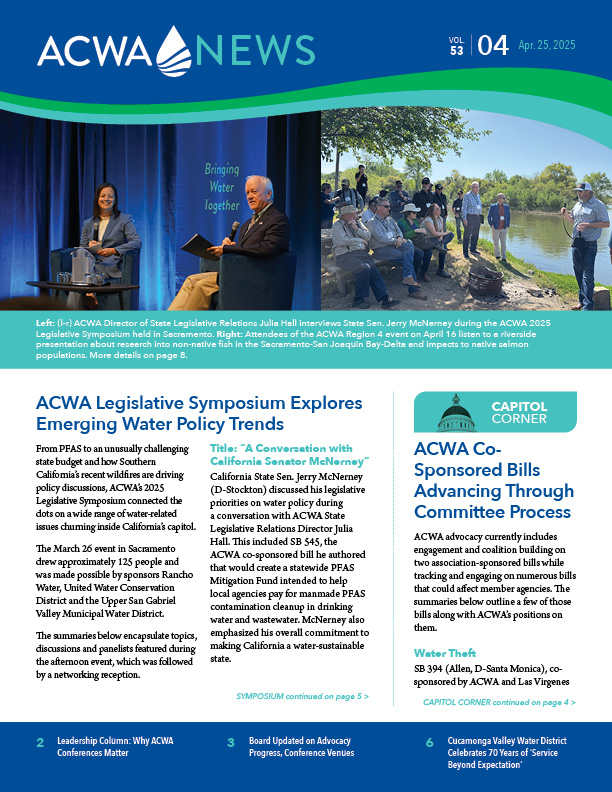 Read the April 25 edition of ACWA News for informative articles about the association and water industry.
Articles include:
- ACWA 2025 Legislative Symposium Highlights Trending Water Issues
- ACWA Interim Executive Director Shares Thoughts on ACWA Conferences
- Cucamonga Valley Water District Celebrates 70th Anniversary
- ACWA Distributes New Resources for Members
Why ACWA Conferences Matter
 What we do affects every single person in California because water is life. Few professions can capture their ultimate purpose with such clarity.
Contrast fulfilling that vital purpose against what it really takes: dozens of professional skill sets working within a vast array of water agencies serving a wide variety of purposes and communities. This spans agricultural water suppliers to urban agencies, wholesalers and retailers, all operating within a statewide system that ranges from organizations employing hundreds of workers in major urban centers to teams of two or three people serving tight-knit rural communities.
For California’s water industry, it all comes together twice a year during ACWA conferences.
Personally, one of so many reasons I look forward to ACWA conferences is being around people who get water, and by extension get me, and who share a passion for learning more about what we do and how to do it better. No matter what your role, an ACWA conference is for everyone within the water industry, regardless if you are new to the field, in the middle of your career or a seasoned water professional.
Next month’s ACWA Spring Conference & Expo in Monterey will be no different and it will be my 13th ACWA conference; however, I will be experiencing it for the first time from another perspective.
Seeing how the association works from the inside has given me a deep appreciation for the massive effort undertaken by ACWA staff to consistently make conferences successful, rewarding and highly informative events. Their work delivers on all fronts when it comes to what conference attendees value most — gaining information, making connections, enjoying networking, learning about innovations and continuing education opportunities.
That said, no organization on earth operates within a vacuum of flawless perfection. One of my priorities is transforming ACWA into a world class organization and elevating its position as a leading voice on state and federal water policy, as well as how we can provide the most valuable and relevant service to members.
Water will always be essential, and so will the ACWA community. Let’s keep learning from each other, growing together and shaping the future of water in California. I look forward to seeing you in Monterey.
Cucamonga Valley Water District Celebrates 70 Years of ‘Service Beyond Expectation’
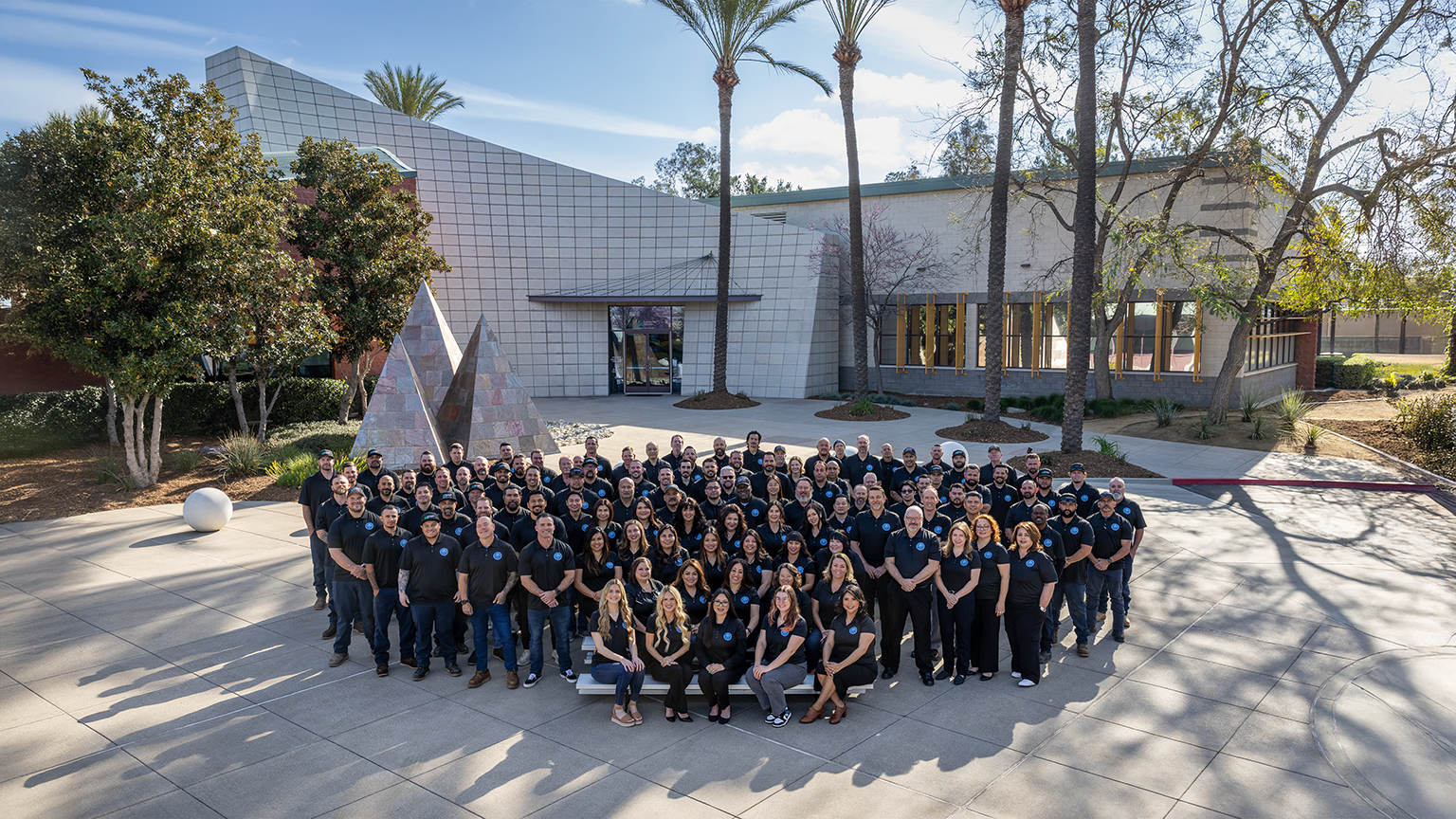
CVWD employees gather for a group photo as part of the district’s celebration of its 70th year in service. Photos courtesy of CVWD
- Local Groundwater: (52%): Sourced from 31 wells in the Chino and Cucamonga Basins.
- Imported Water: Delivered through the State Water Project and treated locally at the Lloyd W. Michael Water Treatment Plant before distribution.
- Local Surface Water: Collected from local canyons and tunnels along the San Gabriel Mountains.
- Recycled Water: (3%): Used for irrigation and industrial purposes in order to conserve CVWD’s potable water supply.

Call for Candidates Opens for ACWA President, Vice President, Region Boards
ACWA members interested in running for association President, Vice President or serving as a Region Board Member may submit necessary paperwork now through June 20. More information on how to become a candidate for the 2026-’27 elections is available online.
In addition, the election process for officers and region boards is now combined. Voting for both sets of candidates will be done electronically by each member agency’s designated voter on a single ballot. Agencies can designate their voting representative now by visiting acwa.com/elections and submitting the Authorized Representative and Information Form by the June 20 deadline.
To learn more about the election processes, including key dates, visit acwa.com/elections.
West Valley Water District’s New Video Series: Water. Service. Community.
RIALTO — West Valley Water District (WVWD) is proud to announce the launch of its new video series, “Water. Service. Community.”, offering an inside look at the people, infrastructure, and purpose driving its commitment to delivering high-quality and reliable water to our customers.
From critical pipeline projects to everyday field operations, this series spotlights the essential work that drives WVWD’s service to its communities and how the District is prioritizing education and community engagement.
“This series reflects the Board’s vision of putting people first—both our customers and the dedicated employees who serve them,” said President Greg Young, “We are proud to highlight our critical infrastructure investments and how we are building a more resilient water system.”
Each episode, released every Tuesday, will spotlight the team members, projects, community partners and values that drive WVWD’s mission—ensuring water delivery that is not only dependable but also cost-effective and sustainable.
“We’re not just delivering water—we’re delivering trust.”, said General Manager John Thiel, “As a purpose-driven organization, we hope this behind-the-scenes look at our operations, both out in the field and among the community, help our customers better understand the skill and commitment that ensure our systems run smoothly.”
New episodes premier every Tuesday on WVWD’s social media platforms and wvwd.org/ourcommitment. The “Water. Service. Community.” series aims to inform and educate the community on the importance of WVWD’s water service and recognize the hardworking team behind our mission.
# # #
The West Valley Water District has proudly served the Southern California communities of Bloomington, Colton, Fontana, Rialto, San Bernardino, and Jurupa Valley since 1952. Through name changes and consolidation, the mission has always remained the same: to provide customers with safe, high quality, and reliable water service at a reasonable rate and in a sustainable manner. The District provides water for over 100,000 customers and is overseen by a five-member, publicly elected Board of Directors.
Tahoe City Public Utility District Utilities Team Honored with Regional Awards
TAHOE CITY — Tahoe City Public Utility District (TCPUD) is proud to announce that it has been awarded the California Water Environment Association (CWEA) Small Collection System of the Year for the Sierra Section. This esteemed recognition highlights TCPUD’s unwavering commitment to maintaining a top-tier wastewater collection system that safeguards public health and protects the environment.
In addition to this organizational achievement, TCPUD Operations Technician, Bryan Dewit, was recognized as CWEA’s Electrical Instrumentation Person of the Year for the Sierra Section. Bryan’s expertise and dedication ensures that our wastewater systems function efficiently and reliably.
“These awards are a testament to the hard work, professionalism, and dedication of our Utilities teams,” said Judy Friedman, TCPUD Board President. “Operating and maintaining a wastewater collection system in a region as unique as Tahoe requires a high level of skill and commitment, and we are incredibly proud of our team’s efforts.”
TCPUD operates and maintains 150 miles of sewer pipe, more than 2,300 sewer manholes, and 21 lift stations to ensure the safe and efficient transport of wastewater to the treatment facility in Truckee.
By implementing industry-leading preventive maintenance, infrastructure renewal, and emergency response practices, TCPUD ensures the continuous protection of Lake Tahoe’s pristine waters and the well-being of our community. This around-the-clock service underscores TCPUD’s commitment to building a healthy mountain community.
The Tahoe City Public Utility District provides water, sewer, and recreation services within its service area. The District’s boundaries lie within Placer and El Dorado Counties, extending from Emerald Bay to Dollar Hill and along the Truckee River to the Nevada County line. For additional information, call Aaron Hussmann at 530.580.6291 or email at ahussmann@tcpud.org.