
Sweetwater Authority Continues Proactive Work Towards PFAS
CHULA VISTA – Sweetwater Authority (Authority) continues to work proactively to mitigate the per- and polyfluoroalkyl substances (PFAS) detected in Sweetwater Reservoir in late 2024.
In March, the Authority transferred approximately 8,000 acre-feet of water from its Loveland Reservoir to Sweetwater Reservoir to reduce PFAS levels.
“This transfer was highly successful and provided a meaningful reduction in PFAS levels at virtually no cost to the Authority or its ratepayers,” explained Sweetwater Authority General Manager Carlos Quintero. “PFAS levels are now below the response level and meet state and federal safety standards. While there is more work to do, this is a great short-term step in the right direction.”
A response level is a higher benchmark than a notification level and requires a water agency to take action.
The Authority also issued a Request for Qualifications (RFQ) in May 2025 for an engineering consultant to help address the PFAS issue. The consultant will assess data, explore treatment options, and estimate costs to help the Authority plan for long-term mitigation efforts in advance of federal EPA compliance deadlines. RFQ responses are due by June 9, 2025.
Because mitigation efforts will likely be expensive, the Authority is pursuing legal action against PFAS manufacturers responsible for creating the chemicals in the first place. It has settled with 3M, DuPont, Tyco and BASF and recently received notice that the Authority will soon receive 20% of the expected payout from 3M, which is $1.248 million, or a net of $957,000 after fees. The remainder of the 3M settlement will be paid out over the next eight years. The DuPont, Tyco and BASF settlement payments have not been finalized.
“Even with settlement monies, we have to consider how a multimillion-dollar treatment facility would be funded,” continued Quintero. “The cost is much higher than any legal payout we’ll receive.”
The Authority is also seeking highly competitive state and federal funding to help with this widespread issue, though there’s no guarantee of additional support.
Amid all these efforts, the EPA announced last week that it plans to develop a rulemaking to provide additional time for compliance, including a proposal to extend the compliance date to 2031. This would give water agencies more time to develop long-term remediation solutions related to PFAS.
It also announced plans to retain the National Primary Drinking Water Regulation (NPDWR) for PFOA and PFOS at four parts per trillion (ppt) individually, while rescinding and reconsidering the decision to individually regulate several other PFAS chains. The Department of Drinking Water, however, has indicated that California does not expect to deviate from the current PFAS proposed MCLs, or maximum contaminate levels.
“This latest deadline modification illustrates how complex and dynamic the PFAS issue is,” explained Quintero.
PFAS remediation is estimated at $200 billion in the United States alone, given the tremendous prevalence of this man-made chemical (Source: AECOM/Bank of America).
“Sweetwater Authority’s highest priority is the health and safety of our community,” said Quintero. “We are staying on top of this issue by closely monitoring our water supplies, acting swiftly when needed, and being transparent every step of the way.”
To that end, the Authority continues its public information campaign to keep rate payers informed. Since learning of PFAS in Sweetwater Reservoir, the Authority has held seven community meetings throughout the Authority’s service area and provided continuous communication with stakeholders via direct and social media.
The Authority has posted resources on its PFAS education webpage, including the latest data related to the Loveland transfer, and information related to limiting exposure through purchasing PFAS-free products. There’s also a guide to PFAS-free purchasing for organizations, as well as EPA resources for reducing PFAS risk and a guide to purchasing water filters.
The Authority will continue to provide updates to customers as additional testing is completed.
For more information, please visit www.sweetwater.org/PFAS, call the PFAS hotline at 619-409-6789 or email pfas@sweetwater.org.
Yuba Water Commits More Than $2.2 million for Local Projects
Yuba Water Agency today committed more than $2.2 million in grants for projects to improve levees and benefit water supply reliability in Yuba County.
Levee improvements
A grant for more than $1.1 million was approved for the Three Rivers Levee Improvement Authority to evaluate flood risk and deficiencies in the Horseshoe Basin levees, which are located within a rural area of Yuba County east of Plumas Lake. The funds will be used to assess the current condition of the levees and identify potential maintenance needed in the future. Yuba Water also approved a grant amendment for approximately $640,000 in additional funding for Reclamation District 2103 for further repairs to its approximately one-mile-long Grasshopper Slough levee near Wheatland. The agency previously provided RD 2103 $495,000 in 2021 to complete design and implement necessary repairs to the levee. However, due to environmental permitting delays, construction costs for the remaining work increased. These funds will allow the district to complete the project this year. “Reducing flood risk is our primary mission for good reason,” said Sami Nall, Yuba Water Agency’s flood risk reduction manager. “Anyone who remembers 1986 or 1997 knows that we simply cannot stop doing everything possible to reduce the likelihood of that ever happening again.”Water supply reliability
Yuba Water approved a 50 percent cost-share grant worth $370,113 for the Camptonville Community Services District for a new chlorine contact tank at its water treatment plant, which is a critical component used to provide safe and reliable water to residents in Camptonville. The current tank is inadequately sized and too old to update or repair. Yuba Water also approved an approximately $49,000 cost-share grant amendment for Cordua Irrigation District for further improvements to the district’s main canal, improving the reliability of water deliveries to Yuba County farmers and ranchers.Chief dam safety engineer reports Yuba Water’s dams are in ‘excellent shape’
Yuba Water’s Board of Directors also received an annual safety update from the agency’s Chief Dam Safety Engineer Tim Truong on the state of the agency’s dams, including New Bullards Bar Dam, the second tallest dam in California and the fifth tallest in the country. During the presentation, Truong outlined several recent dam safety improvement projects as well as several planned for the future. He shared findings from a rigorous third-party inspection of the dams and an audit of the agency’s Dam Safety program. The report found the agency meets or exceeds the highest dam safety standards and regulatory requirements set by the Federal Energy Regulatory Commission and the Department of Water Resources’ Division of Safety of Dams. Yuba Water owns and operates New Bullards Bar Dam, Log Cabin Dam and Our House Dam as part of the Yuba River Development Project, a multipurpose flood risk reduction, water supply, hydroelectric power generation and recreation project on the Yuba River. The agency also maintains Lake Francis Dam. Learn more at yubawater.org.East County Students Win College Scholarships from Helix Water District
Two east county students, Grossmont High School senior Ashley Beard and El Capitan High School senior Agostinho Soto-wang, received $1,000 college scholarships from Helix Water District on May 7, 2025. Both are exceptional students. Midway through their senior year, Beard had a 4.87 weighted grade point average and Soto-wang had a 4.91.
Beard plans to earn a degree in political science and go on to law school – a decision made after a senior year internship at a San Diego law firm showed her how legal advocacy can transform underserved communities.
Beard is an athlete: captain of her varsity softball, soccer and flag football teams, named 1st Team All-League in the CIF San Diego three times and honored twice as a Mission Fed Credit Union CIF San Diego Section Scholar Athlete.
Soto-wang plans to major in bioengineering and bioinformatics. When the COVID-19 pandemic closed schools, he developed an online gaming platform for housebound students and discovered he loves to code. He wants to pursue a career in biomedical research and use machine learning and data to demystify nutrition.
Soto-wang serves on the Student Senate at his high school and is captain of the cross-country team. He is also an AP Scholar with Distinction, president of the medical club and founder of the literature club.
Helix scholarships are $1,000. The Robert D. Friedgen Scholarship was established upon his retirement in 1998, after serving as the district’s general manager for 19 years. Friedgen provided the seed money and the board and others contributed additional funding. The Dr. Lillian M. Childs Scholarship was started by the Helix board in 1999 to honor Ms. Childs upon her retirement from the board and recognize the 20 years of service and leadership she had given to the district.
Applicants must live in the district’s service area, have excellent academic standing and excel in community service and extracurricular activities.
Helix Water District is a local government agency responsible for tap water in San Diego’s east county suburbs. The district’s regional water treatment plant serves 500,000 residents and the district distributes water to 278,000 residents in La Mesa, El Cajon, Lemon Grove, Spring Valley and other unincorporated areas.
Trump Administration Releases Fiscal Year 2026 Budget
WASHINGTON, D.C. — The Trump Administration on May 2 released a summary of its Fiscal Year 2026 budget proposal that recommends a decrease in discretionary and non-defense spending of an estimated $163 billion. Notably for ACWA members, the budget includes estimated cuts of $4.9 billion for the Environmental Protection Agency, $5.1 billion for the Department of Interior, $5 billion for the Department of Agriculture, and $1.7 billion for the Department of Commerce.
While the president’s budget serves as a funding blueprint, it is ultimately up to Congress to set funding levels and appropriate funds for federal programs. ACWA staff is working closely with partner organizations and allies on Capitol Hill to secure robust funding for water infrastructure.
Specific budget proposals include the following:
U.S. Environmental Protection Agency
- Decrease of $2.4 billion for the Clean and Drinking Water State Revolving Fund (SRF), which offers low-cost financing for water quality projects. SRFs are the largest source of federal funds for drinking water utilities, sewage treatment plants, and other infrastructure like water pipes.
- Decrease of $254 million for the Superfund program, which is tasked with cleaning up contaminated areas and responding to emergencies. Informally called Superfund, the Comprehensive Environmental Response, Compensation, and Liability Act (CERCLA) helps protect exposure to per- and polyfluoroalkyl substances (PFAS).
U.S. Department of the Interior (DOI)
- Decrease of $609 million to the Bureau of Reclamation for restoration projects.
- Decrease of $564 million for U.S. Geological Survey (USGS) programs relating to surveys, investigations, and research. These USGS programs provide science information on natural hazards, ecosystems, water, energy and mineral resources.
- Decrease of $198 million for Bureau of Land Management Conservation Programs, including the Wildlife and Aquatic Habitat Management program that helps conserves and improve aquatic ecosystems and land-based wildlife habitats.
- Consolidation of U.S. Department of Agriculture and DOI wildfire fighting strategies including wildfire suppression response, risk mitigation efforts, and coordination with non-Federal partners to combat the wildfire crisis. Specifically, this seeks to consolidate the Federal wildland fire responsibilities into a single new Federal Wildland Fire Service at DOI, including transferring USDA’s current wildland fire management responsibilities.
U.S. Department of Agriculture
- Decrease of $721 million for the Rural Development Programs, which provides loans to low-income communities to plan and develop infrastructure projects regarding aging rural water and wastewater systems.
- Decrease of $391 million for Forest Service Operations, which provides policy, oversight, and operational support over the management of million acres of public land encompassing national forests and grasslands.
- Decrease of $754 million for the Natural Resource Conservation Service (NRCS) Private Lands Conservation Operations, which provides conservation technical assistance to comply with State environmental regulations; this includes California’s Irrigated Lands Regulatory Program, which regulates agricultural runoff. Additionally, this proposal calls for a decrease of $16 million for the NRCS Watershed Operations, which provides assistance to implement conservation practices that address watershed resource concerns such as renovating locally owned dams and installing flood control measures.
U.S. Department of Commerce
- Decrease of $1.5 billion for the National Oceanic and Atmospheric Administration (NOAA), including $209 million for projects pertaining to weather satellites and infrastructure that relate to climate-measurement instruments.
U.S. Army Corps of Engineers
- Decrease of $1 billion for the Harbor Maintenance Trust Fund Surplus, which finances operation and maintenance projects for ports and harbors nationwide.
- Decrease of $7 million to eliminate the Water Infrastructure Finance and Innovation Act program, which provides low-cost, long-term loans for non-Federal water infrastructure projects such as dam safety.
U.S. Department of Homeland Security
- Decrease of $646 million for Federal Emergency Management Agency’s (FEMA) Non-Disaster Grant Programs, which provide assistance to submit applications and review and accept awards, among other things, to help prevent, respond to, and recover from various emergencies.
- Decrease of $491 million for Cybersecurity and Infrastructure Security Agency, which identifies and manages risk to the cyber and physical infrastructure. This includes water and wastewater systems that provide critical services like drinking water, fire suppression, and sanitation.
For more information on the Trump Administration’s budget proposal and the appropriations process, please contact ACWA Federal Relations Director Ian Lyle at ianl@acwa.com.
Otay Water District Awarded Transparency Certificate of Excellence
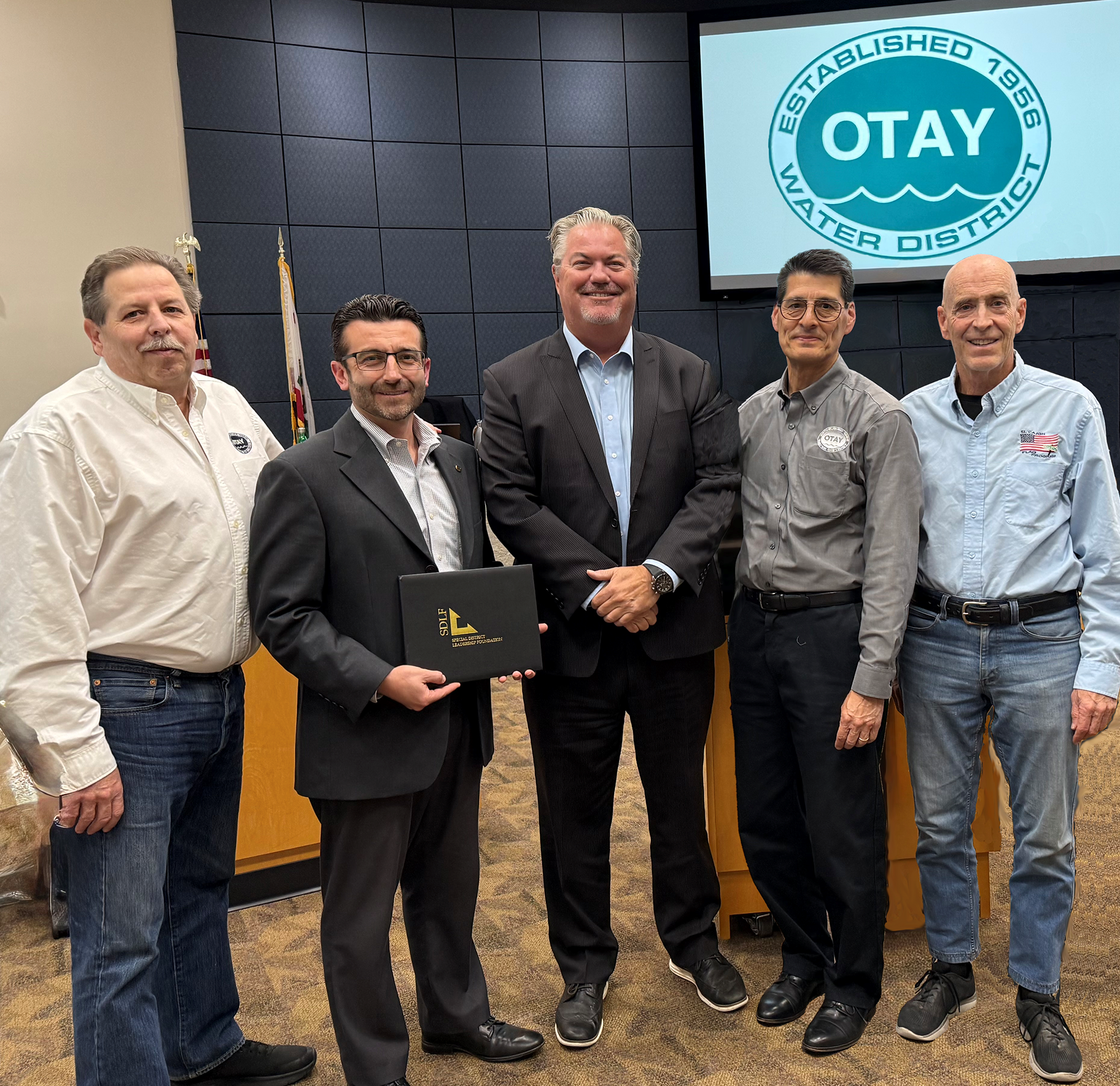
The Otay Water District received the District Transparency Certificate of Excellence from the California Special District Association’s Special District Leadership Foundation at an Otay board meeting (L to R): Gary Croucher, Otay Board Director; Jose Martinez, Otay General Manager; Chris Palmer, CSDA Senior Public Affairs Field Coordinator; Francisco Rivera, Otay Board Director; and Mark Robak, Otay Board Director.
The Otay Water District received the District Transparency Certificate of Excellence from the Special District Leadership Foundation (SDLF) in recognition of its outstanding efforts to promote transparency and good governance and reaffirm its commitment to openness and accessibility for its constituents and local stakeholders.
“This award reflects the Otay Water District’s dedication to open government,” said Board President Jose Lopez. “I commend our staff for empowering the public with information and encouraging engagement and oversight.”
To receive the award, the District demonstrated that it had completed essential governance transparency requirements, including ethics and harassment prevention training for all board members and staff, properly holding open and public meetings, promptly filing financial and compensation reports with the State Controller, and fulfilling other key transparency practices.
SDLF also notified the legislators representing the District’s service area about the achievement. Assemblymembers Marie Waldron, David Alvarez, Akilah Weber, and Senators Steve Padilla and Brian Jones received letters commending the District for its open and transparent practices and recognizing it as a model of best practices for California agencies.
SDLF is an independent, nonprofit organization that promotes good governance and best practices among California’s special districts through certification, accreditation, and other recognition programs. For more about SDLF, visit www.sdlf.org.
Special districts are independent public agencies that deliver core local services to communities, such as utilities, wastewater treatment, fire protection, parks and recreation, healthcare, sanitation, mosquito abatement, ports, libraries, public cemeteries, and more.
The Otay Water District is a public agency providing water, recycled water, and sewer service to approximately 238,008 customers within approximately 125 square miles of southeastern San Diego County, including the communities of eastern Chula Vista, Bonita, Jamul, Spring Valley, Rancho San Diego, unincorporated areas of El Cajon and La Mesa, and east Otay Mesa along the international border with Mexico. For more information about the Otay Water District, visit otaywater.gov.
WVWD Honors Public Safety and Student Creativity for Water Awareness Month
WALNUT – Walnut Valley Water District (WVWD) marked the start of Water Awareness Month with two exciting events held at the Diamond Bar Center on Tuesday, May 6: the annual Community and Public Safety Appreciation Luncheon, followed by the Student Recognition Awards Ceremony.
Observed each May, Water Awareness Month highlights the importance of water conservation and the essential role water plays in sustaining our communities and the environment. In recognition of this effort, the City of Diamond Bar and City of Walnut issued official proclamations declaring May as Water Awareness Month.
WVWD opened the day with the Community and Public Safety Appreciation Luncheon, honoring the Los Angeles County Fire Department, Los Angeles County Sheriff’s Department, elected officials, city staff, community partners, and District staff for their dedication to public safety and water sustainability. Guests enjoyed fresh meals served onsite by the Habit Burger & Grill food truck, while tables were beautifully decorated with centerpieces crafted by Pantera Elementary School students, serving as a special tribute to our public safety heroes.
The afternoon spotlight shifted to local students and teachers as WVWD celebrated their creativity and commitment to water conservation. Nearly 600 students across three local school districts participated in the “Being Water Wise Is…” Art Poster Contest and the High School Media Contest. This year’s media theme, “Small Changes, Big Impact! Make Every Drop Count,” challenged students to creatively promote the value of everyday water-saving actions.
The excitement soared with the announcement of the Community Favorite Award, drawing over 5,000 total votes from community members at WVWD’s Earth Day Block Party and online. The award was presented to the student whose artwork captured the most support. As a special recognition, each winner was given custom stickers featuring their artwork, offering a fun and personal keepsake ideal for decorating water bottles or sharing with friends.
“We are proud to host these events each year as part of an exciting tradition that brings our community together,” said Sheryl Shaw, WVWD General Manager. “Water Awareness Month is a special time to recognize the importance of water and celebrate the people who help protect and preserve it.”
To to explore the winning student artwork and videos, visit the school programs page on our website at walnutvalleywater.gov.
ACWA Honors Calleguas and LVMWD for Innovative Interconnection
MONTEREY – The Association of California Water Agencies (ACWA) today presented the prestigious Clair A. Hill Water Agency Award for Excellence to Calleguas Municipal Water District (Calleguas) and Las Virgenes Municipal Water District (LVMWD) for their innovative interconnection that enhances reliability and resilience. The Calleguas-LVMWD Interconnection allows each agency to better serve its customers by providing an additional source of potable water to improve reliability and flexibility, enhancing the ability to meet demands during periods of reduced imported water supply and reducing the risk for potential water shortages associated with natural disasters. “The Calleguas-LVMWD Interconnection is a creative and necessary example of local water districts working together to provide an alternative path for water delivery, enhancing water reliability and resilience.” said ACWA President Cathy Green. ACWA’s Clair A. Hill Water Agency Award for Excellence is an annual award program that recognizes outstanding achievements by public water agencies. The winning agency has the honor of helping select a deserving student for a $5,000 scholarship sponsored by Jacobs in the name of Clair A. Hill, founder of Jacobs. The award was presented during ACWA’s 2025 Spring Conference and Expo in Monterey where approximately 1,500 water industry professionals in California gathered for programs and panel discussions on a variety of key water issues. The other finalists for this year’s award were:- Orchard Dale Water District for its Miller Reservoir Hazard Mitigation Project
- San Bernardino Valley Water Conservation District for its Groundwater Recharge Modeling
- Santa Margarita Water District for its Trampas Canyon Reservoir
Five California College Students Awarded ACWA Scholarships
MONTEREY – The Association of California Water Agencies (ACWA) has awarded $24,500 in scholarships to five undergraduate college students pursuing degrees in water-related fields of study. “ACWA and its partners are proud to continue to support and foster California’s next generation of water leaders through these scholarship programs,” said ACWA President Cathy Green. “The recipients this year are exceptional students, and we look forward to following their educational and career achievements in the years ahead.” The students were recognized today during ACWA’s 2025 Spring Conference and Expo in Monterey. The students and the 2025-’26 scholarship programs for which they were awarded are: ACWA Scholarship ($3,500)- Amelia Flores, an environmental policy analysis and planning student at University of California, Davis
- Kirsten Larson, an agricultural education student at California State University, Fresno
- Peter Otoshi, a civil engineering student at Cal Poly Pomona
- Jade Meichtry, a bioresource and agricultural engineering student at Cal Poly San Luis Obispo
- Christina Huang, a soon to be civil engineering and environmental engineering student at University of California, Berkeley
Rowland Water District Launches New and Improved Website
ROWLAND HEIGHTS — A redesigned website is now live, offering a faster, simpler way for Rowland Water District (RWD) customers to access water service tools, pay bills, report issues, and stay informed about their local water system.
“We wanted the new website to reflect the way people actually use digital tools in their daily lives – on the go, on their phones, and on their own time,” said Brittnie Gildea, Marketing & Social Media Coordinator. “Whether you are a longtime customer or new to the area, the site is designed to make every interaction simpler and more accessible.”
The refreshed site is available at www.rwd.org and introduces several customer-focused upgrades, including a user-friendly platform, simple one-click payment options, a chat box for questions and information, and improved accessibility with ADA compliance and multi-language support. These tools were developed to ensure all customers regardless of ability or language can easily engage with RWD’s services.
Enhanced navigation and improved search functions help users quickly find what they need, from water education programs and water rates to board meeting agendas and service alerts. New pages also feature community-focused content and resources which support learning, engagement, and outreach.
At the same time, customers will continue to find all the essential information they rely on, including annual water quality reports, long-term strategic plans, and district-wide education efforts. These foundational resources remain a key part of the website and central to its purpose.
“Our goal was to create a more intuitive, user-friendly experience for our customers,” said Tom Coleman, RWD General Manager. “This new site is consistent with one of our core values, to be as welcoming as possible, and reflects our ongoing commitment to service, transparency, and making things easier for the communities we serve.”
Customers are encouraged to explore the new site and share feedback as RWD continues to enhance its digital services.
Visit www.RWD.org for more information.
ACWA Presents Leadership Award to Wes Monier
MONTEREY – The Association of California Water Agencies (ACWA) today presented its 2025 Excellence in Water Leadership Award to Wes Monier, recently retired Chief Hydrologist for Turlock Irrigation District (TID), for his commitment to water resource issues, especially in utilizing advanced technologies in water management practices.
Monier’s focus on partnerships with public, private and educational institutions gave TID access to technologies that have allowed the district to adapt to greater variability by optimizing the operations of its facilities. For example, TID utilizes data garnered through the Airborne Snow Observatory (ASO) program to remove uncertainty and conjecture regarding how fast snow is melting and when and how much runoff enters reservoirs. Because of Monier’s resourcefulness, TID was the first irrigation district to utilize the data. Monier also began incorporating Forecast-Informed Reservoir Operations (FIRO) technology into TID’s water operations. Combining ASO and FIRO data, Wes and his team developed TID’s Hydrocomp Forecast and Analysis Model, which is one of the only hourly and physically-based hydrologic models used for water operations in California.
“Wes has demonstrated remarkable collaboration throughout his career that has resulted in partnerships with wonderful organizations such as NASA and Scripps Institution of Oceanography,” said ACWA President Cathy Green. “The technology and models Wes and his team were able to develop in partnership with these organizations provide TID with insight into the current and future state of its reservoirs to inform water operation decisions on both a short- and long-term basis.”
The Excellence in Water Leadership Award, Building a World of Difference®, recognizes individuals who have made a remarkable and visible contribution to California water. The award, sponsored by Black & Veatch Corporation, was presented during ACWA’s 2025 Spring Conference & Expo in Monterey where approximately 1,500 water industry professionals in California are attending programs and panel discussions on a variety of key water issues.
For more information about ACWA’s awards programs, please visit www.acwa.com/awards.