
Nationwide Search Underway for New ACWA Executive Director
SACRAMENTO — The ACWA Board of Directors has selected the human resources and executive search firm of WBCP to lead a nationwide recruitment process for hiring an Executive Director to lead the association’s day-to-day management.
The Board launched a recruitment effort in January following the departure of former ACWA Executive Director Dave Eggerton, naming Marwan Khalifa as Interim Executive Director. Khalifa previously worked as Chief Financial Officer and District Treasurer for Mesa Water District, also serving on the ACWA Board, Executive Committee and as Chair of ACWA’s Finance Committee.
Khalifa will be considered among any candidates for Executive Director. ACWA President Cathy Green formed a 10-member committee to oversee the recruitment process, and the committee expects to have a new Executive Director in place by fall.
“Finding the right Executive Director to take this association to the next level is a critical decision that I don’t take lightly,” Green said. “The ACWA Board of Directors is eager to get someone in that critical position, but we also want to take the time to make sure it’s the right person with the qualities and qualifications this association needs.”
WBCP is based in Rogue River, Oregon and also has offices in California, Washington and Texas.
Citrus Heights Water District Recognizes Young Artists
The Citrus Heights Water District (CHWD) is proud to announce the winners of its annual Water Awareness Poster Contest, which featured the theme “The Traveling Water Droplet.” CHWD and three of the neighboring water agencies hold an annual poster contest to promote water awareness. Students from four local schools submitted 273 colorful and imaginative entries, each capturing the remarkable voyage water takes through our environment. From clouds to faucets, the creativity displayed by these young artists impressed judges and community members alike. Congratulations to the winners within the Citrus Heights Water District service area:- Winner: Lyra Rutherford, 6th Grade, Mrs. Slayton, Woodside K-8
- Runner-Up: Liliana Hodges, 5th Grade, Ms. Weston, Trajan Elementary School
- Runner-Up: Sophia Richards, 4th Grade, Mrs. Blake, Trajan Elementary School
Bureau Announces Additional CVP Allocation Increases
SACRAMENTO – The Bureau of Reclamation this week announced further increases in water supply allocations for Central Valley Project contractors south of the Sacramento-San Joaquin Bay-Delta.
While all north-of-Delta Central Valley Project contractors are currently at 100% of their supplies, south-of-Delta irrigation water service and repayment contractors are increased to 55% from 50%, and municipal and industrial water service and repayment contractors are increased to 80% from 75% of their historical use, or public health and safety needs, whichever is greater.
“As California’s primary precipitation season concludes, we now have greater certainty about water availability for the remainder of the water year,” stated Acting California-Great Basin Regional Director Adam Nickels in a Bureau news release. “This allows us to responsibly adjust Central Valley Project allocations to better meet the needs of our water users while continuing to support environmental requirements.”
Westlands Water District General Manager Allison Febbo described the increase from 50% to 55% as “disappointing” in a district news release.
“While an increase is appropriate, given current reservoir levels and snowpack, a 5 % increase is disappointing and highlights a critical reality: even in average hydrological years, California’s outdated water system falls short of delivering the water our communities require. As a state, we are failing the family farms and rural communities in the San Joaquin Valley that depend on CVP water to grow food, provide jobs, and sustain the economy. We can and must do better,” Febbo stated, in calling for modernized water infrastructure.
ACWA Urging Members to Join Coalition Opposing AB 1146
ACWA is urging members to join a coalition opposing AB 1146 (Papan), which would give the State Water Resources Control Board unprecedented regulatory enforcement authority for a single, vague cause of action.
Specifically, the bill would prohibit the release of stored water from a reservoir if the release is done under false pretenses. It would also authorize the State Water Board- absent a hearing or due process – to determine whether an operator violated the law and require the operator to immediately comply with its order under a new “interim relief” authority.
ACWA’s State Legislative Committee noted several concerns with the bill and adopted an oppose position. ACWA staff is coordinating with coalition leader California Chamber of Commerce and other organizations in opposition to the bill. Join the coalition by completing an online form.
More information about the bill and a link to join the coalition are available in a Legislative Alert, which was distributed May 28.
WVWD Awards $3,000 in Scholarships to Local Students
RIALTO – The West Valley Water District (WVWD) Board of Directors was proud to present three $1,000 scholarships to local High School seniors to recognize them on their submissions to the District’s annual scholarship contest. Applicants were asked to submit a written or video essay in response to the prompt, “Imagine a Day Without Water.” The prompt encouraged students to reflect on the essential role that water plays in their everyday life and the impact that would fall on them and their communities if they ever faced a day without water. “On behalf of the board, I want to congratulate these students on their success in this contest and on their upcoming graduations,” said WVWD Board President Greg Young. “Their responses to the prompt are a testament to our next generation’s commitment to sustainability and deep understanding of the importance of water conservation.” West Valley Water District offers up to five $1,000 scholarships annually to seniors who live or go to school in West Valley Water District’s service area with a 2.5 gpa or higher and who planned to attend a two-year, four-year or vocational trade school within the next school year. 2025 Scholarship Recipients include:- Alan Chiquete, Bloomington High School
- Nadia Moran Garcia, Bloomington High School
- Jasmin Estrella, Eisenhower High School
# # #
The West Valley Water District has proudly served the Southern California communities of Bloomington, Colton, Fontana, Rialto, San Bernardino, and Jurupa Valley since 1952. Through name changes and consolidation, the mission has always remained the same: to provide customers with safe, high quality, and reliable water service at a reasonable rate and in a sustainable manner. The District provides water for over 100,000 customers and is overseen by a five-member, publicly elected Board of Directors.Kings Subbasin Stays the Course After a Normal Water Year
The Kings Subbasin is not hitting the brakes after a near-average Water Year 2024. Building on the momentum of the historic 2023 water year, Kings Subbasin groundwater agencies remain committed to driving long-term sustainability under the Sustainable Groundwater Management Act (SGMA) through local action and coordination. According to the most recent Annual Report, Water Year 2024 (October 1, 2023 to September 30, 2024) brought slightly above-average surface water diversions, reaching approximately 108% of the Kings River’s long-term average. Though not as abundant as the year before, 2024 was classified as a near-average year in terms of water availability. This marked a return to more typical conditions after 2023’s wet year.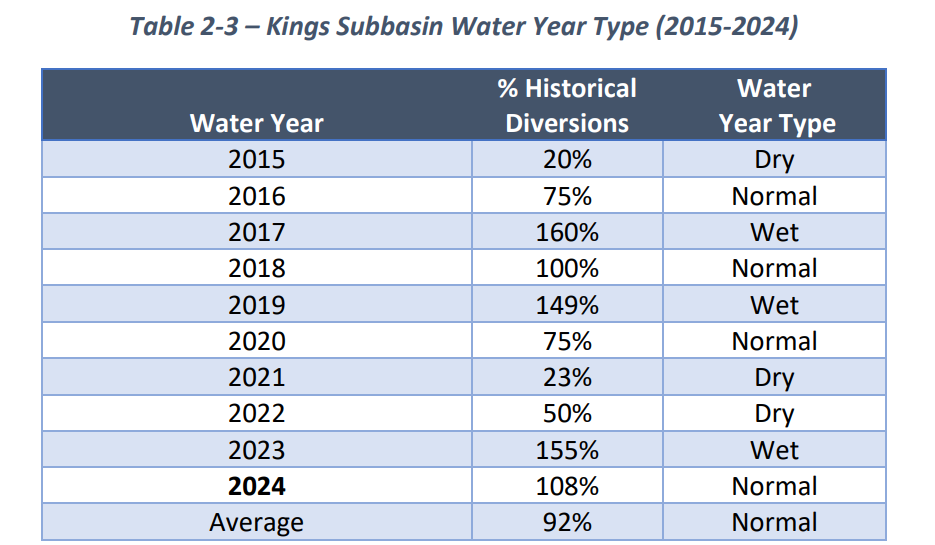
GSP Update and Periodic Evaluation Efforts
Besides building projects, the Kings Subbasin focused on administrative work over the last year. The group updated their respective GSPs and jointly prepared the first 5-year periodic evaluation. The documents were submitted to the Department of Water Resources (DWR) in January 2025. The GSPs were updated to maintain the plans’ approval status, the fundamental requirement to keep local control over SGMA implementation, by addressing State requested “corrective actions”.Recharge Projects Across the Subbasin
Beyond planning, reporting, and studies, the Kings Subbasin has invested considerable effort into building new infrastructure projects to increase surface water capture and recharge capacity since first submitting their GSPs in 2020. And the agencies are getting creative to expand their recharge capabilities. The North Fork Kings GSA broke ground on the Elkhorn Groundwater Banking Project, partnering with Fresno County to transform what was previously a juvenile detention site into a law enforcement training facility, with a portion of the land reserved for a dedicated recharge basin.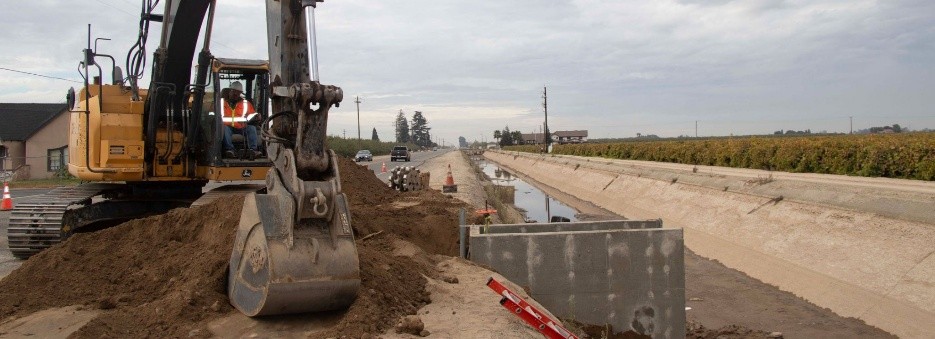
EMWD Recognized for Community Partnerships to Advance Water Sustainability
PERRIS – For many years, Eastern Municipal Water District (EMWD) heard a familiar refrain from large landscape customers in the French Valley area: We really wish we could use recycled water instead of potable water.
There was just one problem: French Valley’s infrastructure hadn’t kept pace with its rapid and uneven growth over the past two decades.
Thankfully, EMWD had a solution – and just as importantly, it had partners equally committed to bringing a sustainable water supply source to the area’s parks, schools, and streetscapes.
EMWD was recognized this week with the One Water Award by The Metropolitan Water District of Southern California (Metropolitan) for its efforts to expand recycled water service in French Valley. It was one of four organizations across Metropolitan’s 5,500-square mile service area who were honored for their commitment to water saving projects that showcased technological innovation, environmental stewardship, and sustainability. EMWD was honored in the collaboration category.
The French Valley Recycle Water Project was an EMWD-led partnership that also included Temecula Valley Unified School District (TVUSD), Valley-Wide Recreation and Park District (Valley-Wide), and Metropolitan. The French Valley area was historically unable to benefit from recycled water use for public landscaping because of a lack of available service, gaps in infrastructure, and existing development.
To resolve the issue, EMWD constructed a new recycled water pump station, storage tank, and 8,400 linear feet of pipeline as part of its Recycled Water Stabilization Program. It also advanced the French Valley Distribution Expansion Project, which added another 14,000 feet of pipeline. The development community installed another 12,000 feet of recycled water pipeline when newer areas of the community were under construction.
TVUSD and Valley-Wide requested assistance with the up-front capital investment needed to retrofit existing sites from potable to recycled water. EMWD provided the funding through its Recycled Water Accelerated Retrofit Program, which is reimbursed through a specialized rate that is above the normal price for recycled water but below the cost of potable water.
Metropolitan provided funding to help retrofit existing landscapes to recycled water, replace 114,000 square feet of nonfunctional turf with climate-appropriate landscaping, and for the installation of new irrigation controllers. The project offset the potable water use equivalent to 1,700 residences per year and delivered immediate cost-savings to the partner agencies.
“EMWD and our partners want to thank Metropolitan for this incredible honor,” EMWD Board President Stephen Corona said. “This project was not just about saving water, but about the power of multiple agencies working together to benefit a community.”
The project was honored earlier this year by the WateReuse Association with its Award for Excellence. Other recipients of the 2025 One Water Award are Vallecitos Water District (Environmental Impact), the Housing Authority of Los Angeles (Community Responsibility), and the American Legion Hollywood Post 43 (Leadership).
# # #
Eastern Municipal Water District is the water, wastewater service and recycled water provider to nearly one million people living and working within a 682-square mile service area in western Riverside County and northern San Diego County. It is California’s sixth-largest retail water agency, and its mission is “To deliver value to our diverse customers and the communities we serve by providing safe, reliable, economical and environmentally sustainable water, wastewater and recycled water services.” More information can be found at www.emwd.org.
Helix Water District Student Poster Contest Winners Highlight What “Being Water Wise Is”
Helix Water District honored local student artists for their winning posters showcasing what “Being Water Wise Is” at an awards ceremony during the district’s board meeting on May 21, 2025.
Each year, Metropolitan Water District of Southern California, one of Helix’s wholesale water providers, holds a regional poster contest to increase student awareness about water.
Helix promotes the contest to all K-12 schools within its service area. This year, 221 students from 20 schools submitted posters depicting how to use water wisely. The following students took top honors:
Grades K – 4 Category:
First Place – Avery Strong, Christ Lutheran School, Grade 3
Second Place – Cruz Kingdon, Christ Lutheran School, Grade 3
Third Place – Sarah Ali, Madison Avenue Elementary, Grade 3
Honorable Mention – Francesca Lieber, Christ Lutheran School, Grade 3
Honorable Mention – Taylin Siemienczuk, St. Martin of Tours Academy, Grade 3
Grades 5 – 8 Category:
First Place – Emma Phillips, Christ Lutheran School, Grade 8
Second Place – Caylao Baron, Christ Lutheran School, Grade 8
Third Place – Asma Noori, Anza Elementary School, Grade 5
Honorable Mention – Holly Woodward, Flying Hills School of the Arts, Grade 5
Honorable Mention – Collin Bolduc, Flether Hills Elementary, Grade 5
Grades 9 – 12 Category:
First Place – Catalina Jones, Helix Charter High School, Grade 9
Helix will forward the winning posters to the Metropolitan Water District of Southern California for consideration for their 2026 “Being Water Wise Is” calendar. The winning posters are also posted on the district’s website at https://hwd.com and Facebook page at https://www.facebook.com/helixwater.
Helix Water District provides water treatment and distribution for 278,000 people in the cities of El Cajon, La Mesa and Lemon Grove, the community of Spring Valley and areas of Lakeside. Helix also provides treated water to neighboring Padre Dam, Otay and Lakeside water districts.
El Dorado Irrigation District Welcomes New General Manager Pravani Vandeyar
PLACERVILLE — The El Dorado Irrigation District (EID) Board of Directors is pleased to announce the appointment of Pravani Vandeyar as the District’s new general manager. Her selection follows a highly competitive national recruitment process that attracted more than 90 candidates.
Ms. Vandeyar brings nearly 20 years of experience in the water utility sector, with a strong record of operational leadership, regulatory compliance, and customer-focused service delivery. She most recently served as the Utilities Director for the City of Sacramento, where she led major initiatives to modernize infrastructure and enhance water system reliability.
She began her career with the City of Sacramento in 2007 as a supervising water quality chemist and later advanced to the role of Drinking Water Division Manager. In that role, she oversaw water production, maintenance, distribution, water quality, and research and development. Ms. Vandeyar holds both a Bachelor of Science and a Master of Science in chemistry, bringing a solid technical foundation to her leadership role.
“Pravani brings a powerful combination of technical expertise, utility management experience, and vision to EID,” said Board President Pat Dwyer. “We are confident that she will provide the leadership and strategic direction needed to guide the District into its next chapter.”
This leadership transition follows the retirement of General Manager Jim Abercrombie, who concludes a distinguished public service career spanning nearly 48 years. Mr. Abercrombie has served as EID’s General Manager since 2009, during which time he led major infrastructure investments, reduced costs, improved operational efficiencies, expanded customer outreach, and strengthened the District’s long-term water reliability. He will remain available through September, if needed, to support a smooth transition.
###
EID is a public agency dedicated to providing high quality water, wastewater treatment, recycled water, hydropower, and recreation services in an environmentally and fiscally responsible manner.
Water Meters Upgrades Boost Accuracy and Customer Control
BEAUMONT — Beaumont-Cherry Valley Water District (BCVWD) is nearing completion of its Automated Meter Reading (AMR) and Advanced Metering Infrastructure (AMI) project, effectively modernizing its water management systems. While substantial progress has been made, BCVWD is moving forward with additional enhancements to further improve service.
Plans include the potential installation of more Advanced Metering Infrastructure (AMI) stations to expand coverage and ongoing efforts to streamline the billing process by leveraging newly available data. The District’s IT team is also developing a customer-facing application that will allow real-time water usage monitoring and personalized alert settings, giving customers more control and insight into their water consumption.
“This capital improvement project represents a major step forward for our District and the community,” said Director Andy Ramirez. “The grant funding, combined with the hard work of our staff and the cooperation of the Bureau of Reclamation, allowed us to deliver this essential upgrade while staying on budget and improving our water system’s reliability.”
Since its launch in 2015, the AMR/AMI project has successfully replaced over 21,800 water meters, transitioning from manual to advanced smart metering technology. Between 2015 and 2019, BCVWD installed 4,957 smart meters.
After receiving a $1.5 million grant from the Bureau of Reclamation (BOR) in 2019, the District ordered the meters and materials needed to complete the project within three years. However, when COVID-19 emerged in 2020, the pandemic caused severe supply chain disruptions, delaying deliveries and installations. Some items were on back order for over a year.
Despite these challenges, the District converted newer meters to be AMR/AMI compatible during this time, and with guidance and flexibility from the BOR—who approved extension requests for the project twice—BCVWD completed the installation of all devices in early 2024. By spreading the project out over a longer period, the District was able to rely on staff to perform much of the work initially planned for contractors, resulting in substantial cost savings. Originally estimated at $5.7 million, the total project cost is now approximately $4.1 million before the grant reduction.
The District has already seen remarkable benefits from the project. Over time, traditional water meters tend to lose accuracy, often underreporting water usage. With new, precise meters and concurrent pipeline replacement efforts, BCVWD has reduced water losses from approximately 10% to just 5%. This improvement allows the District to plan for the community’s long-term water needs more accurately.
“This system not only empowers our customers but also enhances how we manage water resources for our community,” said BCVWD Board Director Lona Williams. “The District is proud of the progress we’ve made and looks forward to continuing to optimize and expand the benefits of AMI technology.”
The AMI system’s advanced capabilities include frequent, high-resolution data readings and remote management. Once fully optimized, customers will enjoy:
· Real-time water usage monitoring
· Customized consumption alerts
· Tools to estimate and manage bills more accurately For more information on the AMR/AMI project or other initiatives by BCVWD, visit bcvwd.gov.