
Chowchilla Subbasin Avoids Probation Under SGMA
SACRAMENTO — At its June 3 meeting, the State Water Resources Control Board approved a resolution to return the Chowchilla Groundwater Subbasin to the Department of Water Resources’ (DWR) jurisdiction under the Sustainable Groundwater Management Act (SGMA).
In March 2023, DWR determined that the local plan to achieve groundwater sustainability in the Chowchilla Groundwater Subbasin was inadequate and referred the subbasin to the State Water Board for potential state intervention.
The local groundwater sustainability agencies (GSAs) for the subbasin revised their plan and the State Water Board determined that the new plan addresses the problems that DWR identified as well as Board staff concerns and, by implementing the revised plan, the GSAs are on track to achieve sustainable groundwater management.
Local groundwater sustainability agencies will continue managing groundwater in the subbasin under DWR’s jurisdiction.
ACWA Election Deadline Approaching for Candidate and Voter Forms
The deadline for ACWA members to submit paperwork to be a candidate for the association’s President, Vice President or Region Board Member for the 2026-’27 term is June 20. More information on how to become a candidate is available at acwa.com/elections.
Agencies must also designate their voting representative by June 20. This year, the election process for officers and region boards is now combined. Voting for both sets of candidates will be done electronically by each member agency’s designated voter on a single ballot. Agencies can designate their voting representative now by visiting acwa.com/elections and submitting the Authorized Representative and Information Form by the June 20 deadline.
Yuba Water Commits Nearly $620,000 in Community Impact Grants
MARYSVILLE – Yuba Water Agency today approved nearly $620,000 in grants for six projects focused on flood risk reduction, water supply reliability, conservation and education, along with nine grants to support first-responder agencies in Yuba County. The funding was awarded through Yuba Water’s Community Impact Grant and Loan Program and the Bill Shaw Rescue Equipment and Training Grant Program.Water supply reliability and water conservation
Yuba Water approved two grants to support water supply reliability projects in the Yuba County foothills. A $108,539 grant to North Yuba Water District will fund fencing around four rural treated water storage tanks to help safeguard water quality and storage. The tanks serve about 800 metered drinking water connections. Camptonville Community Services District will use a $40,960 grant to develop an Operational Sustainability Plan to help the district become more self-sufficient and create a plan to address maintenance, funding opportunities and more. A separate $1,841 grant will pay for a water skimmer to remove debris from holding tanks used for drinking water.Water education
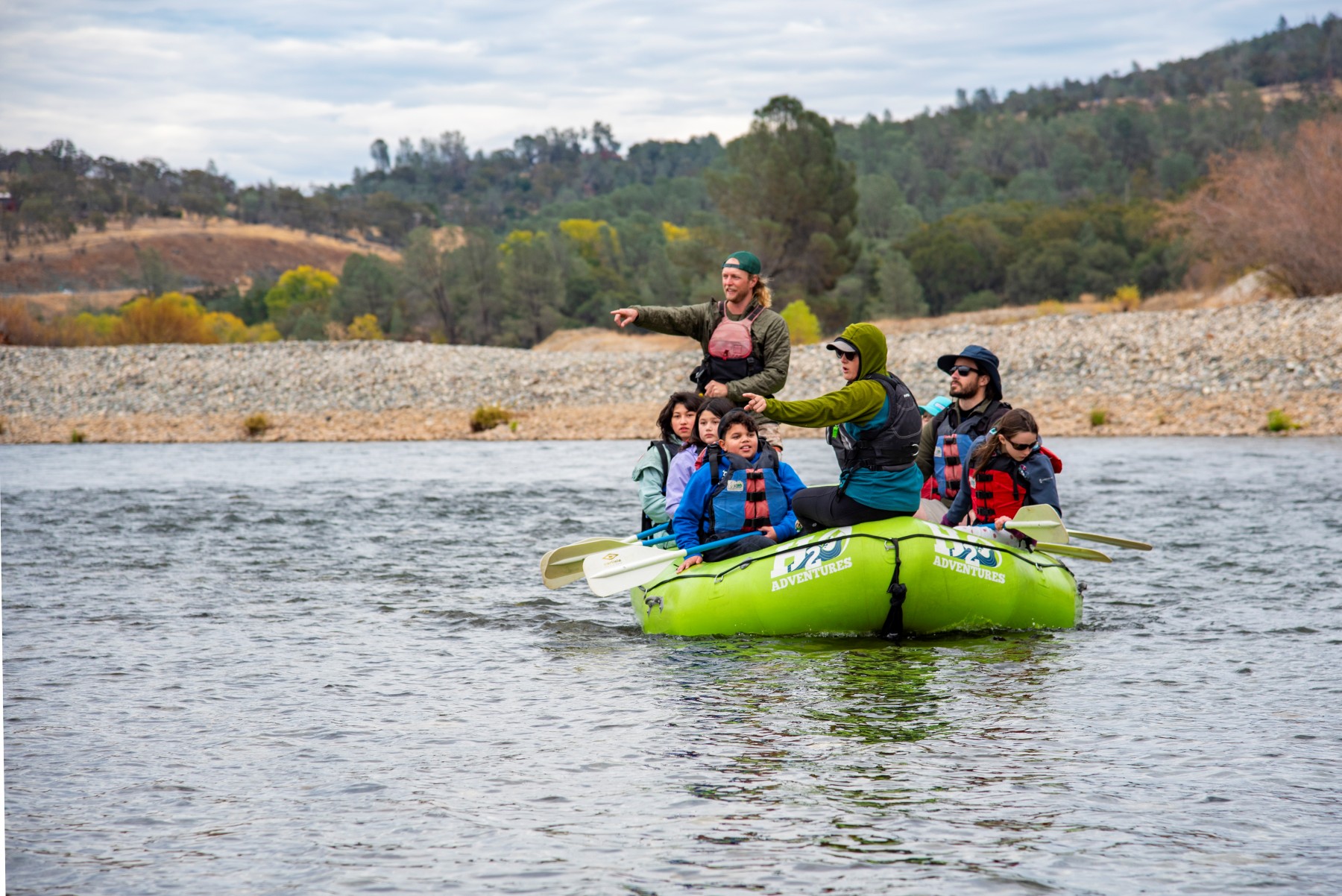 A $196,211 grant to the South Yuba River Citizens League will cover the cost of Salmon Expeditions for all Yuba County fourth graders. The beloved program combines classroom lessons about the Yuba River watershed with a guided rafting trip to see spawning salmon in the lower Yuba River. Nearly 1,500 students, teachers and chaperones are expected to participate this year, more than doubling participation since 2019, the first year Yuba Water funded the program for Yuba County students.
“Thanks to Yuba Water’s continued support, we’re able to give every fourth grader in Yuba County a chance to experience the Yuba River and see salmon in the wild,” said Monique Streit, SYRCL’s education director. “For many of these kids, it’s their first time on a raft or seeing a river up close. These are lessons that deepen their connection to science, nature and their home watershed, and really leave a lasting impact.”
An additional $20,000 grant to the Olivehurst Public Utility District will help cover operational costs and provide water safety education at the county’s only public swimming pool. The pool, located in Olivehurst and open from June through August, offers a supervised alternative to the Yuba and Feather rivers, which are cold, fast-moving and unsafe for swimming in the summer. Yuba County also contributed matching funds for this season.
Flood risk reduction
An $87,500 grant to Reclamation District 784 will help cover the cost of replacing a relief well along the Bear River. RD 784 will cover the additional cost of the $175,000 project. Relief wells reduce pressure under levees during high water, helping prevent erosion or failure and are critical to meeting levee safety standards. RD 784 covers more than 40,500 acres of land and includes more than 33 miles of levees, 60 miles of internal drainage canals, 82 relief wells and 10 pumping stations east of the Feather River.Bill Shaw Rescue Equipment and Training Grants
Yuba Water awarded nine Bill Shaw grants totaling $164,714. The grants are exclusively for first-responder agencies serving Yuba County and the Yuba River watershed and cover one-time costs each fiscal year related to rescue equipment or specialized training connected to Yuba Water’s missions. A summary of this year’s Bill Shaw grantees is below.- Yuba-Sutter Trauma Intervention Program: $11,120 for updated equipment, safety gear and education
- Foothill Fire Protection District: $15,208 for radios and charging bases and battery-powered tripod lights
- Yuba County Sheriff’s Office: $18,977 for drones to support the Sheriff’s Unmanned Aircraft System team with safety and mapping
- Linda Fire Protection District: $19,225 for a drone to aid with water rescues
- Dobbins Oregon House: $20,000 for fire rescue systems equipment
- Yuba County Mounted Sheriff’s Posse: $20,000 for weatherproof jackets and pants for search and rescue missions, recoveries and evacuations
- Camptonville Volunteer Fire Department: $20,000 for radios and pagers
- Smartsville Fire Protection District: $20,000 to purchase updated personal protective equipment that meet current state and federal safety standards
- Wheatland Fire Authority: $20,184 for portable radios
YLWD Receives Transparency Certificate of Excellence Award
RWA Releases Framework for Water Accounting System
SACRAMENTO—The Regional Water Authority (RWA), representing nearly two dozen water providers in the Sacramento region, has released the Water Accounting System (WAS) framework for the Sacramento Regional Water Bank (Water Bank).
The Water Bank is a network of groundwater wells, pumps, and pipelines that enable local water providers to withdraw and replenish underground water reserves. It’s estimated that the region’s aquifers can store twice the volume of water as Folsom Reservoir. The Water Bank is crucial for adapting the region’s water system to climate change, which is expected to reduce snowpack and cause more extreme droughts and floods.
The Water Accounting System provides a structured, transparent method for tracking water deposited into and withdrawn from the Water Bank, including losses and water intentionally left in the basin to support long-term groundwater sustainability. Developed by RWA and participating agencies in coordination with Groundwater Sustainability Agencies (GSAs) and other partners, the WAS aligns with state and federal regulations and supports basin-wide coordination under the Sustainable Groundwater Management Act (SGMA).
“The Water Accounting System builds confidence in groundwater recharge by providing a clear and consistent way to track how and when water is stored,” said RWA Executive Director Jim Peifer. “That’s especially important for in-lieu recharge—a foundational strategy of the Water Bank—where surface water is used in place of pumping to allow groundwater levels to recover. The system enhances transparency and supports consistent, reliable tracking of in-lieu recharge to manage it effectively over time.”
The WAS encompasses a detailed set of fundamentals and components designed to manage water banking activities responsibly and effectively. Fundamentals include, for example, that recharge (deposits) must be made before recovery (withdrawals).
Key elements of the WAS include:
- Recharge and Recovery Accounting: Tracks direct and in-lieu recharge, withdrawals for beneficial use, and establishes consistent definitions across all participating agencies.
- Operational Baseline Definition: Establishes benchmarks for typical surface and groundwater use to distinguish banking activity from normal operations.
- Banking Losses and Leave-Behind Requirements: Quantifies unrecoverable water and mandates a minimum 5 percent leave-behind per recharge event to support aquifer health.
- Forgone Surface Water: Accounts for surface water intentionally unused to enable recharge via in-lieu methods.
- Storage Rights and Protocols: Clarifies ownership, access, and use parameters for stored water within the Water Bank framework.
The WAS was developed in coordination with GSAs, local agencies, and technical experts to support basin-wide integration and GSP reporting. A centralized Data Management System (DMS), managed by RWA, will collect and organize submitted data, with annual reporting aligned to SGMA timelines and monthly accounting during active banking periods.
The Water Bank is identified as a Project and Management Action in both subbasin GSPs, and the WAS provides a critical foundation for advancing regional water resilience in the face of climate variability, reduced snowpack, and extended drought cycles.
“California needs proven tools that can be customized and scale across regions,” Peifer added. “The Water Accounting System is not just a local asset—it’s a working model for how to align groundwater recharge with SGMA compliance, permitting, and environmental safeguards.”
The complete WAS framework is available at https://sacwaterbank.com/was/. For additional information, contact Trevor Joseph, RWA Manager of Technical Services, at tjoseph@rwah2o.org.
The Regional Water Authority (RWA) is a joint powers authority representing nearly two dozen water providers serving 2.2 million people in the greater Sacramento region. Formed in 2001, its primary mission is to help its members protect and enhance the reliability, availability, affordability and quality of water resources. Learn more at rwah2o.org. Learn more about the Water Bank at SacWaterBank.com.
NID launches mulch rebate program to boost water conservation efforts
The Nevada Irrigation District (NID) has launched a mulch rebate program to assist customers with their water efficiency and conservation efforts.
Mulch is a great tool to help save water in gardening and landscaping. Spread as a thick surface layer over soil and around plants, the organic material helps lock moisture into the soil and acts like a barrier to drying winds and direct sun. Mulch reduces the need for frequent watering and helps plants thrive.
Starting immediately, NID customers can receive a rebate up to $50 to purchase mulch from the vendor of their choice.
“This program is designed to serve all our customers, whether they reside in Nevada County or Placer County. It offers applicants a high degree of flexibility, allowing them to choose their preferred nursery or store, as well as select the type of mulch that best suits their needs. To help offset costs, NID will provide a $50.00 rebate to the customer’s water account.” said Kaycee Strong, NID Water Efficiency Technician.
Here’s how it works:
The program is open to NID customers – whether receiving treated or irrigation water — with an active account. There is one rebate available per parcel and/or NID account.
Rebates will be issued on a first-come, first-served basis; they will be distributed in the order applications are received, while funding lasts.
Applicants can purchase mulch from the vendor of their choice. Before they acquire the mulch, they must obtain an NID voucher, which is valid for 30 days from the date of issue.
To redeem the voucher, applicants must submit a copy of the sales receipt and proof of mulch installation and application within 30 days. The rebate will be applied as a credit to the customer’s NID account.
The maximum rebate is $50 or the actual cost of the mulch, whichever is less. Please note: the rebate does not cover tax, delivery, or installation costs.
“NID is pleased to be able to support our customers in their water efficiency efforts. Our community still is under an emergency water shortage this summer; and this rebate program may help customers meet the requested 20 percent conservation goal,” Strong said.
YLWD Celebrates Water Awareness Month by Hosting Director-Led Infrastructure Tour
ACWA D.C. Advocacy Fighting for Water Funding
I had the privilege of working alongside the ACWA East Team earlier this month during a visit to Capitol Hill. I stayed just long enough to feel like a local, automatically referring to coffee shops, restaurants and office locations not only by name, but also by their proximity to either the House or Senate side of the Capitol.
Our ACWA East Team, led by Director of Federal Relations Ian Lyle, includes Federal Relations Representative Caleb Raspler and Federal Relations Representative Libby Spekhardt. Together, we met with members of California’s congressional delegation and federal agency officials to advocate for critical water infrastructure funding and policies that affect ACWA member agencies.
ACWA also hosted a water policy luncheon that brought together many of the water policy professionals that advocate on behalf of ACWA’s members on federal issues along with representatives from national water organizations and staff from several congressional offices.
It was a timely visit. The Trump Administration had just released a summary of its fiscal year 2026 budget proposal. The proposal recommends a sharp decrease in water-related investments including estimated cuts of $2.4 billion to the U.S. Environmental Protection Agency’s Clean and Drinking Water State Revolving Fund, $609 million for U.S. Department of Interior’s Bureau of Reclamation, $391 million for forest service operations, and $7 million to eliminate the U.S. Army Corps’ Water Infrastructure Finance and Innovation Act, also known as the WIFIA program.
During our visits, we highlighted the critical need to ensure and restore funding for these and other water-related investments during the congressional appropriations process.
Additionally, we urged Congress to support the Water Systems PFAS Liability Protection Act. This bill would exempt water systems from PFAS liability under the Comprehensive Environmental Response, Compensation, and Liability, or CERCLA, and hold polluters — not passive receivers — accountable for PFAS contamination.
Another major point of focus included support for the Federal Emergency Management Agency’s Building Resilient Infrastructure and Communities (BRIC) program. Established under the first Trump administration, BRIC serves as an annual funding source for pre-disaster mitigation projects. We strongly advocated to maintain funding for this program, especially since investments to prevent natural disasters are more cost-effective than post-disaster recovery. California has received over $1.2 billion from the BRIC program and is among the top three state recipients with the most funding from the program.
California water managers have a lot riding on the outcome of multiple issues, and you can count on our ACWA East team to keep your interests front and center in our nation’s capital.
Students Light Up the Big Screen with Personal Stories About Water
FREMONT – Award-winning entries created by Tri-city area students for the Alameda County Water District’s 6th annual WaterClips Student Video Contest premiered during a special Board Meeting on May 21. The District awarded over $1,500 in scholarships to students in grades 6-12 for producing 30-second videos conveying the personal significance of ACWD water delivered to their home, neighborhood, school, local businesses and community. This year’s video contest attracted over 100 students to compete as individual or team entries and focus on the theme “ACWD Water and Me.” Student videos highlighted water’s vital role in their daily lives, shaping family traditions or everyday activities. From animation to live action, students showcased their talents in video production, editing, screenwriting and acting as they competed for scholarships up to $500. Teachers were also awarded classroom scholarships for their support as sponsors of winning videos. A panel of prominent representatives from government, media, television and utility industries served as contest judges to view and score each contest submission in both Middle and High School categories. “At ACWD, we believe that inspiring the next generation to understand and care about our water resources is key to a sustainable future,” said ACWD Board President Judy Huang. “This contest is a wonderful opportunity for students to bring their unique perspective about the value of water that can be shared throughout our community.” Middle School Winners| First Prize Winner – $500 | Second Prize Winner – $250 | Third Prize Winner – $100 |
| Aditya Madhavani |
Dhaanush Karthikeyan |
Poorvi Girish |
| Grade 8 | Grade 8 | Grade 6 |
| Video “ACWD Water and Me” | Video “ACWD Water and Me” | Video “ACWD Water and Me” |
| William Hopkins Middle School | Thornton Middle School | Thornton Middle School |
| First Prize Winner – $500 | Second Prize Winner – $250 | Third Prize Winner – $100 |
|
Jadon Li and Pradyun Kanuparthi |
Aarush Sundararajan, Eesha Rustagi and Vihaan Dayal |
Pradyun Kanuparthi, Jadon Li and Preston Hu |
| Grade 10 | Grade 9 | Grade 10 |
| Video: Water is Amazing | Video: A Day in the Life of ACWD Water | Video: Our Life, Our Water |
| Mission San Jose High School | Irvington High School | Mission San Jose High School |
May 30, 2025 ACWA News Available
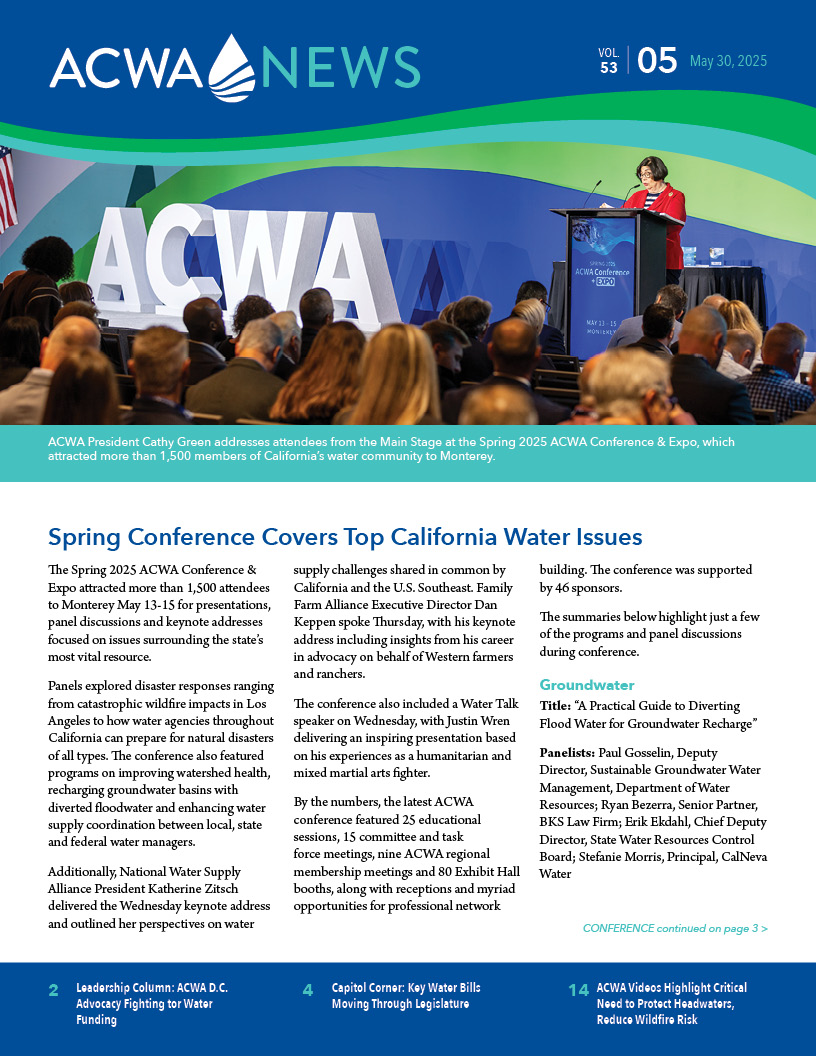 Read the May 30 edition of ACWA News for informative articles about the association and water industry.
Articles include:
- See Articles and Photos from the Spring 2025 ACWA Conference & Expo
- Capitol Corner Updates Status on Key Water Bills in State Legislature
- Interim Executive Director Marwan Khalifa Discusses ACWA Federal Advocacy
- Members Can Use ACWA Video Toolkit to Educate About Protecting Watersheds, Reducing Fire Risk