
CHWD Promotes Respected Engineer as Operations Director
Citrus Heights Water District (CHWD) is pleased to announce the promotion of Todd Jordan to Director of Operations. With over two decades of experience in water utility management and engineering, Jordan brings deep technical expertise and leadership to this critical role.
“Todd has consistently delivered impactful results and innovative solutions as CHWD’s Principal Civil Engineer, playing a pivotal role in delivering key projects and advancing our core programs,” said General Manager Hilary Straus. “His promotion to Director of Operations reflects his continued growth and the value he brings to CHWD. We look forward to his leadership in driving operational excellence and contributing to the ongoing success of our organization.”
Since joining CHWD in 2023, Jordan has proven to be a key asset to the District. His prior experience includes roles with Carollo Engineers, Nevada Irrigation District, the City of Roseville, and MISCOwater. He holds a Bachelor of Science degree in Civil Engineering from California State University, Sacramento, and he is a registered professional engineer in the State of California.
As Director of Operations, Jordan will lead the management of operations and maintenance of water distribution systems, facilities, fleet, metering services, and water efficiency programs. He will also oversee the District’s capital improvement program and operations budget, guide groundwater and water quality initiatives, and collaborate with regional partners on initiatives.
“It’s an honor to work with such a forward-thinking team at CHWD,” Jordan said. “I look forward to continuing to support the District’s mission of providing high-quality, reliable water service to the community.”
For more information on CHWD, visit chwd.org or follow us on social media @citrusheightswaterdistrict.
ACWA-Supported WIPPES Act Advances in Congress with Bipartisan Support
WASHINGTON, D.C. — The U.S. House of Representatives during the last week of June passed the Wastewater Pollution Prevention and Environmental Safety (WIPPES) Act , a bipartisan, bicameral, and ACWA-supported legislation.
This legislation would require wipe manufacturers to clearly label their products as non-flushable to protect wastewater systems from pollution and structural damage, which can cost millions of dollars to repair critical infrastructure nationwide. The legislation passed by a unanimous voice vote, indicating broad support in the chamber.
The WIPPES Act was introduced in March by U.S. Representatives Jared Huffman (D-CA-02), Kevin Mullin (D-CA-15), Lisa McClain (R-MI-10) and Tom Kean (R-NJ-07). Next, the WIPPES Act will be taken up in the U.S. Senate, where ACWA will continue to advocate for the bill’s swift passage.
Companion legislation (S.1092) was introduced by Senators Jeff Merkley (D-OR) and Susan Collins (R-ME) and favorably reported out of the Commerce, Science, and Transportation Committee in May. ACWA has a support position for the WIPPES Act and supported the bill in the previous Congress. ACWA has submitted letters of support to the bill’s sponsors in both chambers, in addition to sending a letter to House leadership urging them to take up the bill for a floor vote.
Amid a lengthy and strenuous budget reconciliation process in Congress — alongside ongoing hearings and markups by authorizing and appropriating committees for the 2026 fiscal year and testimony from federal agency officials — there continues to be momentum for federal water priorities. Lawmakers on both sides of the aisle are advancing commonsense legislation to ensure public water agencies and utilities across the nation can continue delivering clean and accessible water to local communities.
June 27, 2025 ACWA News Available
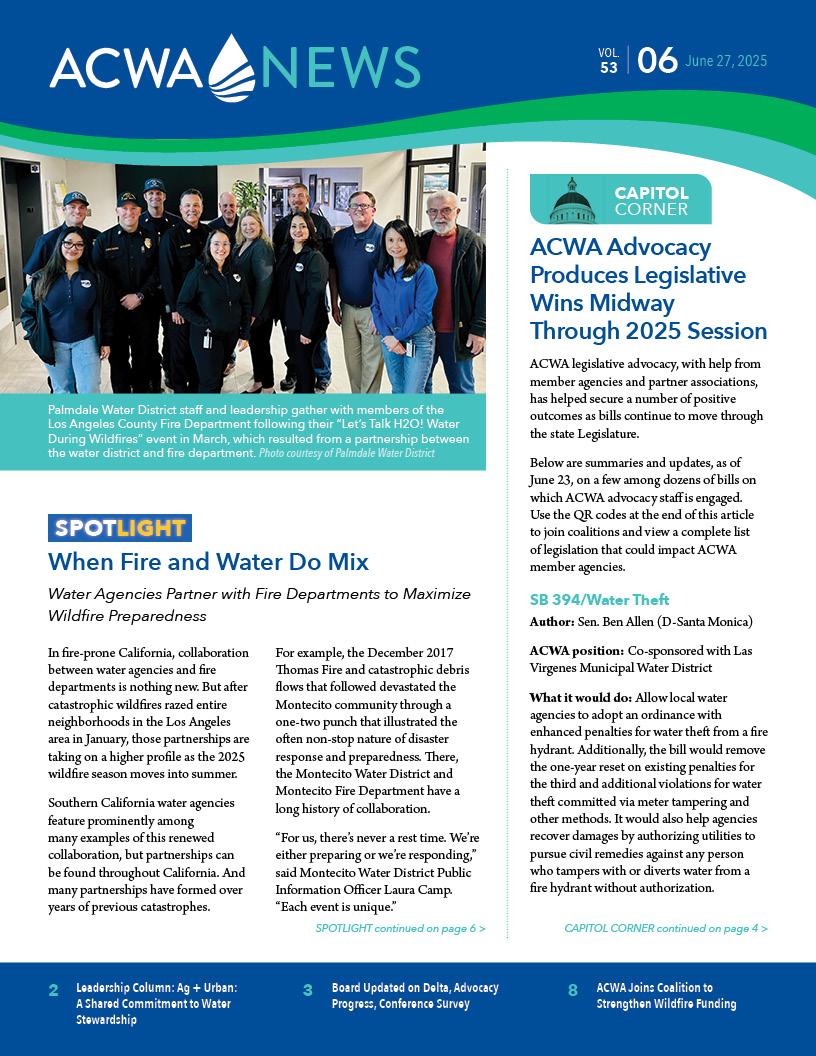 Read the June 27 edition of ACWA News for informative articles about the association and water industry.
Articles include:
- Feature Highlights Collaboration Between Water Agencies and Fire Departments
- Leadership Column: Ag, Urban Members Share Commitment to Water Stewardship
- ACWA Produces Three New Resources for Members
- ACWA Staff Update Board on Delta, Advocacy Progress, Post Conference Survey
Ag + Urban: A Shared Commitment to Water Stewardship
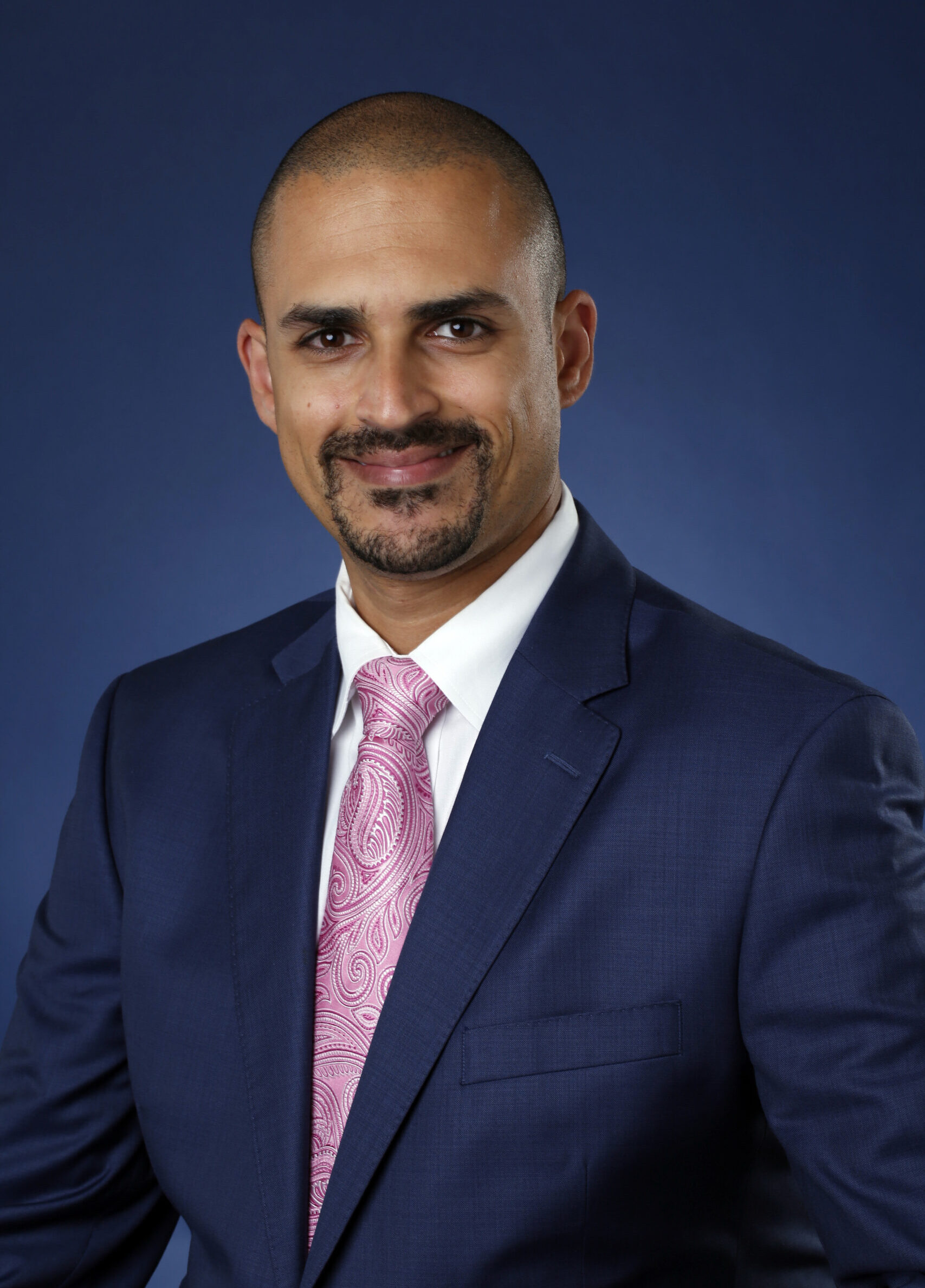 ACWA quietly turned 115 years old on May 28, providing an opportunity to both look back and think ahead. And with ACWA, agriculture features prominently in either direction.
Our association’s history is rooted in agriculture. Legislation during the late 1800s allowed the formation of irrigation districts and became a model for the creation of nearly every other type of public water agency in California. The organization that became ACWA began as the Irrigation Districts Association of California, founded by the Alta Irrigation District, Modesto Irrigation District, Oakdale Irrigation District, South San Joaquin Irrigation District and Turlock Irrigation District.
Over more than a century, our membership grew and evolved, expanding well beyond irrigation districts to include urban, suburban, and regional agencies of every type and scale. Today ACWA is the largest association of public water agencies in the United States and a world-class organization in its own right.
Given the wide differences among how they function, who they serve, and where they operate, it’s easy to assume vast differences between agriculture and urban water agencies. But despite that fact, we’ve always committed ourselves to collaboration. And today, we stand together, solving problems and advancing stewardship of California’s most precious resource.
Both agriculture and urban communities encounter common challenges, ranging from water rights issues to the vulnerabilities of rural and small water systems. For example, disadvantaged communities facing challenges in accessing safe drinking water could include a mobile home park in Los Angeles, as well as small, rural communities in the Central Valley.
Preserving our water rights system, addressing regulatory challenges, reducing redundancy in water data requirements and, above all, investing in state and federal conveyance infrastructure to optimize water supplies provide additional examples of commonality in issues between the urban and agricultural water sectors.
Right now, enormous pressures confront generational farmers and Central Valley communities because the infrastructure they depend on for their lifeline to water is either deteriorating from lack of investment or constrained by regulatory overreach. That is why we must remain united in our advocacy for increased infrastructure investment. That unity could just as well support vital funding that allows urban agencies to continue exploring the potential of desalination, water recycling, and stormwater capture to adapt to a changing hydrology.
Whatever path we find toward answering these challenges, it is a path that will run through mutual support between urban and agricultural water suppliers. That spirit is alive and well within the ACWA community, where it is encouraging to meet so many people from a diverse mix of generations and areas of expertise. They represent the future of our water leadership — agricultural, urban, and everything in between — and together we will shape our association’s future and legacy of unity.
Spotlight June 2025: When Fire and Water Do Mix
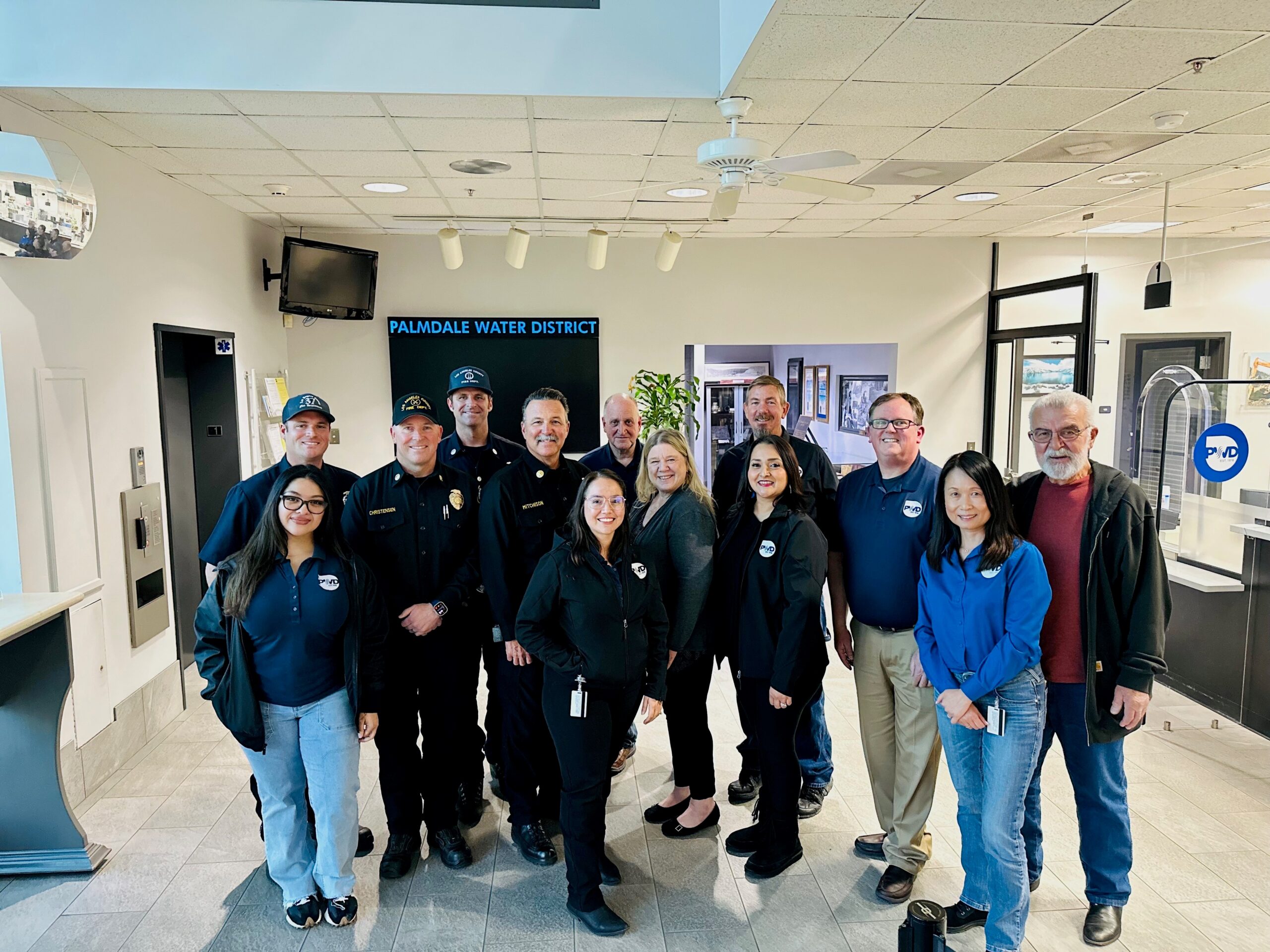
Palmdale Water District staff and leadership gather with members of the Los Angeles County Fire Department following their “Let’s Talk H2O! Water During Wildfires” event in March, which resulted from a partnership between the water district and fire department. Photo courtesy of Palmdale Water District
Water Agencies Partner with Fire Departments to Maximize Wildfire Preparedness
In fire-prone California, collaboration between water agencies and fire departments is nothing new. But after catastrophic wildfires razed entire neighborhoods in the Los Angeles area in January, those partnerships are taking on a higher profile as the 2025 wildfire season moves into summer.
Southern California water agencies feature prominently among many examples of this renewed collaboration, but partnerships can be found throughout California. And many partnerships have formed over years of previous catastrophes.
For example, the December 2017 Thomas Fire and catastrophic debris flows that followed devastated the Montecito community through a one-two punch that illustrated the often non-stop nature of disaster response and preparedness. There, the Montecito Water District and Montecito Fire Department have a long history of collaboration.
“For us, there’s never a rest time. We’re either preparing or we’re responding,” said Montecito Water District Public Information Officer Laura Camp. “Each event is unique.”
Below are summaries of a few among numerous collaborative projects undertaken by water agencies and fire departments successfully working together.
Partnerships
In San Diego County, ACWA member agencies Santa Fe Irrigation, Olivenhain Municipal Water and San Dieguito Water districts are working in close collaboration with at least four local fire departments to prepare adequate resources to ensure swift responses if wildfires threaten the area. This includes preparing emergency generators in case of public safety power shutoffs and having water agency staff brief fire crews on fire hydrant locations and water distribution system pressures during ongoing training exercises throughout the year.
Public Outreach
Olivenhain regularly coordinates with neighboring fire districts and hosts free firewise landscaping workshops for community members, according to the district. It also educates the public on emergency preparedness through publications and in-person events, such as tours, workshops, and community fairs — covering topics like how fire flows are not designed for massive wildfires and reviewing emergency practices.
In the Los Angeles area, West Basin Municipal Water District participated in a Peninsula Wildfire Preparedness Town Hall and Expo, joined by the Los Angeles County Fire Department. The district also conducts fire-scaping workshops approximately twice a year.
Addressing Concerns
The Los Angeles fires brought to the forefront concerns and sometimes misinformation about water supply during fires. The Palmdale Water District addressed that issue at its “Let’s Talk H2O! Water During Wildfires” event in March, which brought together district leadership and representatives from the City of Palmdale and Los Angeles County Fire Department.
The event informed community members on plans to increase water during fire weather events, designing water systems to meet fire flow requirements for developments and an agreement allowing aircraft to use water from Lake Palmdale. Fire and city officials also covered the topics of hydrants, how fires are fought, the city’s emergency plan and home protection.
Infrastructure
Several ACWA member agencies have invested in the installation of water dip sites over the years for firefighting helicopters, such as Heli-Hydrants and mobile HeloPods, hooked up to water supplies that can refill them in minutes during wildfires.
For example, the Jurupa Community Services District in the Inland Empire area located a Heli-Hydrant that can save Cal Fire helicopters a 20-mile flight to Lake Mathews to refill, increasing fire response time upwards of an hour. The district won ACWA’s 2024 Excellence in Innovation Award for the project.
Just this month, the San Gorgonio Pass Water Agency joined forces with Cal Fire and Riverside County Fire along with other local agencies to complete the first of six Heli-Hydrants to be installed in its high fire-risk community.
Communicating with Insurers
Water agencies and fire departments have also collaborated on supporting their community’s residents who face challenges with homeowner’s insurance. Last year, the Vallecitos Water District and San Marcos Fire Department jointly released an open letter that emphasized proactive measures in mitigating wildfire risk through fire protection strategies and innovative water infrastructure.
In February, Yorba Linda Water District worked with the Orange County Fire Authority and the City of Yorba Linda to host a representative from the California Insurance Commissioner’s Office to address the difficulties local homeowners were experiencing with insurance providers due to increased fire risk in the region. The partnership also provided a downloadable joint letter for residents to submit to insurers.
Statewide Effort
In the Sierra Nevada Foothills, ACWA member agencies Calaveras County Water District, Tuolumne Utilities District, Utica Water and Power Authority and Union Public Utility District, along with the Twain Harte Community Services District are implementing a comprehensive approach and engaging local agency and community partners to create a safer and more resilient community.
The primary initiative of the group is to develop a comprehensive and coordinated public information campaign aimed at raising awareness about the role that public water agencies play in enhancing wildfire resiliency, illustrated through an informative flyer shared with the community.
To the south, the Mammoth Community Water District has teamed up with the Mammoth Lakes Fire Protection District and the Town of Mammoth Lakes to emphasize the importance of prioritizing home hardening and creating defensible space as a first line of defense against
ACWA member City of Shasta Lake literally wrote the book on how a community can prepare and prevent wildfires. A 32-page “Shasta Lake Wildfire Information and Preparedness Guide” covers everything from fire-smart landscaping and escape routes to replacing important documents lost to fire and addressing home insurance issues following the L.A. Fires, among numerous topics.
Production of the guide, funded through a Cal Fire grant, is one example of the City’s close working relationship with the state firefighting agency Cal Fire and local Shasta Lake Fire Protection District on mitigating fire risk and public education, a collaboration took on renewed importance after the 2018 Carr Fire. Now, it’s an essential part of being prepared in California’s not-if-but-when wildfire reality.
“Everyone with a stake in protecting our community from devastating wildfire, from the top down, is on the same page. Fire season is now a year-round reality — it’s time to take action, raise public awareness, and reduce fuel loads,” said City Manager Jessaca Lugo.
ACWA Accepting Applications for 2025 Fall Awards
ACWA will announce the following award recipients at its 2025 Fall Conference & Expo in San Diego, being held Dec. 2-4, and the deadline to apply for three of the awards is approaching.
Excellence in Innovation Award
This award recognizes successful innovations by member agencies that continue to support and drive California toward long-term water resilience. Sponsored by CDM Smith, the award recognizes groundbreaking and unique programs, projects, practices and/or technologies implemented by ACWA member agencies.
The winning agency and award finalists will share their innovations on a panel during ACWA’s Fall Conference & Expo. In addition, the winning agency will receive $5,000 to create a video highlighting their innovation.
Submission deadline is Tuesday, Sept. 2.
Excellence in Communication Award
The Huell Howser Excellence in Communication Award honors outstanding public water agency efforts in communicating important information to customers, legislators, media, the public and others. The award focuses on projects and programs that quantifiably meet an agency’s public information, communications or outreach goals in an innovative way while making effective use of available resources.
Submission deadline is Tuesday, Sept. 2.
Emissary Award
The John P. Fraser Emissary Award honors individual ACWA member volunteers who have made remarkable and visible contributions to the enhancement, protection or development of water resources in California by participating in, supporting and advancing ACWA’s mission and goals.
The nomination deadline is Sept. 2.
Outreach Awards
Throughout the year, ACWA asks its members to take action on important legislative and regulatory issues, helping create a coalition to directly affect the outcomes of numerous decisions and advance the association’s legislative and regulatory agenda. ACWA’s Outreach awards recognize the most active member agency in each region, as well as an overall winner and winners in three special outreach categories. Submission deadline is Oct. 1.
For more details about all the awards, including eligibility requirements and submission guidelines, please visit ACWA’s website.
United Water Conservation District Lawsuit Defends Water Rights
A recent ruling by the U.S. Court of Appeals for the Federal Circuit in United Water Conservation District v. United States (April 2, 2025) threatens the constitutionally protected property rights of appropriative water rights holders across California and nationwide. The court held that the federal government can drastically reduce a water rights holder’s ability to divert water under a valid state-issued license without triggering the Fifth Amendment’s requirement for just compensation, so long as a minimal amount of water can still technically be used. This means federal agencies could seize 90%, 95%, or even 99.5% of your water indefinitely without owing anything in return.
This decision erodes long-standing legal protections for water rights holders and invites unchecked overreach by federal agencies such as the National Marine Fisheries Service and the U.S. Fish and Wildlife Service. It removes any incentive to consider economic impacts when imposing Endangered Species Act restrictions, allowing agencies to bypass compensation entirely. These implications extend far beyond one water district.
This is a national issue that affects agricultural, municipal, and industrial water users across the country.
United Water Conservation District (UWCD) plans to petition the court for rehearing, and if necessary, take the case to the U.S. Supreme Court. To strengthen this effort, the Association of California Water Agencies (ACWA) is submitting an amicus brief on behalf of concerned water agencies.
Additional water agency support is essential, and UWCD is encouraging others to join the amicus brief. For more information, please contact UWCD’s Amicus liaison Tara Bravo Mulally at 510.300.5743 or tara@cvstrat.com by June 30th to be a part of this historic ruling.
DWR Semi-Annual Groundwater Conditions Update Highlights Key Trends
SACRAMENTO – California is now collecting more groundwater data than ever before as highlighted in the Semi-Annual Groundwater Conditions Update released today by the Department of Water Resources (DWR). Made up of groundwater data gathered over the past year from various DWR tools and annual reports from local groundwater sustainability agencies (GSAs), the Update includes information on statewide groundwater levels, groundwater storage, recharge, land subsidence, well infrastructure and the status of California’s groundwater conditions. “When it comes to water management in California, it’s important that state and local water decisions are made with the latest, most accurate data in mind. Thanks to the information collected from our local partners, we’re gaining more knowledge about the challenges our groundwater-dependent communities are facing and their progress towards meeting the overall goals set by the Sustainable Groundwater Management Act,” said Paul Gosselin, DWR Deputy Director of Sustainable Water Management. Water Year (WY) 2024 marked a significant milestone for groundwater management in California, as the state celebrated the 10-year anniversary of the Sustainable Groundwater Management Act (SGMA), the statewide regulatory framework established to ensure the sustainability of our groundwater basins by 2040. Over the course of 2024, the state received average precipitation, helping sustain recharge efforts after the exceptionally wet 2023. These last three years (2023, 2024, and 2025) have seen continued increases in groundwater storage. Water Year 2024 increased by 2.2 million acre-feet reported across 98 basins – a direct result of state and local actions to capture and store more water underground. However, the first five months of WY 2025 were notably dry across much of the state, especially in the Central Valley and southern regions. In contrast, portions of Northern California experienced above-average or record-setting rainfall. These sharp contrasts highlight California’s weather shifts and increasing need for dynamic water management. Additional findings from today’s report include: Groundwater Management- Groundwater storage increased by 2.2 million acre-feet reported across the 97 basins during WY 2024. This increase reflects actions such as capturing and recharging high flows during winter storms, expanding recharge basins, improving groundwater monitoring, and coordination among local agencies to reduce groundwater pumping.
- Local GSAs are executing Groundwater Sustainability Plans (GSPs) that incorporate recharge projects, demand reduction, efficiency programs, and land use coordination.
- GSAs are expanding monitoring networks and using annual reports to track key sustainability indicators such as groundwater levels, subsidence, use patterns, and recharge volumes.
- DWR is investing in tools like InSAR, Airborne Electromagnetic (AEM) surveys, advanced modeling, and telemetry to improve data quality and inform water management decisions.
- Groundwater storage in the Central Valley remains highly sensitive to drought and wet periods.
- Active land subsidence continues to be observed in the Sacramento River, San Joaquin River, and Tulare Lake Hydrologic Regions. DWR continues to expand data collection on subsidence in these areas and plans to release guidance for GSAs later this year.
- Fewer dry wells were reported in WY 2024 compared to WY 2021, WY 2022, and WY 2023.
- DWR Semi-Annual Groundwater Conditions Updates
- California’s Groundwater (Bulletin 118)
- California’s Groundwater Live
- Sustainable Groundwater Management Act (SGMA)
- Groundwater Recharge
Groundbreaking Marks Major Investment in Placer County’s Water Future
COLFAX — Placer County Water Agency (PCWA), joined by state and local leaders, today celebrated the groundbreaking of the new Colfax water treatment plant—a milestone investment in reliable drinking water for the foothill communities of eastern Placer County.
The $36 million project to replace an existing, aging facility marks PCWA’s first new treatment facility to be built in more than a decade and underscores the agency’s commitment to long-term water supply resilience, smart planning, and improved water access across the foothill communities.
“This project represents a smart and necessary investment in the future of our region,” said Josh Alpine, PCWA Board Member representing eastern Placer County. “It’s not just about replacing aging infrastructure—it’s about taking an opportunity to plan ahead so that communities like Colfax, Shady Glen, Heather Glen, and Weimar have a safe and sustainable water system for decades to come.”
Event speakers included PCWA General Manager Andy Fecko, State Water Resources Control Board (SWRCB) Member Laurel Firestone, Placer County Supervisor Cindy Gustafson, and Colfax City Mayor Sean Lomen, who highlighted the project’s regional benefits and collaborative planning efforts.
“PCWA’s regional approach is helping more communities gain access to safe, reliable drinking water,” said Firestone, whose agency is providing financial support for the project. “This project is a strong example of how state and local partnerships can deliver safe, reliable, and affordable drinking water to current customers and smaller communities seeking a more resilient and sustainable water system. We look forward to continuing to partner with PCWA on their regionalization program.”
The new plant will replace the original facility built in 1958, which is reaching the end of its operational life. Once complete, treatment capacity will increase from 1.24 to 2.0 million gallons per day, with future plans to expand to 3.0 million gallons per day to serve additional un-served and under-served areas along the Interstate 80 corridor from Colfax to Applegate. The plant’s new location, just north of the town limits of Colfax, offers enhanced safety, accessibility, and room for expansion.
Construction is scheduled to begin in June 2025 and will take approximately two and a half years to complete. The project is financed through a combination of local and state sources, including a $10 million zero-interest loan and $2.5 million in principal forgiveness from the State Water Board’s Drinking Water State Revolving Fund delivered by the Safe and Affordable Funding for Equity and Resilience (SAFER) program. This was a first-of-its-kind incentive program offered by SWRCB to recognize water systems, such as PCWA, that have received and completed voluntary consolidations.
The project is a key component of PCWA’s broader regionalization strategy and aligns with priorities identified in the agency’s water reliability study along the I-80 corridor.
“The Colfax Water Treatment Plant is more than just an infrastructure replacement—it’s a cornerstone project that supports the broader Colfax to Applegate regionalization program,” said Alpine. “These efforts will strengthen water reliability, consolidate small systems, increase fire protection, and create future opportunities for unserved areas, enhancing the sustainability of our region for generations to come.”
###
About PCWA
Placer County Water Agency (PCWA) is the primary water resource agency for Placer County,
California, with a broad range of responsibilities including water resource planning and
management, retail, and wholesale supply of drinking water and irrigation water, and
production of hydroelectric energy.
California Required Disclosure
Funding for this project has been provided in full or in part through an agreement with the State Water Resources Control Board. California’s Drinking Water State Revolving Fund is capitalized through a variety of funding sources, including grants from the United States Environmental Protection Agency and state bond proceeds. The contents of this document do not necessarily reflect the views and policies of the foregoing, nor does mention of trade names or commercial products constitute endorsement or recommendation for use.
Sites Project Authority Releases 2024 Annual Report
2024 marked the start of a new chapter for the Sites Reservoir Project with several major milestones that moved the Sites Reservoir Project closer to final design and construction.
✓ We successfully defended legal challenges to the environmental review process, with courts ruling that the Final Environmental Impact Report (EIR) fully complies with the California Environmental Quality Act (CEQA).
✓ We made advancements in the permitting process with the California Department of Fish and Wildlife (CDFW) issuing the Incidental Take Permits required for construction and operation of the reservoir.
✓ The State Water Resources Control Board began proceedings to consider our Water Right permit.
✓ We began preparing for the next phase of the Sites Reservoir Project by initiating our first land purchase of property west of Maxwell and launching the selection process for a Construction Manager at Risk (CMAR) contractor for the Dams and Reservoir package, which marks a critical step toward construction.
In 2025, we are working toward our next big milestones—selecting a CMAR contractor, moving from design to construction, securing additional real estate acquisitions, and obtaining our Water Right permit. With each milestone, we move one step closer to delivering a 21st century reservoir that provides water reliability, flexibility, and resiliency for generations to come.
Learn more in our 2024 Annual Report