
DPMWD Officially Reorganized into Sacramento Suburban Water District
SACRAMENTO – As of June 30, 2025, the reorganization of Del Paso Manor Water District (DPMWD) into Sacramento Suburban Water District (SSWD) is complete. This marks the official transition of DPMWD into the newly designated Del Paso Manor Service Area (DPMSA) within SSWD.
The reorganization marks the conclusion of a multi-year effort to improve long-term financial stability and reliable water service for DPMWD’s ratepayers without burdening current SSWD customers with the costs associated with necessary improvements to the DPMSA facilities.
“We’re proud to welcome Del Paso Manor customers into the SSWD community,” said Dan York, SSWD General Manager. “Our top priority is strengthening the area’s water infrastructure to support safe, reliable water service at an affordable rate. As we move forward, we’re committed to providing the DPMSA customers with new tools, additional resources, and responsive support throughout the transition and into the future.”
For more information, visit sswd.org.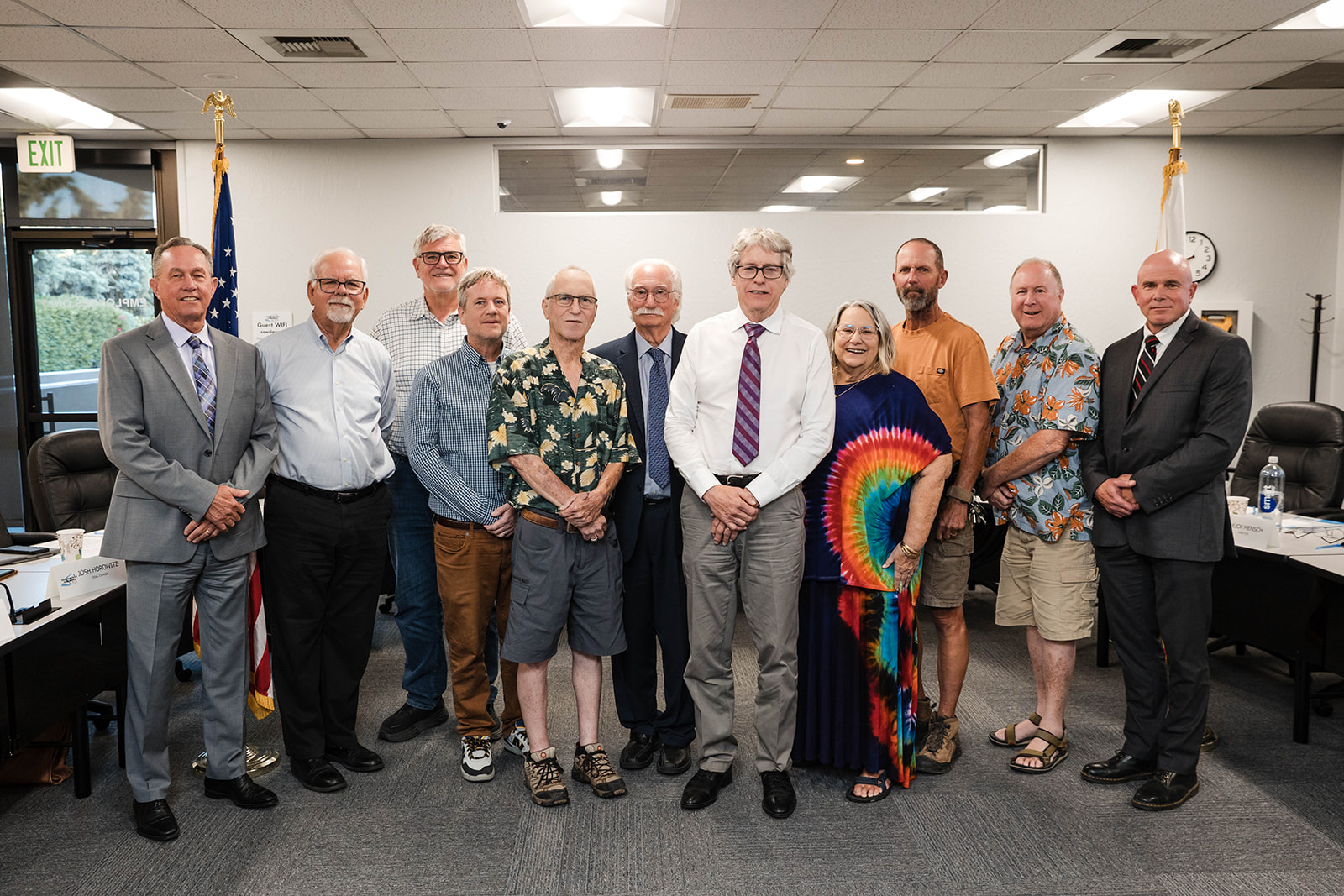 Photo Caption:
The photo was taken during a joint board meeting and tribute event honoring the Del Paso Manor Water District on Wednesday, June 25, 2025.
From left: SSWD General Manager Dan York; SSWD Board Member Jay Boatwright; SSWD Board Vice President Craig Locke; SSWD Board Member Kevin Thomas; SSWD Board Member David Jones; SSWD Board President Robert Wichert; DPMWD Board President Carl Dolk; DPMWD Board Vice President Trish Harrington; DPMWD Board Member Chuck Mensch; DPMWD Board Member David Ross; and DPMWD General Manager Adam Coyan.
OCWD Recognized for Excellence in Financial Reporting for 17th Consecutive Year
FOUNTAIN VALLEY– The Orange County Water District (OCWD; District) received a Certificate of Achievement in Excellence in Financial Reporting (COA) from the Government Finance Officers Association (GFOA) for the 17th consecutive year. The certificate was awarded for the District’s comprehensive annual financial report for the fiscal year ended June 30, 2024 and affirms OCWD’s ongoing commitment to responsible financial stewardship and transparent reporting.
“This award marks a significant achievement for the District,” said OCWD President Denis R. Bilodeau, P.E. “It underscores our commitment to sound financial management, which enables critical investments in infrastructure such as land purchases for groundwater recharge, the Groundwater Replenishment System and Forecast Informed Reservoir Operations – all of which enhance the reliability and resiliency of our region’s water supply.”
The COA is the highest form of recognition in governmental and financial reporting. The GFOA, a nonprofit professional association representing more than 20,000 public finance officials in the U.S. and Canada, awards the certificate to agencies that demonstrate transparency and full disclosure in their reports.
In addition to this national recognition, OCWD was recently honored with the Certificate of Excellence from the Association of California Water Agencies. This award commends the District for providing efficient, economical services while adhering to best management practices and fiscally sound procedures. OCWD also continues to uphold top-tier credit ratings, including a “AAA” rating from both Fitch Ratings and Standard & Poor’s and an Aa1 rating from Moody’s.
These distinctions reflect the District’s long-standing focus on conservative fiscal policies, cost-effective operations and long-term financial planning. OCWD’s prudent approach supports its mission to deliver a reliable water supply to 2.5 million residents in north and central Orange County.
To learn more about OCWD, please visit www.ocwd.com and follow @OCWaterDistrict on social media.
A Century of Stewardship: SBVWCD Surpasses 1.5 Million Acre Feet Recharged
REDLANDS — In an era when aquifers across the globe are being depleted at alarming rates, the San Bernardino Valley Water Conservation District has achieved a historic milestone in sustainable groundwater management. The Redlands-based water district has now diverted and recharged 1.5 million acre-feet—or 489.33 billion gallons—of water into the local aquifer cumulatively since 1912. That volume is enough to fill 740,000 Olympic-sized swimming pools or, more importantly, meet the annual water needs of approximately 6 million households.
“This milestone reflects what’s possible when low-cost, locally led solutions are sustained through time,” said San Bernardino Valley Water Conservation District’s General Manager Betsy Miller Vixie. “For more than a century, we’ve invested in community-based recharge efforts that have protected water supplies, supported infrastructure, and enhanced resilience for our region. The benefits we see today are the result of patient, collaborative stewardship that has protected local groundwater for generations.”
This progress stands in contrast to global trends, where an estimated 21 of the world’s 37 largest aquifers are being depleted faster than they can be replenished, according to NASA satellite data. Over the last two decades, unsustainable groundwater extraction has contributed to both ecological stress and even shifted Earth’s rotational axis. The District’s century-long commitment to groundwater recharge exemplifies an accessible, sustainable model that benefits communities and ecosystems alike.
To help combat changing water demands and weather patterns, the San Bernardino Valley Water Conservation District applies a visionary but pragmatic approach to groundwater management. By diverting stormflows from the Santa Ana River and Mill Creek through 89 percolation basins, the District allows water to collect and seep naturally into the aquifer—where it becomes an essential and dependable supply source during periods of drought. These efforts would not be possible without the steadfast collaboration of local cities, water districts, and public agencies in the upper watershed, whose continued partnership and shared commitment to regional resilience make this work possible.
About the San Bernardino Valley Water Conservation District:
For more than a century, the SBVWCD has stewarded the San Bernardino Valley water basin and the native species of the Upper Santa Ana River Wash. Its collaborative approach to project management assures high-quality local water supplies for people, agriculture, and the environment. This includes groundwater recharge and oversight, and protection of habitat and native species in the Wash. Visit www.sbvwcd.org
July 2025 Priority Issues Update Now Available
The July 2025 Priority Issues Update is now available online to members.
The update is a summary of the latest developments on issues of interest to ACWA members. This issue contains information on HRL funding, wastewater discharge, PFAS and more.
The new and previous Priority Issues Updates can be found here.
Firefighting Helicopter System Takes Flight in the San Gorgonio Pass
BEAUMONT – In a powerful show of innovation and collaboration, San Gorgonio Pass Water Agency (SGPWA) and its partners unveiled the first of seven life-saving Heli-Hydrants after just 18 months of development. More than 100 water leaders and elected officials attended the June 12th ribbon-cutting ceremony near the first Cabazon Water District Heli-Hydrant. The event highlighted how these tank-based systems allow helicopters to refill with water in under 10 seconds, often the difference between containment and catastrophe.
“As a retired Fire Captain Specialist, I know personally how every second matters when fighting wildfires,” said SGPWA Board Secretary Kevin Walton. “These Heli-Hydrants give our firefighters a critical edge, and we are already seeing their impact as they are being used right now to fight the Wolf Fire. SGPWA is proud to lead this effort and work with local water agency partners to protect lives and property across the region.”
The Heli-Hydrant concept was born from the lived experience of retired firefighter Mark Whaling and brought to life with $1.8 million in American Rescue Plan Act (ARPA) funding secured by Riverside County Fifth District Supervisor Dr. Yxstian Gutierrez. Seven Heli-Hydrants will soon serve the Pass area, strategically located on both sides of Interstate 10 for maximum coverage and speed.
“With recent wildfires ravaging our community and Southern California, including the Wolf Fire, these Heli-Hydrants have never been more important,” Supervisor Gutierrez said. “Our community deserves rapid response and safety during fires. I am proud of the local agencies that came together to bring this project to fruition in record time. We are all safer for it.”
The ceremony brought together the region’s firefighting and water partners, including Riverside County Fire, Cal Fire, Beaumont Cherry Valley Water District, City of Banning, High Valleys Water District, Banning Heights Mutual Water Company, and Cabazon Water District.
“This project is proof of what we can achieve when we unite around public safety,” SGPWA Board President Mickey Valdivia added. “Thanks to Supervisor Gutierrez’s commitment and the collaboration in our community, we are giving our region the tools it needs to face devastating wildfires head on.”
For more information about the Heli-Hydrant project and water reliability in the Pass, visit sgpwa.com.
###
About San Gorgonio Pass Water Agency
Formed in 1961, SGPWA is a State Water Contractor that serves a 225-square-mile area of western Riverside County. The service area includes the cities of Calimesa, Beaumont, and Banning, and the communities of Cherry Valley, Cabazon, and the Banning Bench. In addition to importing State Water Project (SWP) water from Northern California to augment local groundwater sources, the Agency builds local system infrastructure, participates in water transfers, partners in statewide water projects and collaborates on regional water reliability and conservation efforts.
IRWD Helps Keep O.C. Beaches Clean
Once again this year, Orange County surpassed other regions in the state with top water-quality marks on Heal the Bay’s annual Beach Report Card. Irvine Ranch Water District is proud to be part of efforts resulting in A+ grades for two top-ranked beaches: Los Trancos and Muddy Canyon.
IRWD uses diversion pump stations at these Crystal Cove sites to divert polluted urban runoff to sewers, where it is later treated and recycled as part of Orange County Water District’s Groundwater Replenishment System. This decreases the amount of pollution that makes its way to our beaches from activities such as washing a car, overwatering or hosing off a sidewalk.
“Los Trancos and Muddy Creek were heavily polluted before IRWD’s involvement,” said Natural Resources Manager Ian Swift. “The extensive work of staff over recent years has contributed significantly to the improvement in water quality.”
District staff from various teams collaborate daily to operate the pump stations 24/7. It’s just one of many examples of the District’s longstanding commitment to sustainability.
Other examples include the San Joaquin Marsh and 45 other wetland sites, which naturally treat urban runoff in the San Diego Creek Watershed before it makes its way to the Upper Newport Bay and ocean.
Learn more about Heal the Bay’s annual Beach Report Card and read the full report here. Learn more about IRWD’s Natural Treatment System at IRWD.com/nts.
Healthy Rivers and Landscapes Funding Restored
SACRAMENTO — Gov. Gavin Newsom on June 27 signed a budget bill that restores more than $351 million in funding for the Healthy Rivers and Landscapes (HRL) Program.
The bill replaces an earlier budget proposal from the Legislature that would have eliminated the funding that was appropriated in the 2022-’23 and 2023-’24 budgets for the HRL program. The restoration of this funding represents progress toward restoring the health of the Sacramento-San Joaquin Bay-Delta (Bay-Delta).
ACWA is a long-standing supporter of the HRL Program, previously referred to as Voluntary Agreements, as the best approach to protecting, restoring and enhancing the Bay-Delta. ACWA staff, in coordination with other associations and individual ACWA members, urged legislators to preserve the funding. ACWA also issued an Outreach Alert encouraging members to contact their legislators, which had a significant impact toward restoring this funding.
The HRL Program is supported by federal, state, and local water leaders to create a comprehensive program of habitat enhancement projects coupled with more water for fish and wildlife, managed in a collaborative, science-based manner.
Learn more about the HRL program’s approach to protecting, restoring, and enhancing California’s Bay-Delta on ACWA’s website or the California Natural Resources Agency’s website.
Inland Empire Utilities Agency Recognizes July as Smart Irrigation Month
INLAND EMPIRE – In partnership with local water providers, the Inland Empire Utilities Agency (IEUA/Agency) is again hosting its free automatic shut-off hose nozzle giveaway to celebrate Smart Irrigation Month and encourage water-wise habits. The Irrigation Association® launched the Smart Irrigation Month campaign twenty years ago to raise awareness about the benefits of efficient irrigation technologies and practices. The campaign encourages residents to use water wisely, highlighting the social, economic, and environmental advantages of smart irrigation. “As we celebrate 75 years of Partnership and Progress, we remain committed to supporting long-term water reliability through sustainable practices like smart irrigation,” said Marco Tule, IEUA Board President. “The Inland Empire historically faces hot summers, with July being one of the hottest months of the year resulting in increased residential water use. Advocating for smart irrigation practices can help reduce water use and demands on infrastructure.” IEUA recommends following these important tips:- Use automatic shut-off hose nozzles to save five to seven gallons of water per minute.
- Water when the sun is down, winds are calm, and temperatures are cool to reduce the chance of water loss due to evaporation or inclement weather.
- Regularly check for and repair all leaks.
- Watering 2-3 times a week.
- Adjust sprinkler systems to prevent runoff onto the sidewalk or street.
- Install high efficiency sprinkler nozzles, drip irrigation, or a weather-based Smart Controller that can provide the appropriate watering schedule and adjust for changes in the weather. Rebates for sprinkler nozzles, irrigation controllers, and more can be found at SoCalWaterSmart.com.
New Water Project Boosts Drought Resilience for Local Growers
OXNARD – United Water Conservation District (UWCD) recently completed the first phase of its Laguna Road Pipeline Project, bringing it one step closer to replacing groundwater as the primary source for agricultural irrigation. This new interconnection links Pleasant Valley County Water District’s (PVCWD) infrastructure with UWCD’s Pumping Trough Pipeline (PTP) System to deliver recycled water and help conserve local water resources.
“Our local farmers are vital to this region,” said UWCD Board Member Keith Ford. “This new connection provides a high-quality water supply that’s not impacted by drought, helping ensure dependable yields for farming and fortify water basin management year after year.”
The $7.9 million project, supported by nearly $5 million in grants, has been in development since 2022 and is being completed in two phases: first, the recent construction of approximately 3,300 linear feet of pipeline north of Laguna Road; and second, the upcoming installation of a new booster pump station to expand the use of recycled water. UWCD secured the grants through the California Department of Water Resources’ Sustainable Groundwater Management Grant and the U.S. Department of Agriculture’s Conservation Innovation Grant.
“By integrating recycled water into our system, we are advancing our core mission of enhancing water resources and strengthening long-term regional sustainability,” said UWCD General Manager Mauricio Guardado. “Our Board’s support for recycled water initiatives has been instrumental in securing the necessary funding and driving this project forward.”
The PTP currently conveys a blend of surface water delivered through United’s diversion facilities and pumped groundwater to growers across more than 5,200 acres on the Oxnard Plain and in Pleasant Valley. UWCD can now access recycled water from the City of Oxnard’s Advanced Water Purification Facility (AWPF), receiving up to 5,000 acre-feet per year (AFY) for agricultural irrigation and reduce its reliance on groundwater pumping.
For more information about this project, visit unitedwater.org.
###
About United Water Conservation District
Since 1927, United Water Conservation District (District) has served as a leader among water agencies by managing, protecting, enhancing and securing the water resources of the Santa Clara River and Oxnard Coastal Plain. The District works to protect the environment’s natural attributes and conserves runoff from all major tributaries of the Santa Clara River, including Piru, Hopper, Sespe, and Santa Paula Creeks. Committed to managing the area’s water supplies through groundwater replenishment and the construction and operation of efficient water supply and delivery systems, the District serves as the conservator of groundwater resources that are utilized by the cities of Oxnard, Port Hueneme, Ventura, Santa Paula, and Fillmore, as well as Naval Base Ventura County and several mutual water districts, farms, and individual pumpers. The District also provides surface water for agricultural irrigation and treated drinking water to the cities of Oxnard and Port Hueneme. www.unitedwater.org
PWD Celebrates Start of Palmdale Ditch Pipeline Construction
PALMDALE – Palmdale Water District (PWD) broke ground today on a multi-million-dollar project that will convert the Palmdale Ditch, built in the 1880s, to an enclosed pipeline. The groundbreaking event at Lake Palmdale was attended by dozens of people, including representatives from the California Department of Water Resources (DWR), offices of local legislators and regional water agencies, and community members. Wearing hard hats and armed with blue shovels, PWD Board members made the ceremonial scooping of dirt to mark the beginning of construction of the Palmdale Ditch Conversion: Upgrading the Flow project. “Projects like this are crucial for making the state’s water infrastructure more climate resilient, particularly during periods of drought,” said Julé Rizzardo, Branch Manager for the DWR’s Financial Assistance Branch. “Palmdale Water District’s Ditch Conversion project prevents valuable water loss and conserves groundwater supplies, ensuring more water supply to support local communities.” Two years ago, DWR’s Urban Community Drought Relief Program awarded PWD $17.58 million for the ditch conversion that was estimated to cost $22.58 million. The U.S. Bureau of Reclamation’s Water SMART Water Energy Efficiency grant program provided an additional $5 million for the project that would convert 7.5 miles of the open ditch to a pipeline system. “Today is a wonderful day for Palmdale Water District,” said PWD Board President Kathy Mac Laren-Gomez. “We are embarking on a project that will save significant amounts of water and, in turn, reduce costs for our ratepayers. My fellow Board members and I appreciate DWR and the Bureau of Reclamation supporting our community and our goals to reduce water waste.” In about 12 months, about 1.5 miles of the pipeline will be completed. Due to greater environmental and inflationary costs than initially estimated, PWD needs an additional $24.5 million to complete the project that will make it possible to transfer greater amounts of water from Littlerock Dam to Lake Palmdale, where water is stored before it is moved to Leslie O. Carter Water Treatment Plant for treatment and distribution. An enclosed pipeline will increase the flow from 18 cubic feet per second (cfs) to 60 cfs and decrease water loss from seepage, evaporation and overspill from an open, dirt ditch. “On average, we will save more than 1,500 acre-feet, or 19%, of the total supply from the Littlerock Dam’s diversion to Lake Palmdale,” said PWD Assistant General Manager Scott Rogers. “That is a lot of water that needs to be saved, especially when we experience drought conditions.” The Palmdale Ditch, which runs 8.5 miles long, has about one mile enclosed in pipes, tunnels and culverts. It was first built in the 1880s by PWD’s predecessor, the Palmdale Irrigation Company, and included a wooden trestle over Little Rock Creek. “The Palmdale Ditch continues to serve the District after more than 140 years and several iterations,” said PWD General Manager Dennis D. LaMoreaux. “By making this investment to turn it into a pipeline, the Palmdale Ditch will continue to be a critical part of the infrastructure for many decades ahead.” Following today’s groundbreaking, Garney Construction will start laying the pipes at Lake Palmdale then southeast toward Littlerock Dam. The project is designed by New York-based Hazen and Sawyer. Since 1918, the Palmdale Water District has provided high-quality water at a reasonable cost. We pride ourselves on providing great customer care; advocating for local water issues that help our residents; educating the community on water-use efficiency; and leading our region in researching and implementing emerging technologies that increase operational efficiency. For more information about PWD, visit www.palmdalewater.org.###