
BCVWD Continues Tradition of Safe, High-Quality Drinking Water
BEAUMONT — The Beaumont-Cherry Valley Water District (BCVWD) has released its 2024 Annual Consumer Confidence Report (CCR), highlighting another year of exceptional water quality with no violations of state or federal drinking water standards. The report provides transparency into water quality testing, District operations, and long-term efforts to secure a safe and reliable water supply for more than 59,000 customers.
“Our District is committed to providing safe, high-quality drinking water year-round,” said Board President Daniel Slawson. “This report shows that our water meets or exceeds the most rigorous health and safety standards. It also reflects the hard work of our dedicated team who monitor, test, and protect our drinking water every day.”
The 2024 CCR details hundreds of water quality tests conducted between January 1, 2024, and December 31, 2024, all of which confirmed full compliance with drinking water regulations. In addition to sharing testing results, the report explains the District’s investment in groundwater recharge efforts, pipeline replacements, wildfire emergency planning, and ongoing infrastructure upgrades, all aimed at securing long-term reliability for the region.
The report also highlights BCVWD’s proactive steps in transparency and community education, offering resources on conservation, water system improvements, and emergency preparedness. Customers can easily access the full report online at https://bcvwd.gov/2024-annual-water-quality-report/.
BCVWD is proud to report that our water quality is exceptional, and we are committed to delivering only the best available supplies to our customers. “The CCR is one of the many ways we keep our customers informed and demonstrate the District’s transparency,” said Director John Covington. “It’s important that our community knows where their water comes from, how it is tested, and what steps we are taking to protect it for the future.”
BCVWD encourages all customers to review the report to better understand the quality of their drinking water and how the District works to responsibly manage and safeguard this essential resource.
For more information, visit bcvwd.gov or contact Director of Operations James Bean at (951) 845-9581.
A Historic Investment in Local Water Security
GOODWIN DAM — With hard hats, shovels, and a bold vision for the next century, South San Joaquin Irrigation District (SSJID) and Oakdale Irrigation District (OID) officially kicked off the Canyon Tunnel Project on August 4, 2025. The 12,000-foot water tunnel promises to revolutionize how water moves through the Sierra foothills. Built beneath steep canyon walls and through an ancient, buried riverbed, the tunnel will bypass a fragile section of the Joint Supply Canal (JSC), protecting critical water deliveries to cities, farms, and families across SSJID and OID’s districts for generations to come.
“This tunnel is a lifeline for our communities,” said Glenn Spyksma, SSJID Board President. “We’re building a future where water keeps flowing no matter what nature throws our way.”
Dozens gathered along Tulloch Dam Road at Goodwin Dam to witness the momentous launch of this major infrastructure upgrade. The Canyon Tunnel is designed to eliminate risks from landslides that have threatened the century-old canal, including a 2013 rockfall that nearly crippled early-season water deliveries. The new tunnel will ensure a safe, uninterrupted water supply to SSJID’s constituents representing 50,000 acres of farmland and the cities of Escalon, Manteca, Lathrop, and Tracy. Likewise, the tunnel will also protect OID’s ability to serve approximately 26,000 acres of irrigated farmland and raw water for domestic purposes to the community of Knights Ferry.
“OID and SSJID have always worked together to solve big challenges,” said Tom Orvis, OID Board President. “This project will take us into the next 100 years with confidence, safety, and strength.”
The project is jointly funded by SSJID and OID, with cost shares based on historic water use from the Joint Supply Canal, a shared facility delivering water from the diversion at Goodwin Dam to OID and SSJID facilities and customers. SSJID is contributing 72% of the total project cost, while OID is funding the remaining 28%. This collaborative investment reflects the shared commitment of both districts to securing a safe, reliable water future for their communities.
Construction is now underway and expected to wrap up in 2028. Operating with minimal maintenance, the tunnel offers modern reliability from a century-old canal system originally built in the early 1900s. It will also reduce costly maintenance and minimize potential risks during the irrigation season.
For more details, visit canyontunnelproject.org.
About the South San Joaquin Irrigation District (SSJID)
South San Joaquin Irrigation District was established in 1909 and is headquartered in Manteca, CA. SSJID provides agricultural irrigation water to about 50,000 acres surrounding Escalon, Ripon and Manteca, and wholesale drinking water to over 200,000 residents in Manteca, Lathrop, Tracy, and in the future, Escalon.
About the Oakdale Irrigation District (OID)
Oakdale Irrigation District was established in 1909 and is headquartered in Oakdale, CA. OID delivers agricultural irrigation water to over 2,900 connections across approximately 81,000 acres in Stanislaus and San Joaquin Counties and provides domestic water service to more than 700 customers.
SSJID in partnership with OID, own and operates the Tri-Dam Project, a series of storage reservoirs and electric generation facilities that produce zero-carbon hydropower in the Stanislaus River watershed.
Rancho Water Awarded Grant to Boost Conservation and Emergency Readiness
Rancho California Water District (Rancho Water/District) has been awarded a $92,000 grant from the U.S. Bureau of Reclamation (USBR) through the Fiscal Year 2025 Water Conservation Field Services Program. The funding will support Rancho Water’s Optimizing Hydrant Efficiency for Water Conservation and Safety project, an initiative focused on reducing water loss and improving emergency readiness across the District’s service area.
The project will involve the installation of 40 high-performance stainless-steel hydrant check valves at high-risk locations, providing critical security during wildfire conditions. A hydrant check valve is a specialized device installed at the base of a fire hydrant that prevents water from flowing backward into the water system if a hydrant is damaged or improperly closed. By allowing water to flow in only one direction, these valves maintain system pressure, reduce the risk of contamination, and prevent water loss due to breaks, vehicle collisions, or other hydrant impacts, which can damage hydrant readiness. These check valves are especially critical during wildfire conditions when system performance is vital. The upgrades are expected to prevent up to four million gallons of water loss each year, while also supporting operational efficiency, system reliability, and rapid response to hydrant damage.
“We are proud to be selected for this federal funding opportunity and look forward to implementing these upgrades that benefit both our infrastructure and our customers,” said Jason Martin, Rancho Water General Manager. “This project demonstrates our commitment to responsible water management, community safety, and innovation in how we deliver reliable service.”
The project is scheduled to begin in Fall 2025. Over the coming months, Rancho Water will work closely with the USBR to finalize the financial assistance agreement before initiating full-scale planning and implementation.
The Water Conservation Field Services Program, administered by the USBR, supports projects that increase water use efficiency, reduce water system losses, and strengthen infrastructure resiliency. The program emphasizes regional and local solutions that protect water supplies and bolster community emergency readiness.
For more information about Rancho Water’s projects and initiatives, visit RanchoWater.com.
Sept. 19 Deadline Set for ACWA Legislative Proposals
ACWA is now accepting legislative proposals through Sept. 19 from member agencies for the 2026 legislative session. ACWA’s State Legislative Committee will evaluate proposals, provide feedback to the proposing agency and determine whether to take a position.
An online form is available for member agencies that wish to submit proposals. Member login is required.
ACWA staff will contact agencies directly as to the status of the legislative proposal after it is submitted. Agencies may be asked to present their legislative proposals to the State Legislative Committee at its Nov. 7 in-person planning meeting in Sacramento.
SMWD Honored with National Tech Award
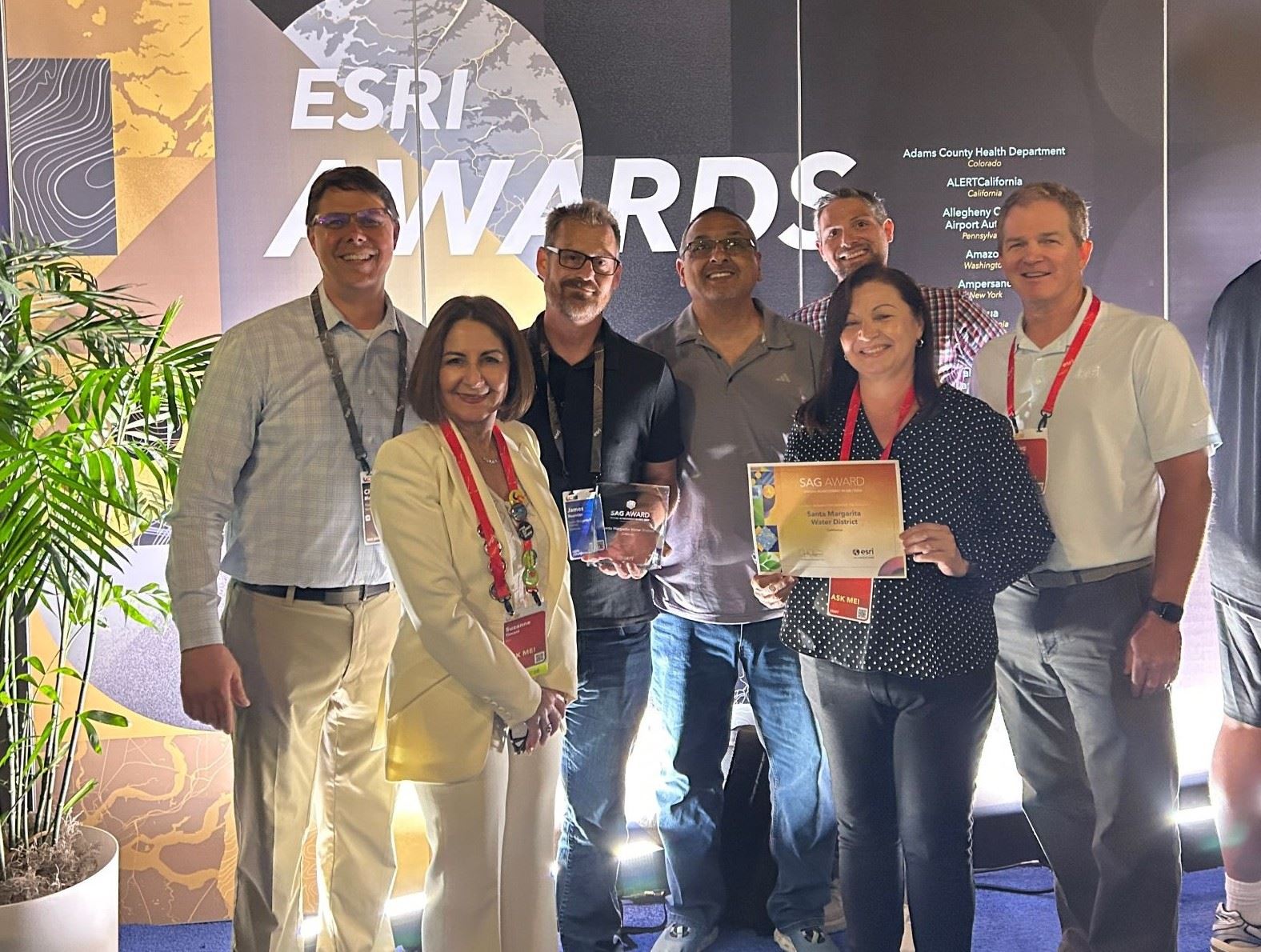
Santa Margarita Water District (SMWD) is proud to share that we’ve received the 2025 Special Achievement in GIS (SAG) Award from Esri, a global leader in mapping and location-based technology. This national award recognizes public agencies that use smart tools to improve operations—and it demonstrates how SMWD is leveraging this technology to better serve you, our customers.
Why It Matters
This award isn’t just about technology—it’s about using smart solutions to improve service, respond faster, reduce costs, and protect your water supply for years to come. Whether you’re a homeowner, a business, or part of a homeowner association, this recognition shows our commitment to providing reliable, efficient, and high-quality water and wastewater services.
Turning Old Records into Powerful Tools
Over the past decade, SMWD has been working behind the scenes to modernize decades of paper-based records and maps, some of which date back over 40 years. Today, that information resides in a single central digital system that tracks and manages everything, from water lines and hydrants to sewer systems and meters. This enables us to better monitor our infrastructure, respond more quickly to issues, and plan more effectively for the future.
How Technology Is Making a Difference
With Esri’s GIS (Geographic Information System) tools, we’re improving nearly every part of our operation:
- Smarter Billing: We use aerial maps and parcel data to set fair and accurate outdoor water budgets, based on real property conditions.
- Better Maintenance: From tracking fire hydrants to inspecting sewer lines, GIS helps us stay ahead of repairs and meet strict water quality regulations.
- Faster Field Service: Our crews now carry mobile devices that show real-time data and work orders—leading to faster repairs and better service.
Meet the Team Behind the Innovation
This transformation wouldn’t be possible without our dedicated team. GIS Specialists James Fournier and Pilar Yager, who have over 30 years of experience, led the charge. They’re supported by Dustin Navarro (IT Manager), Mia Forsline (Management Analyst), and Nate Adams (Director of Water Resiliency)—all working together to make SMWD’s systems stronger and smarter.
What’s Next
We’re not stopping here. SMWD is continuing to expand smart systems that:
- Streamline how we manage service requests
- Improve coordination on infrastructure projects
- Automate key workflows to save time and reduce costs
All of this leads to better service for our customers.
The 2025 SAG Award is more than just a trophy. It’s a reminder of the trust our customers place in us and a sign that we’re using every tool available to deliver the best possible service. We’re proud to lead the way in using technology to protect our resources, plan for the future, and keep your water system running strong.
Source: https://events.esri.com/conference/sagList/?fa=Detail&SID=7972
Mojave Water Agency Begins Critical Infrastructure Project in Phelan
Mojave Water Agency (MWA) officially broke ground on the Mojave River Pipeline Traveling Screen Project today at a morning ceremony held at the project site in Phelan. The event marked a major milestone in the Agency’s ongoing mission to enhance regional water reliability and sustainability.
“This project reflects our agency’s commitment to ensuring that every part of our service area has access to reliable, efficient, and resilient water systems,” said Roelle. “By restoring the Mojave River Pipeline and increasing recharge capacity, we’re preparing for both today’s needs and tomorrow’s challenges.”
Community members, elected officials, and local water partners, gathered at 11987 Duncan Road for the ceremonial turning of the first dirt. The event featured remarks from President Roelle, Project Manager Tesfaye Demissie, and representatives from each of the construction partners, who highlighted the project’s regional significance, particularly for the West Victorville and Phelan areas, both designated as severely disadvantaged communities.
The $6.3 million project, awarded to Nicholas Construction, managed by Kennedy Jenks, and designed by Corollo Engineering, includes the installation of a state-of-the-art traveling screen facility to reduce moss and debris entering the pipeline. It also involves construction of a new two-acre groundwater recharge basin and expanded infrastructure to capture and store water during wet years.
“This is the kind of investment that sets our region up for long-term success,” said Roelle. “We’re not just breaking ground, we’re building a stronger foundation for water security in communities that need it most.”
The project is partially funded by $3.9 million in grant support from the California Department of Water Resources’ Urban and Multi-benefit Drought Relief Program and congressionally directed spending secured by Congressman Jay Obernolte through the EPA’s Community Grants Program for Stormwater Capture and Recharge. As a recipient of federal funds, MWA is also committed to compliance with the Build America, Buy America Act, supporting domestic manufacturing and job creation. Construction is expected to be completed by March 2026.
For more information about the Mojave River Pipeline Traveling Screen Project or other MWA initiatives, visit www.mojavewater.org or contact the Public Information Office at (760) 946-7001.
About Mojave Water Agency:
Mojave Water Agency is a public agency responsible for managing and protecting water resources across a 4,900-square-mile region in Southern California’s High Desert. As a State Water Project contractor, MWA supports groundwater recharge, water conservation, infrastructure development, and long-term regional sustainability.
ACWA Election Ballots Are Out, Voting Closes Sept. 19
ACWA member agencies’ authorized voters received an electronic ballot July 21 to vote for the ACWA President, Vice President and their Region Board for the 2026-’27 term. The deadline to complete voting is Friday, Sept. 19.
The ACWA President and Vice President Candidates’ Town Hall was held July 23. Official candidates running for the 2026-’27 term shared their statements and participated in a Q&A session. A recording of the town hall is available at acwa.com/elections.
To learn more about the election, including information on candidates, visit acwa.com/elections.
ACWA Launches Official YouTube Channel
The Association of California Water Agencies (ACWA) is pleased to announce the launch of its official YouTube channel, a new platform designed to highlight the work of the association, member tools and the innovation and best practices of ACWA member agencies. This initiative is part of ACWA’s Strategic Plan, which calls for the launch of a YouTube channel to demonstrate the forward-thinking work of ACWA members and underscores the value of ACWA membership. The new channel will feature:- Educational content on pressing water issues and policy developments;
- Teasers and recaps of ACWA conferences and other events;
- Playlists featuring ACWA member agency videos; and
- Spotlight videos highlighting the innovations of ACWA award finalists and winners.
Experimental Hatchery Strays Find Suitable Habitat and Cold Water on the Tuolumne
LA GRANGE – In an exciting and unexpected conservation success, 1,200 adult spring-run Chinook salmon—originally released as part of the San Joaquin River Restoration Program—made their way to the Tuolumne River, where they’ve found abundant habitat and cold, clean water in which to spend the summer prior to spawning in the fall.
This remarkable development represents an important milestone for the San Joaquin River Restoration Program and highlights the positive impact of the Tuolumne River Partners (Turlock and Modesto Irrigation Districts and the San Francisco Public Utilities Commission) longstanding stewardship and science-based management of the Tuolumne River.
These spring-run Chinook salmon, part of a long-term experimental reintroduction effort on the San Joaquin River, were drawn to the Tuolumne due to its robust spring pulse flows, favorable temperature conditions, and higher water volumes—conditions created under the Tuolumne River Partners’ annual operations to support fall-run Chinook.
Drone surveys of nine pools in the Tuolumne River on July 16 counted 1,154 fish; fisheries biologists conservatively estimate that the total number of spring-run may be over 1,500. “In addition to the pulse flow, numerous other factors, including large hatchery releases, extremely wet conditions during migration to sea, and closure of commercial fishing, all contributed to the unprecedented spring-run numbers seen on the Tuolumne in 2025,” said FISHBIO Vice President and Senior Biologist Andrea Fuller.
Emergency Relocation Efforts to Prevent Stranding
As spring pulse flows receded and the La Grange Diversion Dam—a historic overpour dam built in 1893—ceased overtopping, the plunge pool at the base of the dam became disconnected from the lower river, trapping a significant number of fish in the pool. In close coordination with the U.S. Fish & Wildlife Service (USFWS), California Department of Fish and Wildlife (CDFW), NOAA Fisheries, and fisheries consulting firm FISHBIO, the Districts supported five relocation operations, successfully moving spring-run salmon to deeper, cooler pools downstream to support their survival over the summer. While CDFW representatives led the effort of physically handling the fish, District staff provided logistical and technical support that aided the relocation efforts.
“We were pleasantly surprised by the number of spring-run salmon identified in the Tuolumne River, and it was impressive to see the way District staff and state and federal fishery agencies worked together – from CDFW designing the relocation plan to TID’s Construction and Maintenance team developing a device to safely relocate the fish from the pool at the base of La Grange dam to a more suitable part of the river,” said Brad Koehn, TID General Manager.
Science-Driven Monitoring and Conservation Commitment
To better understand and support this unique salmon population throughout their entire lifecycle, the Tuolumne River Partners have voluntarily implemented an extensive scientific monitoring program. This includes real-time monitoring of water quality (including water temperature and dissolved oxygen) at key points along the river, detailed mapping of river habitats, and expansion of on-the-ground surveys to track fish behavior and spawning success. Weekly drone surveys continue to monitor the health and numbers of spring-run Chinook.
“Our commitment to science-based, data-driven measures is making a real difference on the Tuolumne River,” said MID General Manager Jimi Netniss. “We’re excited to keep this momentum going and work alongside other agencies and partners who share our vision for a healthy river and fish populations.”
To protect the genetic integrity of both spring-run and fall-run Chinook salmon during the late summer and fall spawning season, the Tuolumne River Partners have proposed the installation of a segregation weir near Old La Grange Bridge that will provide separate spawning areas for spring-run and fall-run Chinook. This would help support the resilience of the overall salmon population.
Together, these efforts will support the significant public investments made in the San Joaquin River Restoration Program.
A Sustainable Path Forward for Spring-Run Salmon
Preliminary data—including submersible video from the CDFW and visual observations during relocation efforts—indicate that the vast majority of the returning fish are hatchery-origin (evidenced by the absence of adipose fins). These findings, coupled with scientific studies specifically conducted on the Tuolumne River, suggest that habitat conditions in the river, enhanced by proactive management, are not only suitable for fall-run Chinook but can also sustain spring-run populations.
Based on the amount of available spawning habitat on the lower Tuolumne River, including newly constructed spawning habitat upstream of Old La Grange Bridge, there is sufficient habitat to support successful spawning and rearing by both spring-running and fall-running Chinook salmon if the available habitat is actively managed to the benefit of both runs. Planned future habitat restoration efforts on the lower Tuolumne River will provide additional habitat to sustainably support spring-run Chinook salmon into the future.
“We’re committed to being good environmental stewards, and it’s great to see our collective efforts pay off with so many fish on the Lower Tuolumne,” said SFPUC General Manager Dennis Herrera.
“Together with our partners, we’re doing the work to protect and restore native fish populations on the lower river. The Old La Grange Bridge project is a preview of the future. It’s an example of the many projects to come as part of our longer-term commitment to significantly invest in improving habitat on the Lower Tuolumne through the Healthy Rivers and Landscapes Program.”
Background on the San Joaquin Restoration Program can be found here SJRRP.
###
Media Contacts:
For Turlock Irrigation District, contact Constance Anderson | cjanderson@tid.org | 209.883.8448
For Modesto Irrigation District, contact Melissa Williams | melissa.williams@mid.org | 209.526.7390
For the San Francisco Public Utilities Commission, contact John Cote | jcote@sfwater.org | 415.417.9319
About the Turlock Irrigation District (TID)
Established in 1887, the Turlock Irrigation District (TID) was the first irrigation district in the state. Today it is one of only four in California that also provides electric retail energy directly to homes, farms, and businesses. TID delivers irrigation water through over 250 miles of a gravity-fed canal system that irrigates approximately 150,000 acres of farmland. TID owns and operates an integrated and diverse electric generation, transmission and distribution system that provides power to a population of 240,000 within a 662 square-mile area. With a drive towards innovation, TID has been a leader in new initiatives and data-driven practices to provide value to its customers. For more information about TID visit www.tid.org, follow @TurlockID on social media platforms and subscribe to TID Water & Power Podcast wherever you get your podcasts.
About the Modesto Irrigation District (MID)
The Modesto Irrigation District, established in 1887, is a vertically integrated public utility located in California’s Central Valley. MID provides irrigation water to more than 2,300 agricultural accounts irrigating more than 60,000 acres and electricity to more than 133,000 residential, commercial and agricultural accounts in Modesto, Empire, Salida, Waterford and Mountain House as well as parts of Escalon, Oakdale, Ripon and Riverbank. MID also treats, delivers and wholesales up to approximately 67,000 acre-feet of drinking water per year to the City of Modesto. For more information about MID visit www.mid.org or follow MID on Facebook (@modestoirrigationdistrict) and X (@mod_irrigation).
About the San Francisco Public Utilities Commission (SFPUC)
The San Francisco Public Utilities Commission is a department of the City and County of San Francisco. The SFPUC delivers drinking water to 2.7 million people in the San Francisco Bay Area, collects and treats wastewater for the City and County of San Francisco, and meets more than 75% of the electricity demand in the city. Its mission is to provide customers with high quality, efficient and reliable water, power, and sewer services in a manner that values environmental and community interests, and sustains the resources entrusted to its care. Learn more at www.sfpuc.gov.
District Earns Distinguished Financial Award for 17th Year
MARINA— Once again, the Marina Coast Water District has been recognized for outstanding financial stewardship—earning the Certificate of Achievement for Excellence in Financial Reporting from the Government Finance Officers Association (GFOA) for the 17th consecutive year.
In recognition of the award, District General Manager Remleh Scherzinger stated, “We appreciate staff for their hard work in achieving award-winning financial practices. The GFOA award confirms that ratepayer dollars are being managed wisely, responsibly, and in full view of the public. He added that, “our goal in working to earn this award is to help build public confidence in the District.”
In additional financial news this year, the District refinanced a bond and saved its customers $2,372,421 in interest payments. The District’s bond rating was also upgraded to AA- Positive Outlook, one of the highest ratings available.