
CHWD Breaks Ground on Two New Wells to Secure Community’s Water Future
Citrus Heights Water District (CHWD) recently began constructing two new groundwater wells to improve water reliability for the community and reduce reliance on Folsom Lake during dry years.
The project is supported by more than $6.6 million in external funding, including over $2 million in Community Project Funding championed by Congressman Ami Bera, as well as grant funding through the Regional Water Authority and the State.
“These new wells are more than an infrastructure upgrade—they’re a smart investment in public health and economic security,” said Congressman Ami Bera, M.D. “I was proud to help secure federal funding for this project, and I’ll continue working to support CHWD’s efforts to deliver reliable and sustainable water supply for families and businesses in Citrus Heights.”
The wells will include aquifer storage and recovery technology, a forward-thinking approach that allows CHWD to inject water underground during wet years and pump it out when needed. This flexibility not only supports CHWD customers—it contributes to the health of the region’s shared water supply and increases resilience across the Sacramento region.
“This is a regional win,” said Brett Ewart, Board Chair of the Regional Water Authority. “By investing in aquifer storage and recovery, we’re moving closer to a true regional water bank that helps balance supplies, manage costs, and strengthen our response to dry periods.”
Construction of Wells #7 and #8 are underway. Both are part of CHWD’s broader Groundwater Expansion and Reinvestment Program.
“These wells are part of CHWD’s commitment to safe, reliable, and affordable water service,” said Ray Riehle, President of the CHWD Board of Directors. “We should all be proud of this investment for our community and future generations. We’re committed to planning ahead, applying for grants, and making smart investments—so our customers always receive high-quality water. These wells represent our mission in action.”
About Citrus Heights Water District
The Citrus Heights Water District provides safe, high-quality water to over 70,000 customers in parts of Citrus Heights, Fair Oaks, Orangevale, Carmichael, and Roseville. Established in 1920, we have proudly served Citrus Heights and surrounding communities for over 100 years. Learn more at chwd.org.
Otay Water District Serves a Vital Role by Preserving Local Habitat, Biodiversity and Water Quality
The Otay Water District’s efforts to preserve local habitat contribute to the region’s biodiversity and support healthy ecosystems, which are crucial for maintaining water quality for its customers and throughout San Diego County.
East Chula Vista’s San Miguel Habitat Management Area (HMA), owned and maintained by Otay, is home to high-quality native habitats, including wetlands, coastal sage scrub, and grasslands, that provide vital refuge for sensitive plants and wildlife, some of which are unique to Southern California.
Various special-status species  have been detected in the HMA, including the coastal California gnatcatcher, the least Bell’s vireo, the Quino checkerspot butterfly, the burrowing owl, the Otay tarplant, and the variegated dudleya.
Established in 1994 under a joint agreement with the U.S. Fish and Wildlife Service and the California Department of Fish and Wildlife, the HMA offsets environmental
impacts from the construction and operation of Otay facilities. When projects impact sensitive habitats, the District protects and enhances native habitats in the 240-acre HMA.
Water agencies preserve habitat to ensure a sustainable and reliable water supply for current and future needs, while also supporting healthy ecosystems and communities. Habitat preservation is crucial for maintaining water quality, regulating water flow, and providing valuable ecosystem services. Healthy habitats also support biodiversity, protect endangered species, and enhance recreational opportunities.
“The San Miguel Habitat Management Area reflects Otay’s commitment to protecting native species and preserving natural resources while delivering safe, reliable water to our community,” says Otay Environmental Compliance Specialist Juliana Luengas.
With ongoing development in Southern California, biological reserves like the HMA serve as critical sanctuaries for plants and animals. The District is committed to ensuring the site is well-managed and that the biological resource needs are met through ongoing maintenance and monitoring.
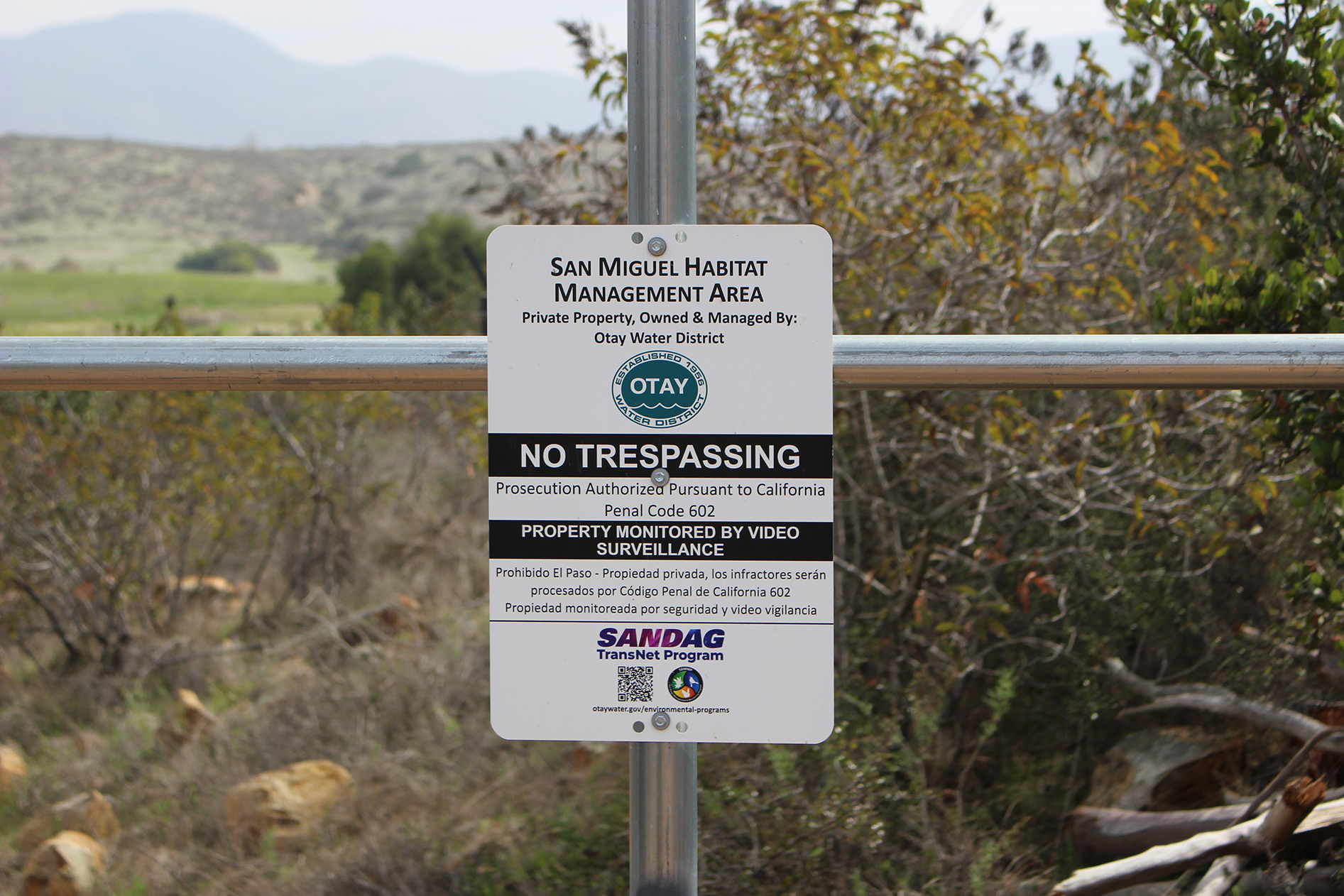
In 2023, the Otay Water District was awarded a grant through the SANDAG TransNet Environmental Mitigation Program for Threat Reduction in the HMA. This program has allocated $4 million annually to help maintain the biological integrity of San Diego County.
Ongoing activities within the San Miguel HMA include updating wildlife surveys and site maintenance.
Help nature thrive in our community! Recently, the Otay Water District has been using the SANDAG funds to combat the increased threat of illegal trespassing. The HMA is private property and closed to the public. The District aims to reduce the number of recreational trespassers, including mountain bikers, hikers, dirt bikers, and ATV riders along the perimeter fencing, and reduce disturbance to habitats throughout the HMA. Trespassing, hiking, biking, littering, or feeding wildlife is strictly prohibited, as these actions can cause serious harm to the sensitive plants and animals.
Learn more at otaywater.gov/hma.
Golden Mussel Veligers Detected in Lake Palmdale; PWD Preparing Plan
PALMDALE – The California Department of Fish and Wildlife (CDFW) has found three golden mussel veligers in plankton samples collected from a dock at Lake Palmdale, which stores Palmdale Water District’s (PWD) water from the California Aqueduct and Littlerock Reservoir. The July 15 confirmation of the golden mussel veligers, which is the larval stage, marks the first of its discovery in a body of water connected to the aqueduct’s East Branch. The invasive mussels have been detected in numerous locations in Northern California and the aqueduct’s West Branch. Although the veligers were collected from a dock close to the aqueduct inlet at Lake Palmdale, the actual source of the mollusk has not been determined. “We are in the process of preparing a monitoring and control plan for handling the golden mussels,” PWD Assistant General Manager Scott Rogers said. “It’s unfortunate they made it to Lake Palmdale, but it’s not a surprise. They’ve been moving south since its discovery last October in the Sacramento-San Joaquin River Delta. “A copper-based algaecide, commercially available as EarthTec, is effective in controlling mollusks,” he added. “We know that other water agencies have used it effectively to control other mollusks.” The Sacramento-San Joaquin River Delta is the heart of the California State Water Project, which moves water from the north to the south via the 444-mile aqueduct. The tiny veligers do not affect the quality of Lake Palmdale’s water, which is treated at the Leslie O. Carter Water Treatment Plant before being distributed to customers. However, they must be controlled because their infestation could clog pipes, pumps and treatment plants. In 2009, the PWD Board of Directors adopted the Policies and Procedures for Boat Access Restrictions at Palmdale Lake, Vessel Inspection, Tamper-proof Tag and Lake Monitoring Program. The Fin & Feather Club, which leases portions of Lake Palmdale for boating and fishing, works cooperatively with the District to have strict inspection rules for boats that are used in the lake under the program. Boaters are required to complete a survey prior to entry, and all boats are subject to inspections. Mollusks, such as the golden mussel, latch onto boats and can be transferred between bodies of water if vessels are not properly washed and cleaned. According to the California Fish and Wildlife Commission, its Invasive Species Program laboratory staff detected the golden mussel veligers from samples that were collected at Lake Palmdale on June 26 and July 10. They were confirmed by cross-polarized light microscopy, polymerase chain reaction and DNA sequencing for species confirmation. Since 1918, the Palmdale Water District has provided high-quality water at a reasonable cost. We pride ourselves on providing great customer care; advocating for local water issues that help our residents; educating the community on water-use efficiency; and leading our region in researching and implementing emerging technologies that increase operational efficiency. For more information about PWD, visit www.palmdalewater.org.###
Clair A. Hill Award Winner Celebrates Project’s Completion with Community
Last month, more than 100 community members, staff, Board members, and elected officials gathered for a celebration marking the completion of the Calleguas-Las Virgenes Interconnection Project. Earlier this year, the districts were honored to receive ACWA’s prestigious Clair A. Hill Award recognizing this achievement. The districts marked this accomplishment and thanked the community for their patience with tacos, ice cream, cake, a raffle, and more, creating a fun-filled and informative evening.
Ten years in the making, this innovative and collaborative project crosses neighborhoods, service areas, and County lines to provide greater water supply reliability for both Calleguas and Las Virgenes MWD. This ability to now share water between the two agencies in times of need is the critical back-up plan needed to ensure that water keeps flowing to residents, businesses, schools, and parks.
This project is especially important for these two water suppliers who are wholly dependent upon imported water from one source, the Metropolitan Water District of Southern California (Metropolitan). If this supply is ever interrupted due to a natural disaster or other circumstance, the new interconnection will allow the two agencies to physically share water between their systems, providing a critical backup supply to facilitate reliable delivery of water. The interconnection also provides opportunities for future collaboration in the development of local water supplies that could help both districts increase self-reliance and reduce their dependence on Metropolitan.
Calleguas Board President Raul Avila noted, “This game-changing effort shows how tight-knit, creative partnerships keep our water flowing strong. By teaming up, we’re delivering lasting wins for our community.”
“We are proud of this project and the strong partnership between our two agencies,” said Andy Coradeschi, LVMWD Board President . This regional asset is a blueprint for other agencies to follow.”
This project was funded in part through the California Department of Water Resources Integrated Regional Water Management Grant Program. Calleguas received $4,369,241.28 in funding from Proposition 1 and LVMWD received $1,975,517 from Proposition 84.
PV Water Celebrates College Lake Water Supply Project
WATSONVILLE — On Friday August 8th, about 100 people, including the Pajaro Valley Water Management Agency (PV Water), elected officials, and community members, celebrated the College Lake Water Supply Project, a major milestone in the region’s effort to achieve sustainable groundwater resources, during a ribbon cutting ceremony.
Speakers at the event included State Senator John Laird, CA State Water Resources Control Board Member, Vice Chair Dorene D’Adamo, PV Water Board Chair Stephen Rider, Board Member and former General Manager Mary Bannister, and General Manager Brian Lockwood, as well as Jule Rizzardo, Financial Assistance Branch Manager, from the Department of Water Resources (DWR), and Director Jennifer Lucceshi from the Department of Conservation (DOC). DWR and the DOC collectively provided approximately $11.8 million in grant funds to support the $80 million project through the Sustainable Groundwater Management Act (SGMA) Implementation Grant ($7.6 million), the Proposition 1 Round 2, Integrated Regional Water Management (IRWM) Implementation Grant ($1.8 million), and the Multibenefit Land Repurposing Program ($2.375 million), respectively.
The Project establishes College Lake as a new water supply source to reduce groundwater overdraft and seawater intrusion, while supporting habitat for the endangered South-Central California coast steelhead. The Project includes three major components: a water intake facility with fish passage, a water treatment plant located at 76 Holohan Road, and a 6-mile, 30-inch treated water pipeline that conveys treated water to approximately 6,300 acres of farmland through PV Water’s 23-miles of conveyance pipeline known as the Coastal Distribution System.
The new facilities feature two pumps to draw water from the lake, an adjustable weir with fish passage, a ballasted flocculation/sedimentation treatment process, sediment drying beds, chemical storage, a treated water pump station and a treatment support building.
Groundwater provides more than 90% of the Pajaro Valley’s water supply. Long-term over pumping has caused water levels to drop below sea level, resulting in seawater intrusion, degraded water quality and reduced groundwater storage.
The College Lake Water Supply Project represents the largest new source of supplemental water developed in the region since the 2009 completion of the Watsonville Area Water Recycling Facility, which is a joint project between PV Water and the City of Watsonville.
Learn more about the College Lake Water Supply Project by visiting: https://www.pvwater.org/college-lake-project.
ABOUT PV WATER
The Pajaro Valley Water Management Agency (PV Water) is a state-chartered water management district, and a Groundwater Sustainability Agency, formed to efficiently and economically manage existing and supplemental water supplies to prevent further increase in, and to accomplish continuing reduction of, long-term overdraft. PV Water works to provide and ensure sufficient water supplies for present and future anticipated needs within its boundaries, generally the greater coastal Pajaro Valley. For more information, visit www.pvwater.org or follow PV Water on Facebook or Instagram.
August 2025 Priority Issues Update Now Available
The August 2025 Priority Issues Update is now available online to members.
The update is a summary of the latest developments on issues of interest to ACWA members. This issue contains information on the Healthy River and Landscapes Program, PFAS and more.
The new and previous Priority Issues Updates can be found here.
Tuolumne Utilities District Utilizes Goats for vegetation Control
Tuolumne Utilities District (TUD) is pleased to announce the continuation of its innovative and eco-friendly approach to vegetation management at Phoenix Lake. Following last year’s pilot program—where 150 goats quickly and efficiently cleared 2.5 acres of invasive species such as star thistle and blackberry bushes—the District has expanded the initiative this year. In July, the goats returned to work at Phoenix Lake and are grazing a larger span of 4.8 acres, further advancing sustainable land management for TUD.
From July 24th to August 19th, the goats will be left to graze with the primary objective of reducing invasive plant species that have been proliferating around the Phoenix Lake Dam, which hinders the natural ecosystem and poses maintenance challenges. Encouraged by the positive outcomes, TUD plans to utilize goats for similar vegetation management tasks in early Spring at the Tuolumne Water Treatment Plant.
The use of goats for vegetation management offers numerous benefits, including reducing the need for harmful chemical herbicides, lowering carbon emissions from machinery, preserving the natural landscape, and offering a cost-efficient land management solution. “We’ve been really impressed by the effectiveness of the goats,” said Kurt Bayers, Raw Water Superintendent at TUD. “They have exceeded our expectations, clearing invasive plants quickly and thoroughly while allowing us to manage the land in a way that’s environmentally sustainable and cost-effective.”
Workplace Safety Excellence Earns Rowland Water Top National Recognition
ROWLAND HEIGHTS — For the third consecutive year, Rowland Water District (RWD) has been awarded the Occupational Excellence Achievement Award by the National Safety Council (NSC). This prestigious distinction highlights RWD’s sustained commitment to protecting the health and well-being of its workforce, part of the organization’s core value system.
Presented in accordance with stringent reporting criteria set by the Occupational Safety and Health Administration (OSHA), the award is given to organizations with injury and illness rates at or below 50% of the Bureau of Labor Statistics (BLS) average for their industry classification. This is historically achieved by only a select group nationwide.
“Workplace safety is embedded in our culture, and we work each day to create a safe, secure environment where our team can thrive,” said General Manager Tom Coleman. “This recognition reflects the ongoing commitment of every District employee.”
RWD’s approach to safety is led by Compliance and Safety Manager Elisabeth Mendez, who oversees a robust safety program centered on regulatory compliance, employee training, and proactive injury prevention.
“We’ve built a workplace where safety is second nature,” said Mendez. “Every team member plays a role in identifying risks and protecting one another. Earning this award three years in a row shows how deeply our team makes safety a priority.”
RWD’s proactive safety measures include:
· Ongoing training programs for all staff
· Investment in modern safety equipment and protective technologies
· Hazard assessments and continuous improvement initiatives
· Strong internal reporting and accountability systems
These efforts reflect an organization-wide commitment to making safety a foundational part of daily operations. By emphasizing prevention and shared responsibility, RWD continues to lead by example within the water industry.
For more about Rowland Water District and its workplace safety initiatives, visit www.rwd.org
State Water Board Adopts Revised Water Measurement and Reporting Regulations
SACRAMENTO — The State Water Resources Control Board on Aug. 5 adopted revised Water Measurement and Reporting regulations, which apply to water rights holders that divert over 10 acre-feet per year.
The State Water board unanimously approved the regulations and they are set to take effect Oct. 1. More information on the regulations and rulemaking process is available online.
“We’re at a point where we need to move forward,” State Water Board Member Sean Maguire said during the State Water Board meeting. “We can’t make good sound, efficient, effective water management decisions without good, sound data. And I think that’s been clear over the past few years with the droughts that we’ve been through.”
ACWA worked extensively with its members and association partners during the past year to secure amendments that have resulted in more feasible and less burdensome regulations. More information is available in comment letters ACWA submitted at acwa.com/resources.
Yuba Water celebrates New Facilities on Marysville Road
MARYSVILLE – The Yuba Water Agency Board of Directors marked the first public meeting at the agency’s new Power Systems facilities today and held a ceremonial ribbon cutting.
Located at 8897 Marysville Road in Oregon House, 10 acres of the 20-acre property have been developed and include a recently completed 14,000-square-foot administration building, communications tower, laydown yard and parking. The site’s warehouse and mechanics shop are still under construction, expected to be complete by the end of the year.
Designed to work with the natural landscape and for the community, the facility is built with non-flammable materials and solar panels that feed excess power back onto the grid, a 150,000-gallon water tank for fire crews and a new, safer school bus stop for students with a turnout, crosswalk and lighting.
“There was a lot of thought and intention put into the new buildings,” said Jon Messick, chairman of Yuba Water’s board and Yuba County supervisor for District 5, which includes the foothills. “The fire-resilient construction, new water tank for fire protection and school bus stop really show the agency’s commitment to public safety and to being a good neighbor.”
The new facilities replace Yuba Water’s previous building near New Colgate Powerhouse at the base of Lake Francis Road, about 15 minutes downhill. The old structure, a repurposed 1950s powerhouse building, no longer met the needs of the agency’s growing staff and operations. While some staff will continue working at the powerhouse, those previously based at the old administration building have now relocated to the new facility.
“The new site is a much-needed upgrade to accommodate our growth,” said Willie Whittlesey, Yuba Water’s general manager. “But its strategically centralized location between our dam and powerhouses is really improving efficiency for our staff, not to mention their quality of life with a much shorter commute, and it offers a significant step up in our ability to collaborate across the agency.”
The new Power Systems site primarily supports the agency’s hydropower mission, which generates more than 400 megawatts of clean electricity and helps fund projects that advance Yuba Water’s other mission areas, including flood risk reduction, water supply reliability, fish habitat enhancement and more.
Hilbers Incorporated of Yuba City built the facilities at a cost of $42 million.
Board approves completing property purchase in Marysville
As the new foothill facility nears completion, Yuba Water is now exploring options to consolidate its four different Marysville offices. Today the agency authorized completing the purchase of two properties at 1227 and 1229 D Street for $680,000. The parcels are directly adjacent to an existing Yuba Water office location, with the goal of potentially developing the combined properties into a future agency headquarters, bringing its Marysville-based staff under one roof for improved efficiency, collaboration and cost savings.
The agency will now begin planning and design for the new site, exploring permitting and zoning needs. No construction will take place for at least one year.
“The properties are right next to an existing agency facility, which basically gives us a block to work with,” said Renick House, Yuba Water board director and Yuba County’s supervisor of District 2, which includes Marysville. “It’s just one street over from an industrial area. I think it has the potential to revitalize the area around Ellis Lake, and it makes good use of the limited resources we have in Marysville.”
Learn more about Yuba Water Agency and its work to power a brighter future for Yuba County at yubawater.org.