
Citrus Heights Water District Appoints Acting General Manager
Citrus Heights Water District (CHWD/District) has appointed Melissa “Missy” Pieri, P.E. as Acting General Manager, effective September 24, 2026.
Pieri has served CHWD for more than 14 years, beginning her career with the District in July 2012 and advancing to her recent role as Director of Engineering/District Engineer in June 2017.
Throughout her tenure, she has developed a strong understanding of the District’s infrastructure, operations, employees, policies, and strategic priorities, while building positive working relationships with local and regional agencies and community partners.
Her leadership has been instrumental in multiple District initiatives, including Project 2030, the District’s proactive effort to replace more than 70% of our aging water mains between 2030 and 2080.
Before CHWD, Pieri worked for 16 years at an engineering consulting firm, providing civil engineering services with an emphasis on water and wastewater infrastructure.
As Acting General Manager, she will oversee the District’s daily operations and ensure continued water service for CHWD’s approximately 70,000 customers.
“With Missy providing leadership, CHWD is well-positioned to continue its core mission of providing a dependable supply of safe, quality water to our customers,” said CHWD Board President Caryl Sheehan.
“The Board has confidence in the dedication of our staff, who work every day to serve our community. We embrace this transition as an opportunity to look to the future and move the District forward into its next chapter.”
The CHWD Board selected Pieri to succeed Hilary Straus, who is retiring after more than 20 years of service to the Citrus Heights community, including a decade as CHWD General Manager.
IEUA Awarded for 28 Consecutive Years of Outstanding Financial Transparency
INLAND EMPIRE – The Inland Empire Utilities Agency (IEUA) has been awarded the Government Finance Officers Association (GFOA) Certificate of Achievement for Excellence in Financial Reporting for the Fiscal Year 2024/25 Annual Comprehensive Financial Report (ACFR). This marks the 28th consecutive year that IEUA has received this prestigious recognition.
The GFOA represents over 25,000 public finance officials throughout the United States and Canada. The Certificate of Achievement for Excellence in Financial Reporting Program was established in 1945 to encourage and assist State and local governments to go beyond the minimum requirements of generally accepted accounting principles. It is the highest form of recognition in governmental accounting and financial reporting, representing a significant accomplishment by a government and its management.
“IEUA and its outstanding professionals take pride in managing public resources responsibly and serving our community with the highest level of integrity,” stated Steve Elie, IEUA Board President. “To maintain this level of excellence for 28 consecutive years our staff must conduct extensive analysis, collaborate internally and externally, and consistently use their technical expertise to ensure continued compliance and award-winning financial reporting. We are grateful to GFOA for this honor and for recognizing staff’s ongoing commitment to excellence.”
Produced fully in-house by IEUA’s Accounting Unit, the ACFR undergoes an extensive review by finance professionals with expertise in governmental accounting and financial reporting. It is judged by an impartial panel to meet the high standards of the program, which includes demonstrating a constructive “spirit of full disclosure” to clearly communicate its financial story and encourage a variety of audiences to read the report.
District Earns Distinguished Financial Award for 18th Year and Credit Rating Upgrade
MARINA — Once again, the Marina Coast Water District has been recognized for outstanding financial reporting and accounting by earning the Certificate of Achievement for Excellence in Financial Reporting from the Government Finance Officers Association (GFOA) for the 18th consecutive year.
In a separate and unrelated action, Standard & Poor’s raised the District’s credit rating to AA last month, one of the highest ratings available. Excellent credit ratings can make a real difference for customers. For example, last year the District refinanced a bond that will save customers over $2.3 million in total interest payments.
In its August 13, 2026 Research Update on the District, Standard & Poor’s stated: “We view MCWD’srecent financial performance and financial capacity asrobust… The rating is underpinned by the district’s… track record of conservative budgeting and financial management, and its prudent approach to water-supply reliability to mitigate risks associated with climate
variability and water shortages.”
In recognition of the award, the credit rating, and overall excellent financial news, District General Manager Remleh Scherzinger stated, “Our first goal is to provide excellent, high-quality, and reliable water services for our customers. In addition, we always work to do it cost-effectively, and this award and strong financial news demonstrate our success. We are proud of our financial team and our entire staff for their excellent work.”
Newsom Proclaims State of Emergency to Help Water Agencies Prepare for Super El Nino
SACRAMENTO – The Association of California Water Agencies (ACWA) thanks Gov. Gavin Newsom for issuing today’s state of emergency, which will help state and local agencies immediately launch flood protection work in advance of a widely forecasted severe El Niño storm season.
The proclamation initiates a wide range of measures to protect California communities and infrastructure now in preparation for potentially heavy flooding this winter. This includes staging flood protection materials, advancing groundwater recharge projects, and enhancing coordination between state, federal and local governments.
“Governor Newsom’s action today reflects his continued leadership to advance California’s resilience to increasingly volatile climate extremes,” said ACWA Executive Director Karla Nemeth. “Giving local water agencies the ability to take decisive action now will help them prepare and safeguard their communities, agricultural resources and public infrastructure from potentially catastrophic flooding.”
September 2026 ACWA News Available
Read the September edition of ACWA News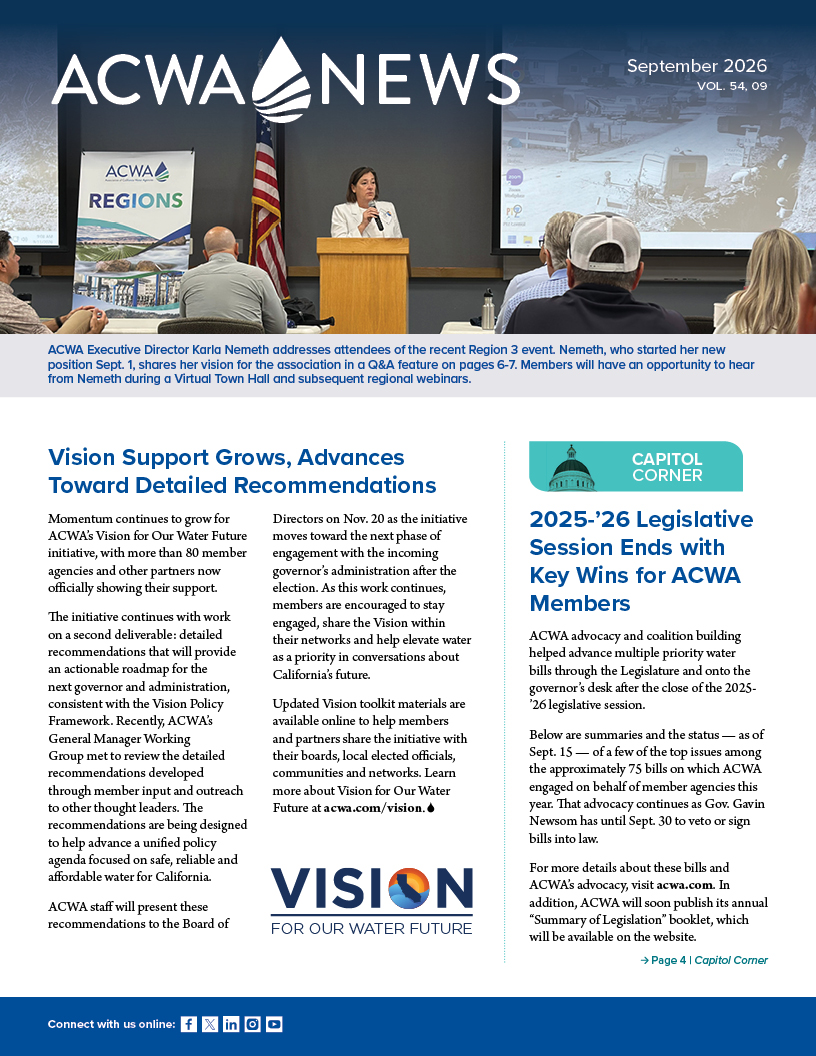 for informative articles about the association and water industry.
Articles include:
- Get to Know New ACWA Executive Director Karla Nemeth
- President’s Column: A September to Remember During a Dynamic 2026
- Access Tools to Celebrate Water Professionals Appreciation Week
- 2025-’26 Legislative Session Ends with Key Wins for ACWA
Spotlight Sept. 2026: Getting to Know New Executive Director Karla Nemeth
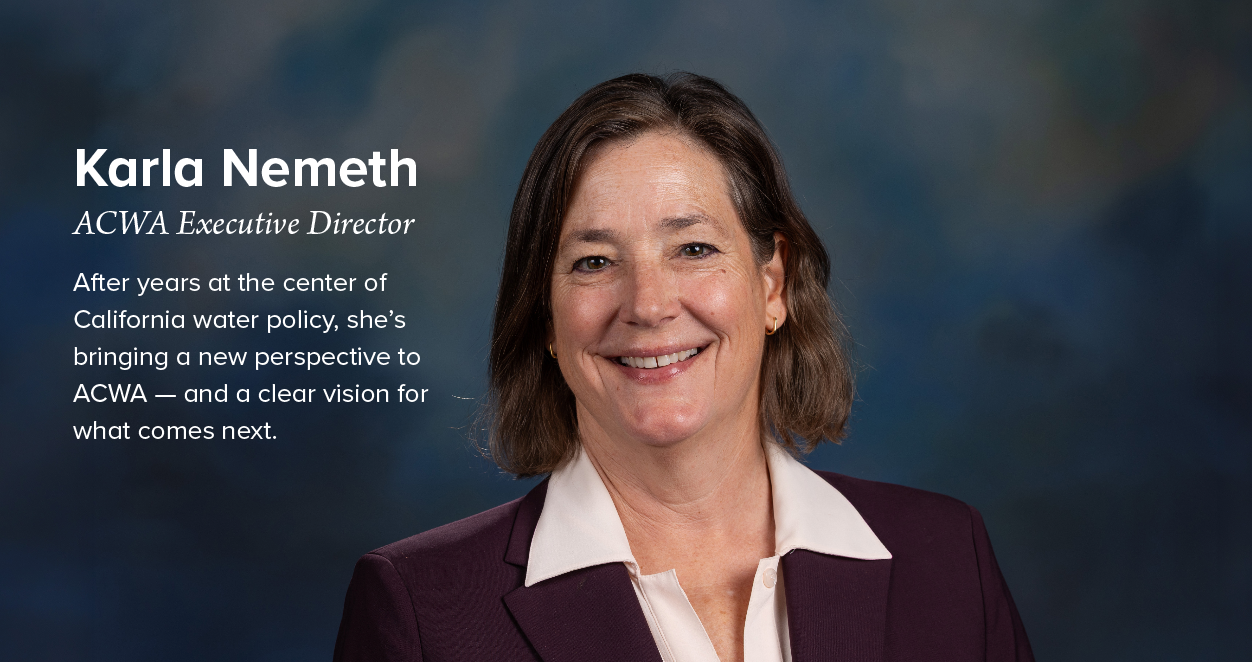 Former California Department of Water Resources Director Karla Nemeth started her new position as Executive Director of ACWA on Sept. 1, bringing more than two decades of water policy experience and high-profile statewide recognition to the association.
ACWA’s Board of Directors selected Nemeth for the position in May following a nationwide recruitment process. Marwan Khalifa, who served as Interim Executive Director for the past 19 months, will remain at ACWA through the end of the year.
Nemeth recently sat down with ACWA News to provide some insight into her priorities and plans for the future.
Q. What inspired you to apply for the position of ACWA’s Executive Director?
A. So many water solutions require a new recognition of our interdependencies and a willingness to evolve the relationship between our local agencies and the state and federal government. ACWA members are some of the biggest innovators in the business — using cutting-edge forecasting to adapt our reservoirs; operating the largest desalination plant in the western hemisphere; investing in working lands that reduce flood risk, refill groundwater supplies, and support salmon; protecting and restoring headwaters to make them more resilient to wildfire; and deploying state-of-the-art value engineering to deliver valuable safe water to our customers. After many years in the California Governor’s Office, Department of Water Resources and Natural Resources Agency, I understand the value of local water agencies uniting around actions that will make a real difference in the lives of Californians — the reliability and affordability of our water supplies. It simply won’t happen without the robust leadership of local water districts. Last, but certainly not least, I love the public sector and its mission-driven people. I’m very inspired by the opportunity to bring up the next generation of water leaders who will also face the challenges of fire, flood and drought. We share the responsibility for their readiness and cultivating their passion for public service.Q. You bring an impressive background in water policy experience to the association. Do you have specific goals for ACWA’s advocacy efforts?
A. I’m excited to build upon ACWA’s Vision for Our Water Future, a member-driven initiative for providing affordable water for California. It will be critical that our recommendations reflect the needs of our members — large and small, ag and urban; and on our coasts, in our valleys, deserts and mountains. Many of our advocacy efforts right now relate to that Vision, such as the Healthy Rivers and Landscapes Program, wildfire liability, clean energy fleet requirements and golden mussels to name a few. But there is more work to be done to position our eventual recommendations for implementation. I started engaging with state leaders and water industry partners on behalf of ACWA from day one, and I plan to visit our nation’s capital soon. I look forward to working with our members and staff to bring this Vision home in time for the new state administration and legislature.Q. What are your top priorities for ACWA?
A. My immediate priority is to get to know ACWA members and staff. So many industries are at a moment of transformation — both in terms of generational changes in the workforce and the scale of the challenges facing our own industry. I’m meeting with member agencies to better understand not only their common water challenges, but what they need and expect from ACWA. Our diversity of membership is our strength, but it’s also a real challenge in setting our California water agenda for the state and federal governments. Understanding our myriad perspectives is essential. Over time, we need to drive water policy research based on our experience as water managers in California and eventually become nimble enough organizationally to put these policies into action. ACWA is also a great convener. But gathering is not enough. A big part of ACWA’s job is to support the momentum that being together generates so that we can turn it into action throughout the state, in Sacramento and in Washington DC.Q. How can ACWA bolster its audience with the next governor and his administration?
A. Another year of challenging hydrology may help, but we’ll be ready. As we swing between very wet and very dry conditions — sometimes within a single water year — it can really grab Sacramento’s attention. And that’s where our Vision comes in. Our recommendations need to be sewn into a strategy that connects the need for safe, reliable and affordable water with the state’s most pressing challenges, such as extreme weather, the economy and housing. ACWA is also focused on influencing the quality of administration appointees. We will be looking for people with strong backgrounds in government operations and a track record not just for collaboration, but delivering outcomes as well. We know the challenges ahead are significant. Our hydrology is changing, our infrastructure is aging, and the demands on our water system continue to grow. We also know that no single agency or region can solve these challenges alone. We need to be willing to collaborate, invest and act as ACWA. Fortunately, there is no other organization with our breadth of experience and expertise. California has a tremendous opportunity in front of us, and we need to be ready to insist on and forge 21st Century water solutions. It’s a big job, and I want to hear from you!
A September to Remember During a Dynamic 2026
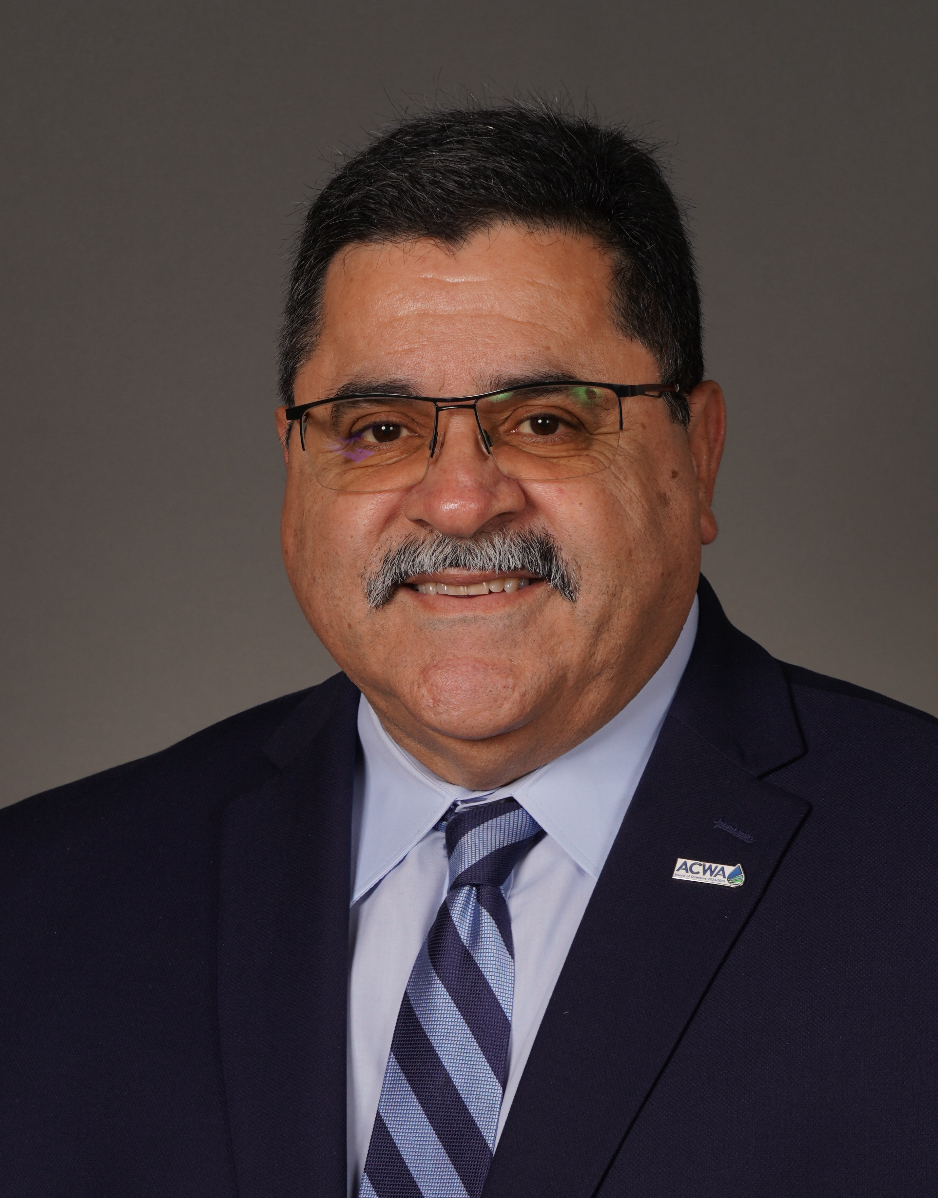 Last January, I wrote that ACWA was entering what promised to be a dynamic year. Looking back, that was a bit of an understatement.
Former Department of Water Resources Director Karla Nemeth has started as ACWA’s newest Executive Director. Introducing her during our Spring Conference was among the most exciting experiences during my term as ACWA President. And what’s even more exciting is how her role as a statewide water leader will continue through ACWA, directing our talented staff and engaging with ACWA member agencies.
At the same time, our Vision for Our Water Future initiative is progressing with meaningful work toward advancing long-term water reliability, affordability, infrastructure modernization and improved water management throughout California.
More than 80 allied organizations and ACWA member agencies have joined the coalition to make water a top priority for our next governor. This coalition equips participating organizations with ACWA-produced tools to elevate the importance of a reliable and affordable water future.
If your agency has not joined the Vision initiative, I urge you to learn more and consider doing so at acwa.com/vision. This member-driven process is developing detailed recommendations that will soon be presented to the ACWA Board of Directors. However, we need to keep this coalition growing to maximize its success in achieving a generational difference in how California manages its water.
We also entered September with several legislative wins. Two ACWA-sponsored bills passed the Legislature in August and, as of Sept. 15, are on the governor’s desk. Member engagement proved critical in getting to this point, and I want to extend my deep appreciation for member agencies’ willingness to join coalitions behind these bills.
One is SB 1153 (Caballero, D-Merced), which would strengthen wildfire preparedness by requiring public water systems to include wildfire response procedures in their emergency response plans. The bill would also clarify the limited role of public water systems during wildfires, reducing their exposure to costly lawsuits that can ultimately increase water rates and negatively affect affordability.
The second bill, AB 2180 (Ward, D-San Diego), would benefit public water agencies by bringing more common sense into the rate-setting process. ACWA has championed this cause in past legislation signed into law, which today helps minimize unnecessary legal disputes over water rates. This bill would build on that success, codifying a process where water system costs may be allocated using reasonable methodologies and available data without having to determine the exact costs for each parcel.
We are also paying close attention to the continuing threat from golden mussels. My agency, Contra Costa Water District, is among members hit hard by this persistent menace to water infrastructure and spearheading research to reduce golden mussels’ propagation and impact. I deeply understand why this is an urgent priority for many fellow water agencies. ACWA is responding to that urgency by supporting funding, educating the public and elected officials, as well as constantly engaging with regulators to strengthen our state’s response to this and all invasive species impacts.
We have accomplished a great deal this year, but there is much more ahead.
As we close out what truly has been a remarkable and dynamic year for ACWA, I want to thank ACWA members for your continued engagement, leadership and commitment to California water.
Frank Hilliker Elected Board Chair of San Diego County Water Authority
New officers for the San Diego County Water Authority’s Board of Directors were elected unanimously today, with Frank Hilliker starting his two-year term as Board chair on Oct. 1, vowing a continued focus on reliable, affordable water and transparent, forward-looking leadership for the region’s 3.3 million residents.
Hilliker, vice chair of the Board for the past two years as a representative of the Lakeside Water District, will serve with incoming Vice Chair Teresa Acosta from the Carlsbad Municipal Water District, and incoming Secretary Ismahan Abdullahi from the City of San Diego. Hilliker will serve as the 29th Board chair since the Water Authority’s founding in 1944. Hilliker follows Nick Serrano, representing the City of San Diego, as Board chair. Serrano has served as a Board member since 2021 and as chair since 2024. His term as chair ends on September 30, when he starts his tenure as chair emeritus. This new leadership team takes the helm at a pivotal moment for the Water Authority, which continues to invest in the infrastructure, transparency and innovation that keeps water reliable and affordable for the region’s residents, businesses, and $267 billion economy. As chair, Hilliker will work with Water Authority staff to help strengthen public trust, deepen regional partnerships and engage the communities the Water Authority serves. “It’s an honor to be voted Board chair of the San Diego County Water Authority,” said Hilliker. “I’m eager to build on the foundation laid by the current Board and leadership team with a focus on reliability and affordability for everyone – from the agricultural community to working families in San Diego.” His tenure begins as the agency puts decades of infrastructure investment to work for the broader region while helping keep local rates in check. In June, the Board approved the lowest water rate adjustment in recent memory – just a 3% wholesale rate increase for 2027, a figure below the national inflation rate. The agency credits recently-signed landmark water transfer agreements – with the Western Municipal Water District and the Eastern Municipal Water District, both in Riverside County, and Burbank Water and Power in Los Angeles County – for helping keep costs in check. These agreements are generating tens of millions of dollars each year for the Water Authority to the benefit of the San Diego region’s ratepayers. The Water Authority is also pursuing a first-of-its-kind framework to explore sharing its desalinated seawater with other states along the Colorado River. A Board member since 2007, Hilliker sits on the Legislation & Public Outreach Committee, Administrative & Finance Committee, Resource Strategy Work Group, and Hodges Litigation Committee. Hilliker is the co-owner of Hilliker’s Ranch Fresh Eggs in Lakeside, a company started by his grandparents in 1942. He is a longtime director for the Lakeside Water District, joining that board in 1998, and currently serves as secretary of the San Diego County Farm Bureau board. A third-generation San Diego County resident, Hilliker is passionate about helping small farmers and ranchers in the region survive and thrive. “I worked on the family farm after school and on weekends, so I know how important reliable and affordable water is for every family and every local business across our region,” said Hilliker. “My upbringing is what makes this personal for me. I know what it means for a farmer, rancher, and family to depend on water showing up when they need it, and that’s the perspective I will bring to every decision this Board makes.” On October 1, Teresa Acosta will take on her new role as vice chair. Acosta currently serves as vice chair of the Water Authority’s Legislation and Public Outreach Committee and as a member of the Administrative and Finance Committee and Hodges Litigation Committee. She was appointed to the Board in June 2023 representing the Carlsbad Municipal Water District. Acosta has served as Carlsbad’s District 4 councilmember since 2020. Additionally, she is the first vice president of the League of California Cities Board of Directors and will become board president at the conclusion of the organization’s Annual Conference later this month. Incoming Board secretary Ismahan Abdullahi currently serves as chair of the Water Authority’s Administrative and Finance Committee and vice president of the Finance Agency JPA. She also sits on the Engineering and Operations Committee. She was seated on the Board in 2021 and is the National Executive Director for the Faith Power Alliance.State Grant Will Help Sonoma Water Continue Invasive Mussel Prevention at Lake Mendocino
SANTA ROSA – Sonoma Water’s Board of Directors today approved accepting a $400,000 grant from the California State Parks Division of Boating and Waterways to continue Sonoma Water’s invasive mussel prevention program at Lake Mendocino. The two-year grant will fund watercraft inspections and early detection efforts through Oct. 15, 2028.
The importance of Sonoma Water’s invasive mussel prevention program was demonstrated on June 26, when a trained mussel detection dog alerted inspectors to the possible presence of invasive mussels on a wakeboard boat attempting to launch at Lake Sonoma. Although inspectors found no visible mussels, the boat was denied access and the owner was directed to have it professionally decontaminated. A water sample collected from the boat yielded laboratory results consistent with the biological markers of golden mussels.
“Keeping invasive mussels out of Lake Mendocino protects one of the region’s most important water supplies and recreational resources,” said Rebecca Hermosillo, chair of the Sonoma Water Board of Directors. “This grant allows Sonoma Water to continue a proven program that has protected Lake Mendocino from invasive quagga and zebra mussels for more than a decade.”
Sonoma Water began inspecting watercraft at Lake Mendocino and Lake Sonoma in 2012 using local funding. Since 2020, the Division of Boating and Waterways has helped fund the program through state grants. Sonoma Water operates a similar invasive mussel prevention program at Lake Sonoma, which is funded separately from the Lake Mendocino grant.
Every watercraft entering Lake Mendocino must be inspected before launching. Staff conduct visual inspections and, when available, use trained mussel detection dogs. The requirement applies to motorboats, kayaks, canoes and stand-up paddleboards. During the inspection, staff ask boaters about recent launch locations and examine vessels for invasive mussels. Boaters are required to arrive with their drain plugs out, and all internal compartments drained. Most inspections take three to five minutes to complete.
Golden, quagga and zebra mussels are invasive species that damage aquatic ecosystems and clog water supply and flood protection infrastructure. Once established, they are extremely difficult to eradicate and can cost millions of dollars to manage. Recreational watercraft are the primary way the mussels spread from one body of water to another.
Adult golden, quagga and zebra mussels can survive out of water for up to 30 days after attaching to a boat or trailer. If introduced into a reservoir, they can damage water supply facilities, flood protection infrastructure and aquatic habitat while increasing long-term maintenance costs.
Boaters should avoid launching in infested waters and check the California Department of Fish and Wildlife’s list of infested water bodies before traveling with a watercraft.
For more information about the invasive mussel prevention program, visit dontmoveamussel.com.
Meet ACWA’s New Executive Director at Upcoming Member Events
ACWA’s new Executive Director Karla Nemeth will discuss her vision for the association’s future during a Virtual Town Hall meeting Oct. 6. Nemeth, former California Department of Water Resources Director, took over the position on Sept. 1. The members-only Town Hall will provide insight into ACWA’s evolving priorities and role in the statewide water landscape. Members can register to attend at acwa.com/events. ACWA will also host a series of virtual regional office hours to provide members an opportunity to ask Nemeth questions and discuss priorities for their regions and agencies. The regional office hours schedule:- Regions 1 & 5: Oct. 23, 10 – 11:30 a.m.
- Regions 6 & 7: 30, 10 – 11:30 a.m.
- Regions 8, 9 & 10: Friday, Nov. 6, 10 – 11:30 a.m.
- Regions 2, 3 & 4: Friday, Nov. 13, 10 – 11:30 a.m.