
New Water Pipeline Will Bring Treated Water to 48 Homes West of Auburn
As many as 48 homeowners in the Duncan Hill community west of Auburn may soon have a reliable drinking water supply on the way after the Placer County Water Agency Board of Directors today approved the initiation of the environmental phase to construct a new 1.5-mile-long treated water pipeline.
Total cost of the pipeline, fire hydrants, and related structures is estimated at $10.6 million and is included in PCWA’s County-Wide Master Plan, adopted in February 2022. The project is important not only for homeowners in the rural Duncan Hill area but also for service reliability throughout the larger PCWA system.
The new 12-inch diameter pipeline will connect two existing pipelines and consolidate the Auburn/Bowman water system to the Foothill water system. This will eliminate two dead-end pipelines, improving water quality throughout both systems. It also improves PCWA’s ability to move water around its service area.
The project is another step in PCWA’s longstanding commitment to unify water service in the county and bring safe, reliable drinking water to rural sections of the community that have lacked it for years.
“This important project creates a valuable link in our pipeline network where none currently exists and will provide benefits to all our customers by making our water system more resilient,” said PCWA board Chairman Robert Dugan. “In addition, we’re pleased to offer access to high-quality treated water service to a number of families in the Duncan Hill area who have not had access to it before.”
The project will provide access to a reliable and safe treated water supply to about 48 homes in the Duncan Hill area. Some of these customers purchase raw water from PCWA’s Fiddler Green Canal for domestic purposes but must buy bottled water for drinking, cooking, and bathing. Others depend on private wells for their domestic needs, some of which have intermittent water availability or water quality concerns.
Connecting individual properties to the new pipeline will be paid for either by the homeowner or by grants.
The new pipeline will enable additional connections in future phases, which could serve an additional 70 homes in the area.
The project site is located approximately 0.2 miles west of the City of Auburn and primarily accessed from Ophir Road at the intersection of Stone House Road. The new pipeline is proposed within Millertown Road, Calnick Lane, Voyiatzes Road, Duncan Hill Road, and Ophir Road.
Challenges associated with the project include crossing North Ravine Creek and PG&E’s Penstock/Wise Canal. In addition, construction will occur amid steep terrain and narrow road rights-of-way.
Construction is expected to start in Spring 2025 and be completed by Spring 2026.
PCWA has found no significant environmental impacts associated with the project. It has prepared a mitigated negative declaration, in accordance with the California Environmental Quality Act, to address routine construction impacts.
For more information about the project, please visit PCWA’s Environmental Planning page on our website at pcwa.net or call the agency at (530) 823-4850.
###
About PCWA
Placer County Water Agency (PCWA) is the primary water resource agency for Placer County, California, with a broad range of responsibilities including water resource planning and management, retail and wholesale supply of drinking water and irrigation water, and production of hydroelectric energy.
New Assistant General Manager Announced for Rancho Water
TEMECULA— The Rancho California Water District (Rancho Water/District) has announced the promotion of Jason Martin to the position of Assistant General Manager.
With a tenure of over 17 years at Rancho Water, Mr. Martin’s journey began in 2006 when he assumed the role of Information Technology (IT) and Customer Service Manager. His outstanding contributions led to his elevation to the Executive Team in 2015 as the Director of Administration, overseeing crucial departments such as customer service, IT, administration, and water use efficiency.
General Manager Robert Grantham expressed his enthusiasm, stating, “It is my honor to announce that Jason Martin has been promoted to Assistant General Manager for Rancho Water. Throughout his dedicated service, Jason has exhibited unwavering commitment to our staff, our mission, values, and our community. His creative prowess and passion make him an invaluable asset within our leadership team.”
During his time with Rancho Water, Mr. Martin spearheaded numerous impactful projects benefitting the local community. Notably, the MyWaterTracker tool created a cutting-edge, real-time solution for customers to track their water use and identify leaks on their property. In addition, the CropSWAP program, initiated in 2016, has transformed over 300 acres of farmland, transitioning from high-water-use crops to more sustainable alternatives. Recently, Mr. Martin extended the success of this program with a regional expansion, encompassing neighboring counties and water district customers.
“It will be my pleasure to step into the role of an Assistant General Manager for Rancho Water,” said Mr. Martin. “The District has several pivotal projects on the horizon and I’m excited to lead our exceptional team in advancing these initiatives. I look forward to working on these projects which will benefit the community and move Rancho Water forward as we continue to focus on water sustainability, financial transparency, and technological innovation.”
Mr. Martin holds a bachelor’s degree in management information systems from California State University, San Bernardino. For more information about Rancho Water, please visit us at RanchoWater.com.
Director Joy Langford Selected as WRD Board President
LAKEWOOD – January 23, 2024 – Water Replenishment District (WRD) Director Joy Langford has been unanimously selected as Board President, with Directors Rob Katherman as Vice President, Vera Robles DeWitt as Secretary, and Sergio Calderon as Treasurer. President Langford, a Board member since 2022, brings over fifteen years of experience in environmental project management, intergovernmental relations, and policy. She graduated with honors from the University of California, Santa Barbara, holding a Bachelor of Science in Economics and a Bachelor of Arts in Urban Planning. Following her appointment, President Langford expressed, “It’s an honor to be elected as Board President. During my tenure, I aim to expand resources and community outreach in Division 1 communities [South Los Angeles, Compton, and Inglewood] and the entire 43-city service area, working towards making California a renewable economy with water sustainability at the forefront.” As a native Angeleno, President Langford acknowledges the significance of ensuring climate-resilient water resources, particularly in drought years. She also emphasizes the importance of educational opportunities to empower youth and provide opportunities for learning about the water industry and environmental field. President Langford assumes this role as WRD embarks on innovative projects like the Brackish Groundwater Reclamation Program. This program targets salty groundwater resulting from over-pumping that occurred decades ago; aiming to provide a new water supply, increase groundwater use, and create underground storage space for new water sources. As the largest groundwater agency in the state, representing four million people, President Langford and the WRD Board are committed to ensuring the region’s water future through policy initiatives, project funding, and community education. For further details about WRD and its water management initiatives, please visit www.wrd.org.**************
The Water Replenishment District of Southern California is the regional groundwater management agency that protects and preserves the quantity and quality of groundwater for two of the most utilized urban basins in the State of California. The service area is home to over ten percent of California’s population residing in 43 cities in southern Los Angeles County. WRD is governed by a publicly elected Board of Directors which includes Joy Langford, Rob Katherman, John D. S. Allen, Sergio Calderon, and Vera Robles DeWitt.Santa Ana Watershed Project Authority Receives Grant for Regional Climate Resilience Program
RIVERSIDE – The Santa Ana Watershed Project Authority (SAWPA) has been awarded a ground-breaking grant from the Governor’s Office of Planning and Research’s Integrated Climate Adaptation and Resiliency Program (ICARP) to work with key partners and communities to help build climate resilience in the Santa Ana River Watershed.
The grant funds of $644,190 will be used to develop a first of its kind Santa Ana River Watershed Climate Adaptation and Resilience Plan for the region that aims to address climate risks such as drought, wildfire, increasing temperatures, sea level rise, and flooding in the Santa Ana River Watershed by identifying vulnerabilities and developing adaptation projects. The new Plan will augment SAWPA’s existing One Water One Watershed (OWOW) Program, which has been enhancing water reliability and watershed resources in the region for over 20 years. Grant partners include SAWPA’s member agencies, the Soboba Band of Luiseňo Indians, and the Inland Southern California Climate Collaborative (ISC3), a nonprofit focused on fostering climate resilience in communities.
The partnership between SAWPA, the Soboba Band of Luiseňo Indians, and ICS3 brings together a diverse range of expertise and resources. By combining their knowledge and efforts, the project aims to create a comprehensive and effective plan that will mitigate the impacts of climate change and ensure the long-term sustainability of the Santa Ana River watershed.
In addition to its focus on enhancing the resilience of the Santa Ana River Watershed, the grant awarded to SAWPA is fundamental and crucial for engaging with community-based organizations in the region. By partnering with local CBOs, SAWPA will be able to reach and involve communities in the implementation of the Plan. This engagement is essential to ensure that the plan addresses the specific needs and concerns of the communities within the watershed. By working closely with CBOs, SAWPA will be able to foster collaboration, gather local knowledge, and promote community input of the plan, ultimately leading to more effective and sustainable outcomes.
“We are thrilled to receive this grant from ICARP and partner with the Soboba Band of Luiseňo Indians and the Inland Southern California Climate Collaborative,” said Rachel Gray, Water Resources and Planning Manager of SAWPA. “This funding will allow us to develop innovative strategies to address climate change risks and identify projects that build resilience in the Santa Ana River Watershed. We are committed to working together to protect our communities, environment, and water resources.”
The grant award is a testament to SAWPA’s dedication to environmental stewardship and its commitment to engagement and innovation.
The grant funding was part of $21.7 million awarded statewide as part of ICARP’s Regional Resilience Planning and Implementation Grant Program.
SAWPA is a regional Joint Powers Authority that is comprised of five member agencies including Eastern Municipal Water District, Inland Empire Utilities Agency, Orange County Water District, San Bernardino Valley Municipal Water District, and Western Municipal Water District. Together, the member agencies work collaboratively to ensure a reliable and sustainable water supply for the region while protecting and enhancing the natural resources of the Santa Ana River watershed.
For more information about SAWPA and its ongoing initiatives, please visit sawpa.gov.
###
About SAWPA
The Santa Ana Watershed Project Authority (SAWPA), a public water agency was formed as a joint powers authority and is located in Riverside, California. SAWPA focuses on a broad range of water resource issues including water supply reliability, water quality improvement, recycled water, wastewater treatment, groundwater management, brine management, and integrated regional planning. SAWPA’s mission is to manage the Inland Empire Brine Line and to develop and maintain regional plans, programs, and projects that will protect the Santa Ana River basin water resources to maximize beneficial uses within the watershed in an economically and environmentally responsible manner. To learn more, please visit sawpa.gov.
About Soboba
The Soboba Band of Luiseño Indians is a federally recognized tribal government established by executive order on June 18, 1883. The Tribe supports the well-being of its tribal members by providing a wide range of services through Tribal government programs and departments such as the Soboba Fire Department, Public Works, Family Services, Housing, Cultural Resource, and more. The Soboba Band of Luiseño Indians is the proud owner and operator of the Soboba Casino Resort and Legacy Bank. Visit soboba-nsn.gov
About ISC3
The Inland Southern California Climate Collaborative (ISC3) is co-facilitated by UC Riverside’s School of Public Policy and Office of Sustainability. ISC3 works to build the capacity of local and regional governments, advocating for more equitable climate funding and resources in the Inland SoCal region. ISC3’s mission is to unite diverse stakeholders and cultivate collaborative efforts to tackle the pressing climate-related challenges affecting San Bernardino, Riverside, and Imperial Counties. Through collective action, ISC3 strives to mitigate the worst effects of climate change while simultaneously fostering resilience in communities in the face of current challenges, ranging from extreme heat and droughts to wildfires and floods. To learn more, please visit iscclimatecollaborative.org.
Moulton Niguel Signs Historic Global Knowledge-Sharing Partnership with Denmark
LAGUNA HILLS – Moulton Niguel Water District has signed a knowledge-sharing partnership with industry-leading experts from the Danish Water Technology Alliance and Aarhus Vand A/S, a municipal-owned utility serving Aarhus, the second largest city in Denmark.
The unprecedented agreement paves the way for the agencies to share information on system operations, collaborate on sustainability initiatives, and identify new strategies to reduce water loss.
“From smart metering to direct potable reuse, Moulton Niguel is committed to implementing the most innovative technology to offer our customers the best service at the lowest cost,” said Moulton Niguel President Duane D. Cave, who has more than four decades of experience in the utility industry.
He added, “We are excited to learn from our innovative partners at Aarhus Vand and the Danish Water Technology Alliance on how they reduce costs and advance sustainable water solutions.”
Under the Memorandum of Understanding, the utilities will collaborate on key areas of water and wastewater service, including system optimization strategies, innovations in wastewater treatment, data-sharing approaches, opportunities for potable reuse, and alternative water supplies.
“Both Aarhus Vand and Moulton Niguel Water District are global innovators in sustainable water and wastewater practices,” said Karina Topp, Chief Executive Officer of Aarhus Vand. “We are confident that this partnership will represent a win-win for water customers in Denmark and South Orange County.”
The partnership builds on a 2016 agreement between the country of Denmark and the state of California to collaborate on the latest water technology, research, and management techniques. Since then, the Danish Water Technology Alliance has facilitated international delegations and fact-finding trips, as well as numerous networking and collaborative events and opportunities for Danish and California water professionals.
“Aarhus Vand and MNWD share a desire to create a more climate-resilient and efficient water sector. Both utilities demonstrate that strengthening global collaborations and knowledge-sharing is the best way to achieve this. The WTA is very excited to support and contribute to the continued strong relationship between MNWD and Aarhus Vand.”
“Orange County is recognized around the world for our innovative leadership in sustainability and water conservation,” said Joone Kim-Lopez, Moulton Niguel’s CEO and General Manager. “This shared commitment to addressing the world’s most pressing water challenges creates a dynamic opportunity for our agency to share how we’re succeeding as well as study alternative strategies being implemented by our industry-leading counterparts in Europe.”
The global knowledge-sharing agreement with Denmark builds on Moulton Niguel’s recent achievements as a global-leading water and wastewater utility. Last year, the agency was designated for the second time as a “Utility of the Future Today” by the National Association of Clean Water Agencies, Water Environment Federation, Water Research Foundation, WateReuse Association, and the U.S. Water Alliance. Additionally, the South Orange County water and wastewater provider has been honored for seven consecutive years as one of Orange County’s Top Workplaces by The Orange County Register and Energage, a human resources technology company.
ABOUT MOULTON NIGUEL WATER DISTRICT: Moulton Niguel Water District delivers high-quality drinking water, recycled water, and wastewater services to more than 170,000 customers in Laguna Niguel, Aliso Viejo, Mission Viejo, Laguna Hills, Dana Point, and San Juan Capistrano. A leader in conservation and environmental protection, Moulton Niguel maintains the lowest average water bill in South Orange County.
ABOUT AARHUS VAND: Aarhus Vand is a Danish limited company owned by Aarhus Municipality. Operating throughout the entire water cycle, they specialize in rainwater management, climate adaptation projects, drinking water production and distribution, wastewater purification, and safeguarding a balanced and healthy water cycle.
ABOUT WATER TECHNOLOGY ALLIANCE: The Water Technology Alliance is a Danish national outreach program with the goal of building a bridge between the North American and the Danish water sector with the aim of sharing know-how on sustainable water management, seeking inspiration from the latest innovation, and foster partnerships.
John Kennedy Named General Manager of Orange County Water District
FOUNTAIN VALLEY – The Orange County Water District (OCWD) Board of Directors is proud to announce the appointment of John Kennedy as general manager, effective January 27, 2024. Kennedy, who currently serves as the District’s executive director of engineering and water resources, was selected by the Board to succeed Michael R. Markus, who retires after more than 35 years with OCWD, including serving as general manager since 2007.
Kennedy brings to the role more than 40 years of experience in the water and civil engineering industry. His career with OCWD, which began in 1995, has seen him responsible for a wide range of critical functions, including developing long-term financial projections, capital improvement programs, and acting as a liaison with 19 local cities and retail water districts.
“John Kennedy’s deep understanding of our operations, his leadership skills, and his vision for the future of water resources in Orange County make him the ideal choice to lead OCWD,” said OCWD Board President Cathy Green. “We are confident that under John’s leadership, OCWD will continue to excel in its mission of providing sustainable water solutions for our 2.5-million-person service area.”
The District is an award-winning industry leader in groundwater management, water reuse and water quality. Kennedy’s expertise has been vital in developing and administering groundwater basin management programs, implementing capital projects, and establishing District water rates for groundwater pumping. In his new role, Kennedy will guide OCWD in its ongoing endeavors toward maximized water supply, sustainable water resource management and technological innovation.
“I am deeply honored by the Board’s confidence in me and excited to lead OCWD into its next chapter,” said Kennedy. “I look forward to working with our incredible team to continue providing safe, reliable water to Orange County.”
A registered professional civil engineer in California, Kennedy holds Bachelor of Science and Master of Science degrees in civil engineering from the University of Pittsburgh, and a Master of Business Administration from Pepperdine University. His educational and professional background positions him exceptionally well to lead OCWD into a new era of water management and innovation.
EBMUD Board Elects Lesa R. McIntosh as President and William B. Patterson as Vice President
January 19, 2024 ACWA News Available Online
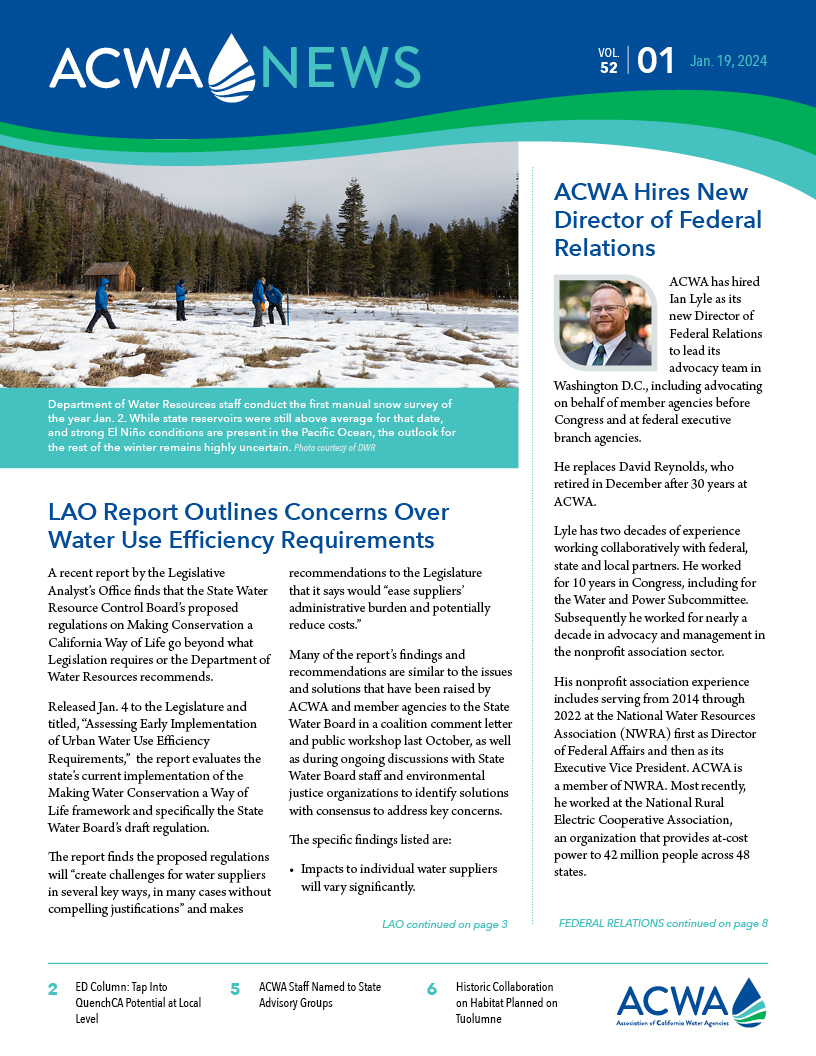 Read the January 19 edition of ACWA News for informative articles about the association and water industry.
Articles include:
- ACWA Names New Director of Federal Relations
- LAO Expresses Concerns Over Water Use Efficiency Requirements
- Executive Director Dave Eggerton Discusses QuenchCA’s Local Potential
- ACWA Representatives Named to State Advisory Groups
Spotlight Jan. 2024: Agencies Collaborate on Salmon Habitat Restoration on Tuolumne River
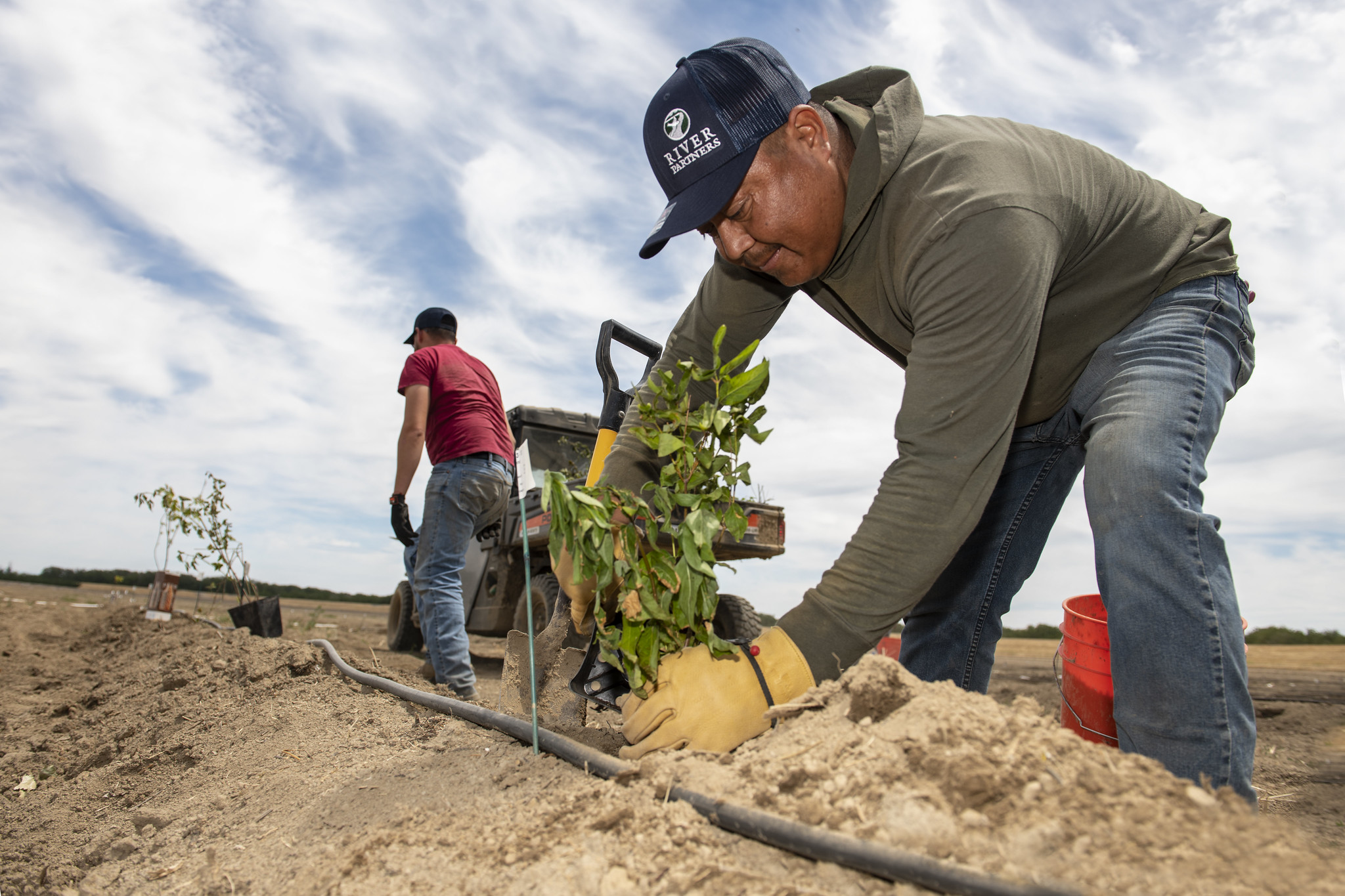
Workers with River Partners plant vegetation as part of projects that restored riverine habitat along the Feather River. Photo courtesy of River Partners
The Modesto and Turlock Irrigation Districts (MID and TID) and the San Francisco Public Utilities Commission (SFPUC) are teaming up with a nonprofit organization to design and implement a collaborative, holistic habitat restoration program along the lower Tuolumne River to improve the health and long-term recovery of the fishery and local communities it serves, according to an MID news release.
The joint effort demonstrates the power of public-private partnerships in making critical, lasting improvements to ecosystem and community health along California waterways like the Tuolumne River. The agencies are self-funding the $80 million multi-year program and recently chose the leading California riverway restoration organization, River Partners, to lead planning and restoration efforts.
Over the next 12 months, River Partners will design a series of restoration projects along the lower Tuolumne River and its floodplain from Don Pedro Reservoir downstream to the San Joaquin River that will improve conditions for salmon and other native aquatic species. By 2030, project partners aim to develop 77 acres of suitable salmon rearing and floodplain habitat and add approximately 100,000 tons of gravel in specific river reaches for optimal salmon spawning and rearing.
River Partners will lead a multi-disciplinary team of biologists, ecologists and other technical experts, including Applied River Sciences (formerly McBain Associates), in the restoration planning and design needed to implement the comprehensive program.
MID, TID and the SFPUC chose River Partners for its long track record of innovative and effective river and floodplain restoration throughout the Central Valley and across the state, which has earned the organization numerous honors for its on-the-ground impact. Since its founding in 1998, River Partners has restored nearly 20,000 riverside acres across the Central Valley and beyond in over 20 watersheds. Its portfolio of successful projects includes creating interconnected, thriving floodplains that sustain wildlife and habitat, support Valley agriculture, preserve and replenish freshwater resources and enhance surrounding communities.
“MID is proud of our continued stewardship and commitment to the Tuolumne River and our communities that rely on it,” stated MID General Manager Jimi Netniss in the news release. “We’re eager to begin this partnership with River Partners given their rich knowledge of our watershed and impressive track record of success in procuring, designing, permitting, constructing and monitoring habitat improvement projects across California. Building upon decades of collective stewardship and Tuolumne River-specific science, together we can deliver a robust and impactful program.”
“We’re making significant investments and partnering with renowned experts to put years of discussions, scientific-based planning and river studies into action and accelerate momentum in implementing our unwavering commitment to a successful habitat restoration program,” stated TID General Manager Michelle Reimers in the news release. “We’re excited to continue the ongoing stewardship of the Tuolumne River – improvements that our community will see the benefits of for generations to come.”
“We’re proud to collaborate with River Partners, the irrigation districts, and others on the Tuolumne River to restore habitat and make improvements that will benefit salmon and other native species,” stated SFPUC General Manager Dennis Herrera in the news release. “We’ve always been willing to do our part to further protect natural habitats, including in times of drought. We and the districts have committed to self-fund millions of dollars in habitat improvement projects, as well as ensure more water for the Tuolumne, even in dry years.”
“River Partners believes creating a thriving future for California’s natural resources, ecosystems and people requires deep commitment with diverse public and private partners,” stated River Partners President Julie Rentner in the news release. “That’s why we’re excited to partner with the unique alliance of MID, TID and the SFPUC who are working proactively to restore the lower Tuolumne River and achieve real, lasting benefits for species on the brink and vulnerable communities. Our hope is that this partnership and its impact will serve as a model for effective collaboration and results along other California rivers and communities.”

Quench California Makes the Case for Infrastructure Investment Locally and Statewide
 Water agencies adopting new rate schedules must overcome a challenge familiar to most in the ACWA community. How do you reach customers and explain what makes their water possible? How can you make clear the tremendous financial investment required to maintain the infrastructure behind what so many take for granted?
For any agency, this is where successful education and outreach to customers can make all the difference, because when they understand how water infrastructure functions and what that means in terms of cost and their quality of life, they understand the nature of what’s required to keep their water supply safe, secure and reliable. There are very real consequences to how well people understand water infrastructure, and that makes the work of any water agency more effective regardless of the circumstances.
Fortunately, ACWA members have a powerful educational resource devoted to creating that understanding — Quench California, our award-winning public education campaign at www.QuenchCA.com.
Through the vision of ACWA Immediate Past President Pamela Tobin, the association launched QuenchCA two years ago as a public education campaign to build awareness for the need and benefits of expanding water infrastructure investment. While it’s a statewide campaign, it also has extraordinary potential in providing benefits at the local level.
A significant investment by ACWA made QuenchCA possible, and a new partnership opportunity provides member agencies with customized ads targeted to their customers. The agency pays for the ad placement while a public relations firm, hired by ACWA to help lead the campaign, develops digital ads and strategy that will help meet the agency’s individual outreach goals.
For example, ACWA member City of Roseville used its partnership to have digital ads developed that highlight the agency’s groundwater banking project. The ads were targeted to zip codes within the city’s service area and ran for two weeks in October, generating approximately 848,559 impressions, or views, and resulting in 286 clicks to a QuenchCA.com website page that highlighted details of the project.
More members joining this effort can multiply the campaign’s impact on an exponential scale. When we educate people about local water infrastructure and the vital role it plays in their communities, we help lay the foundational support we need from the public on the critical importance of caring for our infrastructure. On a statewide level, that understanding will be essential to the success of any significant public investment in infrastructure, such as through a water bond.
The QuenchCA campaign can also connect you with online toolkit items that allow your agency to customize its message online or through social media. You can learn more about these advanced partnerships, or simply access the campaign’s resources, by contacting your ACWA regional affairs representative or ACWA Director of Communications Heather Engel at heathere@acwa.com.
Whether local or statewide, QuenchCA gives the water community an effective way to leverage public awareness of infrastructure within the bigger picture of strengthening the climate resilience of water supplies across California. We know how to build it, but it’s public support for infrastructure investment that will actually put that know-how to work.
Be a part of the momentum behind this potential and consider supporting the QuenchCA campaign through an advanced partnership, or by utilizing its many outreach tools.