
Moody’s Investors Service Affirm EBMUD’s Top Rating
Moody’s Investors Service affirmed its highest “Aaa” bond rating of East Bay Municipal Utility District (EBMUD) water system revenue bonds on January 29. The update maintains a Triple-A streak dating back to May 2022 when Moody’s first upgraded the water bonds, making EBMUD the only water utility in California to receive Moody’s top assessment. Moody’s January 29, 2024, report cited several factors in its rating affirmation, including:- “The district’s water system has a healthy financial profile that has demonstrated resilience through previous periods of drought.”
- “The strong credit profile is supported by a history of sound financial operations supported by timely rate increases resulting in ample liquidity and healthy debt service coverage that consistently exceed budgeted projections.”
- “Credit strength reflects strong regulatory compliance, capital planning and ongoing initiatives to diversify water supplies, storage and recycling capabilities, and robust drought contingency planning to ensure that operations and finances remain stable even under severe drought conditions.”
February 16, 2024 ACWA News Available Online
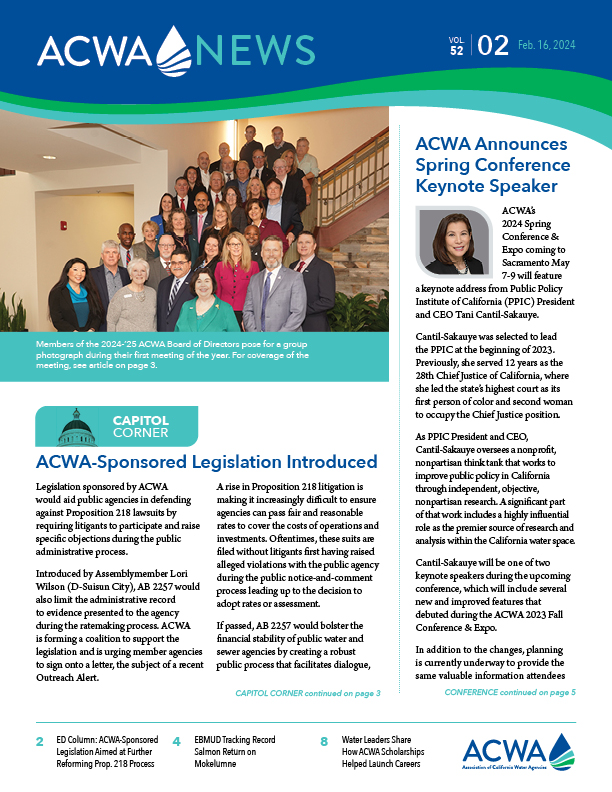 Read the Feb. 16 edition of ACWA News for informative articles about the association and water industry.
Articles include:
- ACWA-Sponsored Bill on Prop. 218 Process Introduced
- Past ACWA Scholarship Recipients Share Advice on Careers in Water
- See Fun, Informative Member Approaches to Social Media in Like, Share & Follow
- ACWA Announces Thursday Keynote Speaker for 2024 Spring Conference & Expo
ACWA-Sponsored Legislation Aimed at Further Reforming Proposition 218 Process
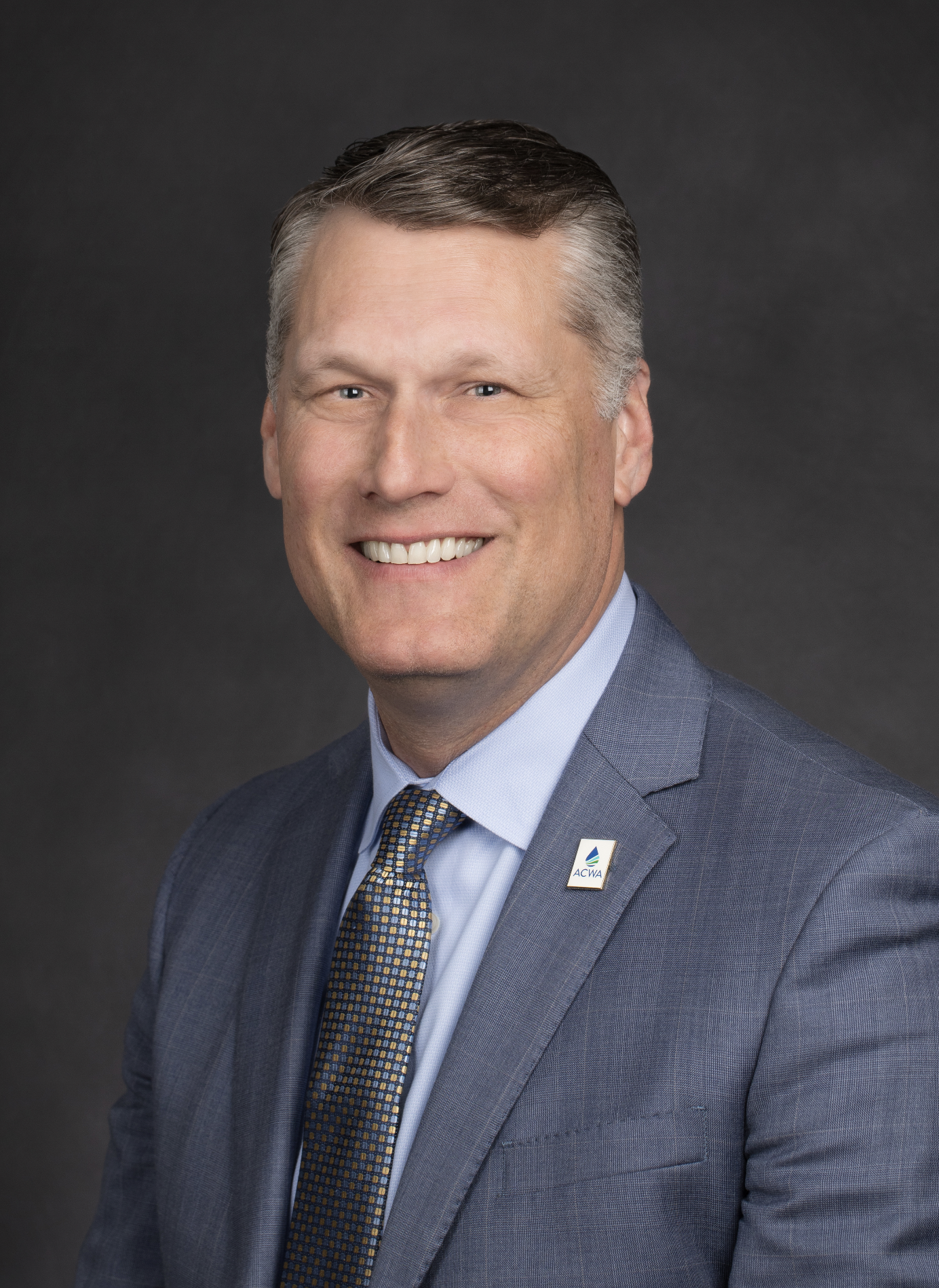 When ACWA builds strong coalitions, we give our advocacy the best possible opportunity to succeed in benefiting our members. And this year, we’ve hit the ground running by launching a coalition in support of an ACWA-sponsored bill that could inject some badly needed common sense into the Proposition 218 process for setting rates.
We’ll depend on member agencies joining this coalition by signing onto a letter and engaging with their local legislators. A recent Outreach Alert contains all the information your agency needs to get behind this effort.
As some ACWA members unfortunately know from first-hand experience, the current system allows litigants opposing rate settings to avoid the administrative process altogether and surprise agencies with a lawsuit after the rates have already been adopted.
The bill ACWA is sponsoring would aid public agencies in defending against Proposition 218 lawsuits by requiring litigants to participate and raise specific objections during the public administrative process. In doing so, this proposal intends to bring to light all possible complaints and provide an opportunity to resolve a dispute and avoid litigation altogether.
Authored by Assemblymember Lori Wilson (D-Suisun City), AB 2257 would build on the success of ACWA-sponsored legislation in 2021. That bill created a 120-day statute of limitations for filing lawsuits against water and sewer rates through the Proposition 218 process. The momentum behind its success relied on nearly 100 organizations, including ACWA members, joining a coalition in support of the bill as it moved through the Legislature.
We’ll rely on that level of engagement on our latest sponsored legislation, as well on many other advocacy efforts, as we move into another consequential year in Sacramento and our nation’s capital.
If your agency has a history of engagement through ACWA, your continued support will prove essential to the success of our advocacy. If you are a new member, or haven’t engaged through ACWA in the past, keep an eye out for updates from ACWA. They will give you the background, tools and specific steps on how to engage.
This is a great year to get involved and experience how you can make a positive difference within California’s water community, for your agency and especially for the people you serve.
Spotlight Feb. 2024: Water Leaders Share How ACWA Scholarships Helped Launch Careers
 ACWA began its scholarship program in 1961 with the goal of investing in future water leaders and cultivating a rich workforce of water professionals dedicated to ensuring safe and reliable water for all Californians. Over the past 63 years, ACWA has awarded scholarships to numerous students, enabling them to pursue their water-resources related education and career goals.
In addition, the newly formed ACWA Foundation launched its separate scholarship program last year by awarding a total of $50,000 to eight students.
ACWA members are encouraged to promote available ACWA scholarship opportunities in their newsletters and on their websites, as well as internally through employee communications and announcements as member agency employees and their families are eligible to apply.
This year, $34,500 is available through five scholarships, including ACWA Scholarships that are awarded to two undergraduate students majoring in engineering, agricultural or urban water supply, environmental studies, public administration and other water-resources related fields. As a few accompanying profiles of past recipients show, ACWA Scholarships can help make a meaningful impact in launching careers in water.
The application deadline for 2024 scholarships offered through ACWA is March 1. For more information about ACWA’s scholarships, visit www.acwa.com/scholarships. For more information about the ACWA Foundation scholarships, visit www.acwa-foundation.org.
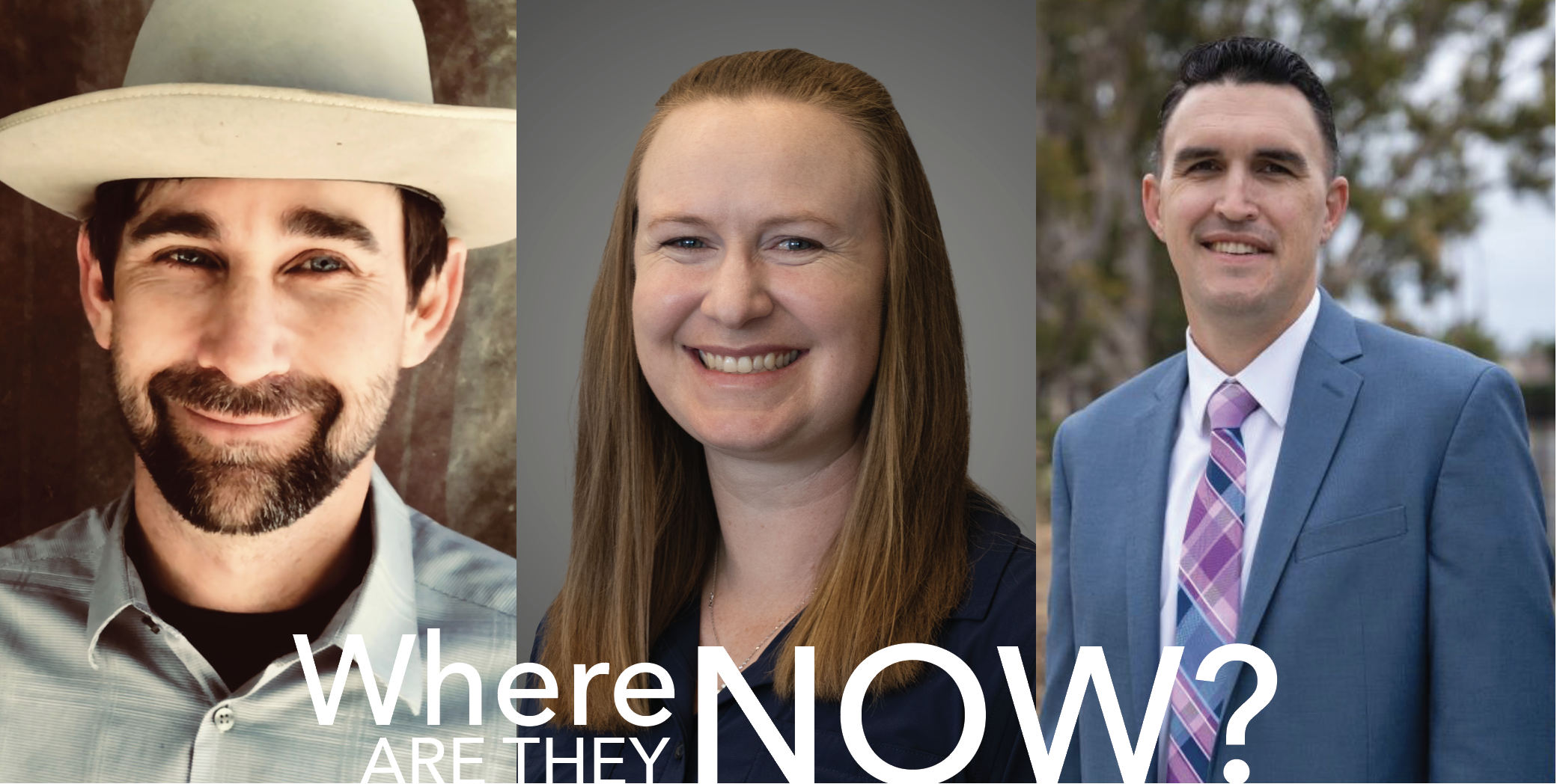
Jacob Katz, Ph.D.
2005 ACWA Scholarship Winner Current position: Senior Scientist, CalTrout How did earning an ACWA scholarship help your water career? “By opening my eyes to the diversity of perspectives within California water, it really helped me see how important it was to build coalitions and work toward a California that has sufficient water for our natural and human communities.” What advice would you give college students considering a career in water? “Do it. We need you!”Lynn Groundwater Moeller
2009 Clair Hill Scholarship and 2010 ACWA Scholarship Winner Current position: Senior Engineer, Provost & Pritchard Consulting Group How did earning an ACWA scholarship help your water career? “Part of the ACWA scholarship application was an essay that included what I hoped to achieve in my professional career. While writing the essay, I took some time to really think about what I wanted to do in my professional career. Looking back at the essay, I realize that the ACWA scholarship application process helped my water career by putting my goals and aspirations in writing. In my essay I said that I aspired to address both structural improvements in California’s water systems and improvements in water use efficiency. “I’m happy to say I have been doing just that. I have lived up to the goals that I set for myself and continue to work with California water agencies to improve their water systems and work towards sustainability.” What advice would you give college students considering a career in water? “My advice would be to take advantage of internships during college. College and internships are a time to learn more about the water industry since there are a variety of different career paths you can take within the industry. Take water classes that sound interesting to you. Have different types of internships in the water industry to help you figure out what type of work you enjoy. When you enjoy what you do, it doesn’t feel like work.”Benjamin Smith
2011 ACWA Scholarship Winner Current position: Director of Recharge and Wetland Operations at Orange County Water District, lectures at CSU Long Beach for undergraduate civil engineering water courses. How did earning an ACWA scholarship help your water career? “The ACWA scholarship not only helped me cover higher education expenses, but helped confirm that I was on the correct career path. Water engineering and management was of interest to me prior to entering a bachelor’s program. The process of applying for the ACWA scholarship aided me to study the water world more deeply and further confirm my passion for the field.” What advice would you give college students considering a career in water? “A career in water resources has strong job security and a lot of advancement opportunities for individuals that apply themselves to the field. As you study water and other topics in college, make sure you are really applying yourself to the course material. You are not just checking off a to-do list, but you are laying the foundation for a successful career and years of helping others to live safe and prosperous lives. “It helps to understand the course material if you understand the real-world applications of what you are studying, so seek out internships, professional associations, and technical tours. For example, when you know what a pump looks like and how it connects to pipes, you will be able to understand pump curves, efficiency, and horsepower on a deeper level.”
Students Attend Mojave Water Agency’s Youth Water Summit
VICTORVILLE — The Mojave Water Agency showed local students that they are “The Future of Water” at its seventh annual Innovators High Desert Water Summit held in the Powell Auditorium in Victorville on Feb. 9.
The event is designed to immerse middle and high school students in water education and conservation with a keynote presentation, breakout sessions, and interactive exhibits. This year, Mojave Water Agency collaborated with California State University, San Bernardino’s Institute for Watershed Resilience to show students some of the latest water-related technology and inspire them to consider a career in water.
“Water is the lifeline of our desert. We only get about 5” of rain a year and live in a constant state of drought,” said Board President Kimberly Cox in her welcome address. “We’re here today to show you the possibilities that you have for your future, because you are the future of water and sustainability in our High Desert. We need you.”
In her keynote address, CSUSB Masters student Christine Seeger shared her non-traditional path to working in water that took her from returning to college at age 30 with the intent to be a computer coder, to studying headwater stream resiliency within the San Bernardino National Forest.
“Like water, your course may change, and you have to be flexible,” said Seeger, who praised the students and schools for participating in the Water Summit. “Had I known about these career paths in my high school years, even middle school years, I think college in my 20s would have turned out a lot different because I would have been studying things that interested me back then.”
The audience of about 175 students from all over the Agency’s 4,900-square-mile service area, also attended breakout sessions that featured speakers from the college. Undergraduate students Julia Pineda and David Hernandez provided hands-on lessons about water quality testing. Graduate student Teresa Deaguilera demonstrated mapping technology used to study environmental justice in the water industry; and Angeli Richard lead sessions on modeling watersheds with Legos.
The event culminated with a presentation by this year’s Agency essay contest award winner, Alexis Cisneros, a senior at Hesperia High School who secured a $3,000 scholarship for her “Aqua Viva” community conservation contest concept. Essay finalists who earned $1,000 scholarships were Mariana Strong, who also served as this year’s emcee; and Diego Cruz, both students from Oak Hills High School.
Highlights of the event, including all speaker presentations and award recipients, will be available to view online and social media soon thanks to a generous sponsorship by the County of San Bernardino. The Agency is also grateful for the additional collaborators who provide hands-on exhibits for the students including GeoTech, California Rural Water Association, City of Victorville Water Department, Victor Valley Wastewater Reclamation Authority, San Bernardino County Special Districts, Joshua Basin Water District, and the Mojave River Watershed Group.
For more information, please visit the Agency’s website at www.mojavewater.org or follow us on social media @mojavewater.
February 2024 Priority Issues Update Now Available
The February 2024 Priority Issues Update is now available online to members.
The update is a summary of the latest developments on issues of interest to ACWA members. This issue contains information on the climate resilience bond, Proposition 218 legislation and more.
The new and previous Priority Issues Updates can be found here.
Western Water Launches Groundwater Storage Program
RIVERSIDE – Capitalizing on wet weather while preparing for the next dry period, Western Municipal Water District’s (Western Water) Board has approved a substantial investment in its groundwater banking program, taking a major step to enhance its water supply for its customers.
“A water bank functions much like a personal savings account but for water. It allows us to stockpile surplus water underground, ready for withdrawal in times of need,” said Board President Mike Gardner. “During wetter seasons, we can recharge groundwater basins, effectively ‘depositing’ water. This stored water can be withdrawn during dry periods.”
In light of California’s notorious weather extremes – from the severely dry years of 2020, 2021 and 2022 that drastically diminished vital water deliveries, to the deluge in 2023 that swelled snowpacks to 200% above normal and replenished state reservoirs– Western Water has developed a proactive approach to future water reliability.
The Board, seizing the moment in 2023, approved an investment over two years, targeting the secure storage of surplus water supplies. This decisive action is already beneficial, achieving a quarter of the project’s goal by banking more than 5,000 acre-feet of water—sufficient to satisfy the indoor water needs of over 20,000 families of four annually. In 2024, Western Water will continue building on this momentum, increasing water storage capacity to ensure even greater resilience against future droughts.
Western Water is also a partner in the Santa Ana River Conservation and Conjunctive Use Program (SARRCUP), a collaborative regional groundwater banking initiative that is developing infrastructure critical to distributing the banked water across the region. The SARRCUP program constructed new major pipelines and pump stations, connecting with adjacent agencies, and installed new wells to extract stored water. These infrastructure enhancements support a more resilient and efficient water supply system in the region.
The SARCCUP partnership received $55 million in grant funding from Proposition 84 funds, which provides funding for projects that help local public agencies meet the state’s long-term water needs. Western Water received $26 million towards facilities and conveyance to increase available water supplies in dry years and prepare the communities we serve for future droughts.
“Our evolving climate scenarios demand a proactive and adaptive approach to water management,” said General Manager Craig Miller. “Groundwater banking is a sustainable, environmentally friendly approach to saving wet year surplus water supplies and better prepare for periods of lower rainfall and snowpack.”
Western Water’s efforts extend beyond regional projects. They are a regional leader for broader initiatives, such as the CA Water for All (Senate Bill 366 (Caballero) sponsored by the California Municipal Utilities Association). This statewide initiative emphasizes the importance of a collaborative, comprehensive approach to tackling California’s water challenges. By working with stakeholders at all levels, California can develop sustainable solutions for our water needs.
“Similar to Western Water and other like-minded local water suppliers that have invested in drought resiliency projects, the State of California must invest in capture, conveyance, and storage solutions to shore up our water supply for our children and grandchildren,” said Miller.
To learn more about Western Water’s water supply reliability efforts, visit WesternWaterCA.gov/WaterSupply. To learn more or get involved in CA Water for All, visit CAWaterforAll.com.
###
Western Municipal Water District is one of the largest public agencies in Riverside County, providing water and wastewater (sewer) services to nearly 1 million people, both retail and wholesale customers who live, work, and play within 527-square miles in one of California’s most populous regions. Learn more: WesternWaterCA.gov.
Local High Schools Receive New Water Refill Stations and Water Bottles for Students
ROWLAND HEIGHTS – Rowland Water District (RWD) delivered 1,700 reusable water bottles to students and staff at Nogales High School, and 280 to Santana High School this month to be used at their newly retrofitted water bottle filling stations. Both schools are the latest beneficiaries of RWD’s “What’s In Your Bottle?” initiative, a turnkey program for schools in RWD’s service area that replaces an existing drinking fountain with a water bottle filling station and an informational sign. The water bottle filling stations pour cool, clean drinking water on demand, helping students and staff keep hydrated all day long. “We’re proud to offer our bright local youth access to fresh, pure water while reducing single-use plastics with our water bottle filling stations,” RWD Education & Community Outreach Coordinator Brittnie Gildea said. “It is a great learning opportunity for students to find out what goes into their tap water and the waste we accumulate when using store-bought water.” Since the inception of the program in 2019, RWD has completed 11 retrofits at 10 schools in the Rowland Unified School District. Rowland plans to continue the program at Hacienda La Puente Unified School District within the next two years. Learn more about the “What’s In Your Bottle?” initiative at www.rwd.org/filling-station-program/.###
About Rowland Water District Rowland Water District was formed 70 years ago to provide water service to 200 ranchers and farmers in a rural, agricultural community. Over the years, the District has evolved to meet the changing needs of a dynamic and rapidly growing customer base. Rowland Water currently delivers 14 million gallons of safe drinking water to about 55,000 people every day. The District maintains 150 miles of potable water pipeline and 25 miles of recycled water pipeline to serve 13,800 customer connections across 17.2 square miles in southeast Los Angeles County, including portions of Rowland Heights, Hacienda Heights, La Puente, and the cities of Industry and West Covina.Windsor Water District Initiates Potential Annexation
WINDSOR – At its meeting on February 7, 2024, the Windsor Water District (WWD) Board of Directors, took the first step toward the potential annexation of a portion of Sonoma Water’s Airport Larkfield Wikiup Sanitation Zone (ALWSZ). The purpose of expanding WWD’s service area via annexation would be to provide for maximum efficiency of operations for both agencies, offer a significant increase in available storage for recycled water, and gain a greater level of beneficial reuse of recycled water, thus preserving potable water for other uses.
The WWD Board (comprised of the Town Council of the Town of Windsor) authorized the Windsor Town Manager to issue a letter to the Sonoma County Local Agency Formation Commission (LAFCO) requesting expansion of the WWD sphere of influence and annexation of a specified portion of the ALWSZ service area. Authorizing the Town Manager to issue the letter is not a final approval of the annexation – such approval from the Board of Directors of the WWD will be sought later, once applications and further studies are complete.
The WWD proposes to annex a portion of the ALSWZ service area that is currently served drinking water by the WWD, and, in addition, provide sewer service to the remainder of the area via a contract with Sonoma Water. It’s important to note that the proposal would annex a portion of the ALWSZ into the WWD service area – not into the Town of Windsor.
The annexation process is expected to take at least 12 months. In the meantime, the WWD and Sonoma Water are negotiating an agreement by which WWD would provide wastewater collection and treatment for all of ALWSZ area on a contractual basis, prior to completion of the annexation.
“We’re very motivated to fully explore this possible consolidation, which will benefit Sonoma Water, Windsor Water District, and the communities served by both agencies” said Grant Davis, General Manager of Sonoma Water. “We expect this project will increase operational efficiencies and expand recycled water use, and serve as an outstanding example of inter-agency collaboration for the greater good.”
Town of Windsor Mayor Rosa Reynoza stated, “This effort underscores Windsor’s Net Zero goals, and highlights our ability to collaborate with our neighbors and partners in responsibly managing our precious water resources.”
Sonoma Water’s ALWSZ treatment plant needs significant upgrades and expenditures to maintain its operations. It currently operates at a significant deficit to the County of Sonoma and lacks the service area necessary to sufficiently increase sewer rates to meet the required operational and capital expenses identified. The Windsor Water Reclamation Facility currently has enough excess rated capacity to fully treat all flows and loadings from the ALWSZ.
These factors point to a wastewater treatment system that could be more efficient, economical, and beneficial to all parties and the ratepayers, through consolidating services. This project is expected to provide increased storage of recycled water, which in turn would help boost the beneficial reuse of that water, and contribute toward Windsor’s net-zero discharge goal. Maximizing regional resources in this collaborative manner will help increase the availability of recycled water for use at costs below potable water rates, and will help foster sewer rate stabilization. Consolidation will provide an estimated 250 million gallons of additional recycled water.
More information about how the Windsor’s efforts to achieve net-zero status at its Water Reclamation Facility is available on the Town’s website.
The Town of Windsor is located 63 miles north of San Francisco in Sonoma County’s Russian River Valley, part of the Northern California wine country. It encompasses an area of 7.3 square miles, and has a population of about 26,000. Windsor draws visitors from around the world to enjoy the area’s extraordinary natural beauty, first-rate lodging, and abundance of world-class wineries. Visit www.townofwindsor.com.
EMWD Awarded for Desalination Program Leadership
Perris — Eastern Municipal Water District was recognized this week by CalDesal with its inaugural Institutional Achievement Award for its efforts to promote water desalination as a safe, sustainable and reliable water supply source.
Cal Desal is an industry organization committed to advancing ocean and groundwater desalination as a viable resource to ensure a sustainable water future for communities throughout California.
EMWD was nominated for the award by engineering consulting firm Black and Veach, which has helped design EMWD’s groundwater desalination facilities.
EMWD meets nearly 10 percent of its demand through its groundwater desalination efforts. In 2022, it commissioned its third groundwater desalination facility – the Perris II Desalter – to provide 5.4 million gallons of drinking water per day. EMWD cumulatively produces more than 14 million gallons of drinking water per day at its desalination complex in Menifee.
EMWD’s service area has groundwater that is brackish (salty) due to natural soil conditions, historical land use and agricultural activities. Its desalination program helps remove those salts and makes enough beneficial drinking water to serve more than 30,000 households each year.
Approximately 65,000 tons of salts are removed each year and disposed of to the Pacific Ocean through the Inland Empire Brine Line.
EMWD received $22.5 million from the State Water Resources Control Board to construct the Perris II Desalter. It has cumulatively received nearly $100 million in grant funding to support its advancement of the program in incremental fashion, including brackish groundwater wells, pipelines and treatment facilities. This includes a $50 million authorization from the United States Army Corps of Engineers via the Water Resources Development Act. EMWD is actively seeking an additional $50 million authorization to further expand the program.
EMWD has also worked with private companies to pilot new technologies to maximize the recovery rate of desalination. The pilot projects have provided critical data to the industry about how to increase recovery rates to the 90th percentile.
As it eyes future partnerships to further promote the role of desalination in its water supply future, EMWD is also looking at other diversification including potential seawater desalination partnerships.
“EMWD is incredibly appreciative of CalDesal for this prestigious honor,” said EMWD Board Director Jeff Armstrong, who serves on CalDesal’s Executive Committee. “EMWD is a strong advocate for desalination as part of a diverse and sustainable water supply portfolio, and we look forward to continuing to expand our to desalination program to further benefit our customers through a safe and local water supply.”
# # #
Eastern Municipal Water District is the water, wastewater service and recycled water provider to nearly one million people living and working within a 601-square mile service area in western Riverside County and northern San Diego County. It is California’s sixth-largest retail water agency, and its mission is “To deliver value to our diverse customers and the communities we serve by providing safe, reliable, economical and environmentally sustainable water, wastewater and recycled water services.” More information can be found at www.emwd.org.