
JCSD Honors Congressman Takano with Local Leader of the Year Award
JURUPA VALLEY – The Jurupa Community Services District (JCSD) honored Congressman Mark Takano with its Local Leader of the Year award. The award was presented at JCSD’s annual Community Awards lunch, which recognized several customers and community members who have contributed to JCSD’s mission, programs, and principles, which make Jurupa Valley and Eastvale wonderful places to live, work, and visit. Congressman Takano has strongly supported JCSD and its award-winning water, wastewater, parks, and recreation services. He is recognized with the Local Leader Award for his vital role in securing essential grant funding for JCSD projects, leading the authorization process for a major JCSD project in last year’s Water Resources Development Act, and his consistent support for infrastructure projects and funding. “I am deeply honored to receive this award from the JCSD. The JCSD is hard at work supporting essential projects that make a critical, measurable impact on people’s lives. Together, we are ensuring a sustainable and prosperous future for our community.,” said Congressman Takano. JCSD Board President Bart Moreno added, “Congressman Takano’s contributions have been pivotal in our mission to provide award-winning services to Jurupa Valley and Eastvale. His efforts have made a lasting impact on our community’s well-being and long-term development.” The luncheon also celebrated other community members and customers for their achievements. Awards included landscape and conservation accolades to multiple JCSD customers, acknowledging their commitment to environmental sustainability. Jason Gu and Grants Management Consulting were recognized as the Professional Partner of the Year for their outstanding support in securing grant funding. Matt Olson received the Community Member of the Year award for his exceptional service and dedication to the community. Special recognition was given to Riverside County Flood Control and Water Conservation District (RCFCWC) and community leader George Rife. RCFCWC was honored with the Don Galleano Water Champion award for its collaborative spirit and support, which includes extensive grant funding for critical JCSD projects. George Rife was presented with the Richard Welch Parks Champion Award, honoring his significant contributions to JCSD’s parks and recreation services and to the Eastvale community. For more information about this item, please contact Arman Tarzi, JCSD Manager of Government & Public Affairs, at atarzi@jcsd.us.# # #
Founded in 1956, the Jurupa Community Services District is a public agency providing services and programs to Jurupa Valley and Eastvale. It is governed by a Board of Directors comprised of five elected representatives from both cities. Serving over 130,000 people in a 40-square-mile area, JCSD provides a variety of community services and programs, including water, sewer, streetlights, frontage landscape maintenance, graffiti abatement, and parks and recreation services.Sacramento-Area Water Providers Harnessed Historic 2023 Storms to Boost Groundwater Levels
Sacramento-area water providers leveraged the historic winter storms of 2023 to boost groundwater levels through in-lieu recharge, banking over 12.3 billion gallons of water during the year, according to a new analysis from the Regional Water Authority (RWA), which represents nearly two dozen water providers serving 2.2 million people in the greater Sacramento region. In-lieu recharge is the combined management of both surface water and groundwater use, resulting in the replenishment of groundwater supplies within the aquifers. Every gallon of surface water served to customers in lieu of groundwater results in water saved in the groundwater aquifer. RWA’s analysis found that water providers opted for 70 percent surface water in 2023 (a very wet year) compared to 53 percent in 2022 (a very dry year). This substantial 17 percent shift allowed the groundwater aquifers to recover, resulting in nearly 38,000 acre-feet (over 12.3 billion gallons) of water stored—enough to serve about 113,700 households for a year. “Mother Nature built the natural infrastructure, and we’re changing how we interact with it,” said RWA Executive Director Jim Peifer. “Using more surface water in wet years helps save underground water for future needs, similar to saving money in the bank for a dry spell. It’s about using what nature provides more abundantly at the moment while conserving other resources for when times are leaner.”For over two decades, local water providers have utilized in-lieu recharge to store water in the region’s groundwater aquifers, resulting in significant increases in stored water and sustainable groundwater levels even during a megadrought. Some water providers are also equipped to store water through Aquifer Storage and Recovery (ASR), which allows them to deposit treated water into the groundwater aquifer during wet times using specially designed wells that can both recharge (inject) and recover (extract) water.
Now, efforts are underway to expand these practices through the Sacramento Regional Water Bank, which utilizes the region’s extensive groundwater aquifers to store excess surface water when available. The region’s aquifers can store twice the volume of water as Folsom Reservoir.Optimizing the existing Water Bank infrastructure will make it possible to double the amount of water that can be stored to about 65,000 acre-feet of groundwater in wet years. And already-identified projects can triple recharge quantities to 90,000 acre-feet annually, serving about 270,000 households.
“The last two years have provided a case study for how our water system can be reoperated using existing infrastructure to harness a climate change-resilient water supply adapted to the extreme swings from dry to wet,” Peifer said. “And will be storing even more water with a fully functioning Water Bank.” —————————————————————————- Here’s what local water providers did to capture the storms in 2023:- Sacramento Suburban Water District (SSWD): More than doubled the percentage of surface water served to its customers in 2023 compared to 2022, banking 18,772 acre-feet of groundwater in the aquifers, enough to meet the annual water needs of over 56,300 households.
- Sacramento County Water Agency (SCWA): Increased surface water use by 29 percent in 2023 compared to 2022, resulting in approximately 10,220 acre-feet of groundwater stored in the aquifers, enough to meet the annual water needs of more than 30,600 households.
- City of Sacramento: Increased surface water use by 26 percent in 2023 compared to 2022, resulting in nearly 6,800 acre-feet of water stored in the groundwater basin, enough water to serve 20,400 people.
- City of Roseville: Increased the amount of water stored by 22-fold, banking 2,134 acre-feet of water in 2023 (enough to serve over 6,400 households) through Aquifer Storage and Recovery compared to just 96 acre-feet in 2022, when surface water was limited due to dry conditions.
Other local water providers who are part of the Sacramento Regional Water Bank and will also shift between surface water and groundwater use include California American Water, Citrus Heights Water District, Fair Oaks Water District, Carmichael Water District, and Golden State Water Company.
—————————————————————————-The Regional Water Authority (RWA) is a joint powers authority representing nearly two dozen water providers serving 2.2 million people in the greater Sacramento region. Formed in 2001, its primary mission is to help its members protect and enhance the reliability, availability, affordability and quality of water resources. Learn more at rwah2o.org.
City of Folsom Kicks Off Water Vision Project
Folsom’s Environmental and Water Resources Department is continuing its planning effort to guide the management of the city’s water resources over the next 50 years. Currently, the city gets its drinking water almost exclusively from Folsom Reservoir. The Folsom Water Vision project will help the city evaluate water supply alternatives to proactively plan for increased droughts, flood events, rising temperatures, and other challenges.
The city kicked off the Water Vision Project February 20 with an inaugural stakeholder meeting. The project team delivered a presentation highlighting current water resources, projected customer demands, and the community engagement strategy for project planning. More than 50 attendees offered feedback, addressing what they value, their concerns, and desired changes regarding Folsom’s water. Details and a recording of the workshop are available on the city’s website.
Understanding the community’s needs and priorities for water resource management is vital to the success of this planning effort. The community is invited to the second in a series of public meetings to learn about the project and share your needs, interests, and goals for creating a resilient water future.
For more information, contact Environmental and Water Resources Director Marcus Yasutake at 916-461-6161 or myasutake@folsom.ca.us. Stay informed at www.folsom.ca.us/watervision.
March 15, 2024 ACWA News Available
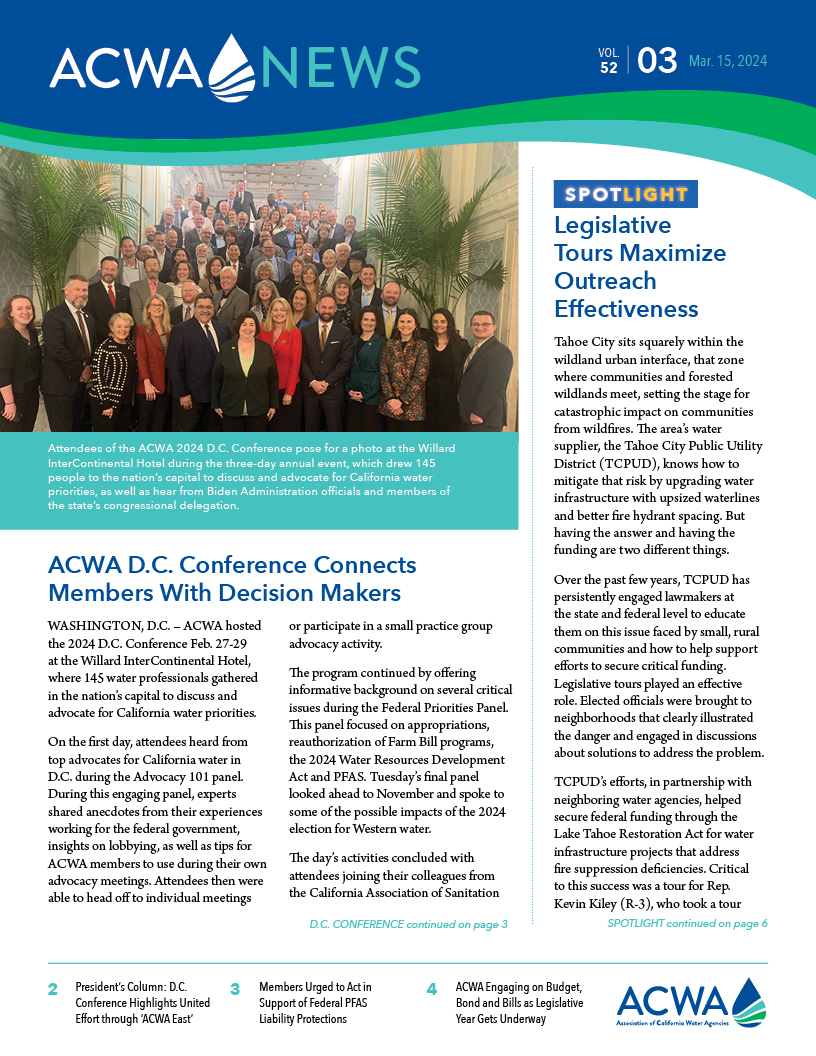 Read the Mar. 15 edition of ACWA News for informative articles about the association and water industry.
Articles include:
- D.C. Conference Attendees Connect with Administration, Congressional Leaders
- President Cathy Green Discusses Value of ACWA Federal Advocacy
- Agencies Share Experience, Advice on Legislative Tours and Outreach
- State Water Board Releases Revised Draft Regulation for Water Use Efficiency
Spotlight March 2024: Legislative Tours Maximize Outreach Effectiveness

McMullin Area Groundwater Sustainability Agency General Manager Matt Hurley hosts U.S. Rep. John Duarte on a recent tour of the agency’s On-Farm Flood Capture Project. Photo courtesy of MAGSA
Tahoe City sits squarely within the wildland urban interface, that zone where communities and forested wildlands meet, setting the stage for catastrophic impact on communities from wildfires. The area’s water supplier, the Tahoe City Public Utility District (TCPUD), knows how to mitigate that risk by upgrading water infrastructure with upsized waterlines and better fire hydrant spacing. But having the answer and having the funding are two different things.
Over the past few years, TCPUD has persistently engaged lawmakers at the state and federal level to educate them on this issue faced by small, rural communities and how to help support efforts to secure critical funding. Legislative tours played an effective role. Elected officials were brought to neighborhoods that clearly illustrated the danger and engaged in discussions about solutions to address the problem.
TCPUD’s efforts, in partnership with neighboring water agencies, helped secure federal funding through the Lake Tahoe Restoration Act for water infrastructure projects that address fire suppression deficiencies. Critical to this success was a tour for Rep. Kevin Kiley (R-3), who took a tour and worked to add projects to his 2024 fiscal year Community Project Funding list. A separate tour also demonstrated the value of these projects to Marie Alvarado-Gil during her race for the state Senate in 2022. The tour helped, now Senator Alvarado-Gil (D-Jackson), further cement her ongoing support for more state funding related to wildfire protection, already strong through her home community’s experience with the Caldor Fire in 2021.
“Seeing what can happen, what did happen with the Caldor Fire, then seeing a community facing the same risk, I think that really connected with her,” said Kim Boyd, TCPUD Director of Strategic Affairs and one-person public affairs team.
Boyd and other ACWA member agency communication professionals recently shared their experience and advice using tours to educate elected officials about critical issues. While larger agencies are at an advantage with larger staffs, smaller districts can also successfully incorporate tours for lawmakers into their outreach.
In the Central Valley, the McMullin Area Groundwater Sustainability Agency (MAGSA) invited Rep. John Duarte (R-13) for a visit to the McMullin On-Farm Flood Capture Expansion Project. The tour tied together how the agency is engaged to bring its area into groundwater sustainability.
“Tours take your projects out of the abstract giving elected officials an on-the-ground insight into the work you are doing,” said MAGSA Deputy General Manager Cristel Tufenkjian. “You can visualize a giant sequoia tree from a picture, but physically standing in front of one brings a whole new perspective to the word ‘giant.’ Tours are an invaluable tool for MAGSA and worth the time and effort.”
Prepare for Persistence
Eastern Municipal Water District (EMWD) in Riverside County maintains a robust legislative outreach program that has included about a dozen facility tours during the past five years.
EMWD hosted a tour last year tied to its plans to build an indirect potable reuse facility. Local congressman U.S. Rep. Mark Takano attended along with U.S. Secretary of the Interior Deb Haaland. The facility is scheduled to break ground later this year.
However, organizing a successful tour can require persistence.
“There have been times, especially when we have newly elected legislators, that it has taken a while,” said EMWD Director of Policy and Governmental Affairs Jolene Walsh, about sending invites for other tours and not hearing back. “But we don’t give up and assume they’re not interested. We continue to engage and attract their attention.”
Personalize Materials
Elected officials understand the connection between what they see during a tour and what it means to their constituents’ quality of life. However, finding ways to further amplify that connection can heighten a tour’s ultimate value. EMWD emphasizes this link through personalized materials, such as personalized Capital Improvement Program booklets. These include a cover with an elected official’s photo and copy that highlights specific infrastructure and exactly how it benefits a given district.
“They really appreciate having the summary of projects in their area,” EMWD’s Walsh said. “It draws a direct line between the value of a project and the quality of life for their constituents.”
Find Partners
A common thread running through advice on legislative tours from agencies contacted focuses on forging partnerships. The resulting teamwork can result in a highly effective, and compelling, tour for elected officials and decision makers. This can include teaming up with neighboring districts, cities and regional alliances.
For example, TCPUD worked through its membership in the Tahoe Fire for Water Partnership in organizing the tours for U.S. Rep. Kiley and Senator Alvarado-Gil.
“Leveraging partnerships is a must,” said TCPUD’s Boyd, adding that tours have become part of a ramped-up outreach program for the district during the past four years.
The Upper San Gabriel Valley Municipal Water District (Upper District) regularly offers a tour for local partners and elected officials. Familiar with the Upper District’s tours, Assemblymember Blanca Rubio (D-Baldwin) requested one on a couple of occasions to educate her staff on local water issues and for her agriculture contacts in the Central Valley.
With Assemblymember Diane Papan (D-San Mateo) becoming the new chair of the Assembly Water, Parks and Wildlife committee, Upper District staff worked with Rubio’s office to offer a February tour and acquaint her with its region and local water supply. In addition to state Senator Maria Elena Durazo (D-Los Angeles), two board members from the Los Angeles Regional Water Quality Board also joined.
“What was unique about this tour is that we worked collaboratively with the other agencies in our region such as Three Valleys, San Gabriel Valley Municipal Water District and Rowland Water District to help highlight their infrastructure needs and present a unified message on our water supply needs,” said Patty Cortez, Upper District’s Assistant General Manager for External Affairs.

D.C. Conference Again Highlights Importance of Our United Effort through ‘ACWA East’
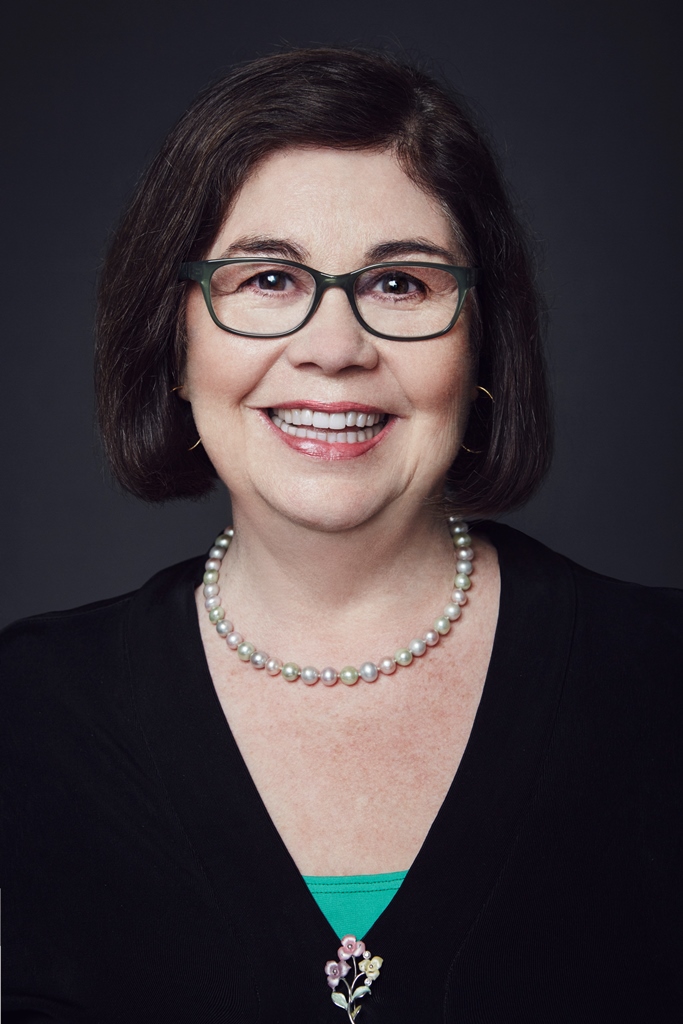 ACWA’s presence in Washington D.C. counts among our association’s most valuable resources for member agencies. Bringing that fact home is ACWA’s annual D.C. Conference, where I recently joined more than 140 attendees for a three-day immersion into how, why, and where decisions on federal policy shape California’s water.
I am grateful to all who attended and participated in ACWA’s D.C. Conference. Additionally, my heartfelt appreciation goes to ACWA staff for organizing the conference, and to ACWA’s Federal Affairs Committee Chair Jolene Walsh, from Eastern Municipal Water District in Region 9, and Vice Chair Scott Peterson, from San Luis & Delta-Mendota Water Authority in Region 6, for moderating the Federal Advocacy 101 Panel and the Congressional Speech Program.
This year’s event featured policy experts and leaders within Washington D.C.’s water advocacy community, sharing insights into federal priorities, as well as how California water agencies can engage in their own federal advocacy. It also included a panel discussion on this year’s pivotal election, moderated by ACWA’s new Director of Federal Relations Ian Lyle. We heard keynote addresses from Acting Assistant Administrator of the U.S. Environmental Protection Agency’s Office of Water Bruno Pigott; U.S. Forest Service Associate Chief Angela Coleman; and Bureau of Reclamation (Reclamation) Commissioner Camille Calimlim Touton, who heads an arm of the federal government that plays a vital role in managing and funding California water infrastructure.
Reclamation has a substantial impact on California water through its operation of backbone infrastructure such as the Central Valley Project and reservoirs on the Colorado River. Reclamation is also a valuable federal partner that supplies planning and financial assistance for important projects, including the raise of B.F. Sisk Dam on San Luis Reservoir and restoration of capacity in essential conveyance facilities like the Friant-Kern Canal. The diligent federal advocates of ACWA East champion the cause of California’s water agencies in their work with officials at Reclamation, other federal agencies, and members of Congress.
Overall, ACWA East’s advocacy is the finger ACWA keeps on the pulse of a myriad of issues affecting ACWA members. With billions of dollars in funding still available for Western water through the Inflation Reduction Act and Bipartisan Infrastructure Law, and critical issues such as PFAS liability, regulation of lead and copper service lines, low-income rate assistance, and many others before Congress and federal agencies, it’s easy to see how vital our work in D.C. is to the whole of California water management. We will continue to support our members in maximizing federal funding for water infrastructure and prioritizing local control for your agency to continue fulfilling its critical mission.
Coming into my new role as ACWA President, I am keenly aware of the early origins of our association, founded as the Irrigation Districts Association of California. Today, we represent the interests of diverse types of public water suppliers in California. We are, and must always remain, united in advancing each other’s success in serving communities, farms, and businesses across the entire state. ACWA’s commitment to being the leading voice for California water, both agricultural and urban, is at the heart of our 30-plus-year presence in our nation’s capital, where ACWA East works on behalf of our membership on every major federal water issue affecting your future. We are proud to lead for you, the united, local water management community of California! .
MCWD Celebrates National Groundwater Awareness Week
It’s National Groundwater Awareness Week. Because groundwater is the main source of water for Marina Coast Water District (MCWD) customers in Marina, Seaside, and the Ord Community, it is a good time to share how MCWD and its local partners are putting more water into the ground to ensure current and long-term water supply resiliency for communities, businesses, and the environment.
Managing Our Groundwater For the Long-Term
Marina Coast Water District serves as a Groundwater Sustainability Agency (GSA). As a GSA, MCWD is responsible for the long-term management and health of our shared groundwater supply, partly funded with a $6.45 million grant. MCWD is starting a new project to protect Groundwater Dependent Ecosystems with Salinas Valley Basin GSA and Central Coast Wetland Group to better understand how to sustainably manage these ecosystems.
Preventing Seawater Intrusion. The District is evaluating a plan to extract intruded water near the coast to prevent seawater from flowing inland. This is a collaborative effort by MCWD and the Salinas Valley Groundwater Sustainability Agency.
Indirect Potable Reuse of Recycled Water. MCWD completed a study showing how the District could inject recycled water into the groundwater aquifer and store it for future use.
Monitoring Wells in Collaboration with Neighboring Water Agencies
MCWD staff is planning to install two monitoring wells in the Marina-Ord area and are working with the Seaside Watermaster and Monterey Peninsula Water Management District (MPWMD) to install additional wells that will monitor for seawater intrusion.
Collaborating on Long-Term Groundwater Management
MCWD is participating in the Regional Deep Aquifer Study. The Study will provide a greater understanding of the deep aquifer — its breadth and size, safe yield, and more. Marina Coast Water District is undertaking this effort with urban and agricultural users in the Salinas Valley Groundwater Basin.
Reliable Partner and Leader in the Center of the Groundwater Basin
The major water resources in the region all intersect in MCWD. The District owns a currently offline desalination plant that it is working to refit and bring online, shares ownership in a water recycling plant, and has aquifer storage and recovery facilities within its boundaries, along with extensive groundwater rights.
To share costs and ensure future reliable supplies for all, the District works extensively with Salinas Valley Basin Groundwater Sustainability Agency, Monterey County Water Resources Agency, Monterey Peninsula Water Management District, Seaside Watermaster, City of Marina, City of Seaside, City of Del Rey Oaks, City of Monterey, the County of Monterey, and California State University Monterey Bay.
MCWD will continue to provide customers with affordable, high-quality water, recycled water, and wastewater services through effective planning, management, and development of water resources in an environmentally sensitive manner.
###
District Earns Two Awards for Project of the Year
MARINA — Marina Coast Water District is proud to announce that it received two Projects of the Year awards, one for emergency disaster preparedness and the other for an environmental project. Both are from the American Public Works Association (APWA), Monterey Chapter. The first is for the Ord Village Lift (pump) Station, and the second is for Recycled Water Pipelines. Award Director Phillip Edwards stated that “Your project was impressive, and… your entire team should be very proud of their project’s award.” More About the 2024 Project of the Year for Emergency Disaster Preparedness Less Than $5 Million. The project involved taking the existing Fort Ord Village sewer lift (pump) station located on the west side of Highway 1, within the Fort Ord Dunes State Park (FODSP), and moving it to the east side of Highway 1 away from the Dunes and closer to most of the customers. More About The 2024 Project of the Year For Environmental Projects Greater Than $5 Million and Less Than $25 Million. These recycled water pipelines expand the geographic reach of the Regional Urban Water Augmentation Project to serve irrigation customers along 5 miles of newly completed recycled water distribution mains in the Cities of Marina, Seaside, and unincorporated Monterey County. This is the culmination of many years of work, partnering with Monterey One Water to build the recycled water treatment plant, modifying ordinances, developing rates, negotiating with permitting agencies, training on safety protocols, building infrastructure, and more. These awards confirm the District’s commitment to protecting the environment as well as public health and safety by improving aging facilities and supporting community needs now and in the future.###
About Marina Coast Water District: The MCWD’s mission is to provide customers with high-quality potable and recycled water, wastewater collection, and conservation services that are safe, affordable, reliable, and sustainable through planning, management, and development of water resources in an environmentally sensitive manner. To learn more about Marina Coast Water District, visit www.mcwd.org.Westlands Water District Exceeds Annual Groundwater Recharge Goal
FRESNO –Westlands Water District (District) has officially recharged 380,000 acre-feet (af) of surface water back into District aquifers since March 2023 – exceeding the District’s ambitious target of recharging 275,000 af of groundwater by the end of this water year on February 29, 2024. The initial target of 200,000 af of recharge was exceeded in November and updated to reflect the positive momentum.
“Hats off to District farmers for their commitment and contributions to this significant achievement,” said Allison Febbo, General Manager, Westlands Water District. “Farmers in Westlands rank amongst the most productive and water-efficient in the world. Surpassing our groundwater recharge goal demonstrates that our farmers are stepping up doing their part to both ensure groundwater sustainability and aid in the long-term prospects of continuing to clothe and feed the nation with the bounty from this incredibly fertile land. Still, we acknowledge that Westlands cannot survive on groundwater recharge alone. For groundwater recharge to be truly effective, we must restore a robust and reliable surface water supply.”
Coming off a dry year with a 0% allocation, the District and farmers were quick to pivot to take advantage of the opportunity that came with increased surface water supply from the 2022/2023 winter. Westlands set an initial goal of recharging 200,000 af of surface water back into the Westside subbasin. Quickly the District and farmers got to work setting up a groundwater recharge program, approving, and implementing projects. District farmers took part in groundwater recharge programs and incentives established by the District to maximize the amount of water recharged. Projects included recharge basins, Aquifer Storage and Recovery (ASR) wells, Flood-Managed Aquifer Recharge (Flood-MAR), and sublateral recharge. In total, 527 groundwater projects were approved throughout District boundaries, with a few more in development. With the implementation of these projects, we were able to successfully use 100% of our allocated supply and additional surface water made available from the Central Valley Project.
“With increasingly unreliable surface water supplies we’ve invested in making sure that every drop is maximized. We’ve led the way in implementing water conservation technologies and are forging ahead to implement solutions like groundwater recharge to help increase District water supplies,” said Jeff Fortune, Board President, Westlands Water District. “Recharge projects- which have recharged approximately a year’s worth of our aquifer’s sustainable yield- will provide a lifeline to hundreds of family-owned farms during evermore frequent periods when the District receives a low or no water allocation from the Central Valley Project. The Board is proud of the efforts of District farmers to take advantage of groundwater efforts during our recent wet winters and the District stands ready to build on this momentum.”
Westlands will continue to prioritize groundwater recharge efforts and projects in the 2024/2025 water year – minimizing water supply volatility by taking advantage of surface water supply when available to improve groundwater levels and store for future use.
###
About Westlands Water District
Westlands Water District is recognized as a world leader in agricultural water conservation and has served the farmers and rural communities on the west side of Fresno and Kings counties for more than seven decades. As stewards of one of California’s most precious natural resources, Westlands continually invests in conservation and champions farmers deploying innovative irrigation methods based on the best available technology.
West Valley Water District Board of Directors Adopts a New Strategic Plan
RIALTO – West Valley Water District (WVWD) Board of Directors approved its 2024 Strategic Plan that will provide focus and direction for the District’s efforts as a community partner and essential public utility provider. The plan was developed over a series of workshops with District staff and includes vision and mission statements, an affirmation of core values, and a set of strategic goals across a wide spectrum of topics which address the current priorities of the Board and the District. Vision: The West Valley Water District will be a model for innovation and sustainability, with a commitment to our growing communities and our employees. Mission: The West Valley Water District provides our community with high-quality and reliable water service in a cost-effective and sustainable manner. Core Values: Innovation, Regional Partnership, Preferred Workplace, Public Trust and Integrity, Sustainability. These core principles help ensure that the District maintains a path that aligns with the customers and the community it serves in the most effective and efficient manner. “Our new Strategic Plan asserts the vision, mission, and core values of the District and establishes a set of strategic goals to help us achieve them,” said WVWD Board President, Greg Young. “The plan will provide the district’s overall direction, and it also provides a means for the Board and the community to measure progress as the District continues to work on behalf of our customers.” Strategic Goals Identified:- Manage and Deliver a Safe, Reliable, and Sustainable Water Supply
- Be an Exemplary Employer
- Develop and Grow Effective Communication and Advocacy Practices
- Strengthen Partnerships with Outside Agencies
- Sound Planning, Innovation and Best Practices
- Effective Financial Stewardship
- Health, Safety, and Regulatory Compliance
- Superior Customer Service
# # #
The West Valley Water District has proudly served the Southern California communities of Bloomington, Colton, Fontana, Rialto, San Bernardino, and Jurupa Valley since 1952. Through name changes and consolidation, the mission has remained the same: to provide customers with safe, high quality, and reliable water service at a reasonable rate and in a sustainable manner. The District provides water for about 100,000 customers and is overseen by a five-member, publicly elected Board of Directors.