
OC’s Largest Recycled Water Reservoir Nears Capacity
RANCHO SANTA MARGARITA– Recycled water has been pouring into Orange County’s largest recycled water reservoir this winter and spring, bringing Santa Margarita Water District (SMWD) to a significant milestone this week. Trampas Canyon Reservoir has reached an unprecedented 90% capacity, edging closer to full capacity for the first time since its construction was completed in the summer of 2020.
“Trampas Canyon Reservoir is operating just as we envisioned,” said President Saundra Jacobs, SMWD. Think of it as a savings account—not for a rainy day, but for a sunny one. By storing this water now, we can utilize it for irrigation purposes instead of tapping into our drinking water reserves during the hot, dry summer months.”
As of this week, the reservoir’s surface stands at a level of 618.95 feet, reflecting a storage volume of 4,438 acre-feet, equivalent to 1.45 billion gallons. With a capacity designed to hold 1.6 billion gallons, the reservoir reaches depths of up to 88 feet and could fill the Rose Bowl approximately 20 times over.
Between Trampas Canyon Reservoir, Upper Oso Reservoir, and Portola Reservoir, the collective storage is 8,275 acre-feet, or 87% of total capacity.
People who see SMWD’s full reservoirs might assume that the water was collected from recent storms, but the answer is more intricate—and innovative—than that.
The water in Trampas Canyon Reservoir as well as nearby Upper Oso Reservoir, and Portola Reservoir, is not rainwater. It is actually treated wastewater, purified for use in landscape irrigation.
The unexpected abundance of rain led many homeowners’ associations across SMWD’s service areas—including Mission Viejo, Rancho Santa Margarita, Coto de Caza, Las Flores, Ladera Ranch, and Talega—to smartly suspend the use of their sprinkler systems.
This reduction in demand for recycled water aligned seamlessly with SMWD’s strategic approach to store surplus water in seasonal reservoirs purposefully built for this exact scenario. These recycled water reservoirs serve as a crucial buffer against future uncertainties, alleviating concerns amid the persistent drought gripping the region and the state.
Another pivotal concern for SMWD has been its historical dependence on drinking water imported from hundreds of miles away. The development of this local network of recycled water reservoirs aims to assist SMWD in achieving its goal of recycling 100% of wastewater for reuse while showcasing the District’s unwavering commitment to fostering a local, reliable, and sustainable water supply for the region.
The public may tour the Trampas Canyon Reservoir on Saturday, May 4, at 9:30 AM at the District’s annual Water Festival. Reserve a seat by clicking here.
ACWA Staff, Members Show Support for Agreements to Support Healthy Rivers and Landscapes
SACRAMENTO — ACWA staff and members addressed the State Water Resources Control Board Thursday in support of the Agreements to Support Healthy Rivers and Landscapes (Agreements) during the second of a three-day public workshop. The workshop was organized to provide a more detailed overview of the Agreements and an opportunity for State Water Board members to ask questions.
Formerly known as Voluntary Agreements, ACWA supports the Agreements as the best available approach within the Bay-Delta watershed for water supply reliability, the environment, communities, agriculture and more.
This approach represents a comprehensive, multi-year solution that brings together dozens of water agencies with the state and federal governments to pool resources and take concrete actions to provide targeted river flows and expand habitat in the Bay-Delta watershed. Real-time scientific monitoring and collaborative decision making would guide implementation of the Agreements.
The State Water Board is expected to decide by next year on whether to include the Agreements in the Sacramento/Delta update to the Bay-Delta Plan. The other option is a regulatory approach strictly focused on imposing a percentage of unimpaired flows on rivers within the Sacramento River and Delta watershed.
ACWA State Relations Advocate Stephen Pang joined several representatives from ACWA member agencies and other organizations speaking in support of the Agreements, through individual comments or as participants in presentations.
“ACWA supports the Agreements because they represent the most holistic and comprehensive solution for managing the Delta. They align with the state’s Water Resilience Portfolio, they align with the coequal goals, they would restore habitat and help native species recover, and at the same time they would provide water supply reliability for 27 million people and 3 million acres of farmland,” Pang testified. “If I could leave you with one takeaway from my comments, it would be that the Agreements provide the most benefits, with the fewest impacts to the beneficial uses of water.”
Bureau Updates CVP Allocations
SACRAMENTO – Today, the Bureau of Reclamation announced another increase in the Central Valley Project 2024 water supply allocation for south-of-Delta contractors and those in the Friant Division. While all north-of-Delta CVP contractors are currently at 100% of their supplies, south-of-Delta agricultural contractors are today being increased from 35% to 40%. Last week, on April 18, the Friant Division Class 1 allocation was increased from 95% to 100% and the Class 2 allocation increased from 0% to 5%.
All other CVP contract allocations remain the same per the March 22 water supply update. Initial CVP contract allocations were announced on Feb. 21.
“Hydrologic conditions have improved enough that we are able to provide this gradual increase,” stated California-Great Basin Regional Director Karl Stock a Bureau news release. “We realize that our contractors were hoping to see a greater amount of water, and we understand how critical irrigation is to California agriculture and the surrounding communities. However, continued uncertainty in long-term hydrology and regulatory constraints necessitate Reclamation’s approach with available water supplies.”
Westlands Water District issued a statement and news release expressing disappointment in the Bureau’s latest allocation. The revised allocation for south-of-Delta agricultural contractors, including Westlands Water District, was updated with an increase of 5% from 35% to 40% of the total water contract, according to a release from the district.
“With the state’s reservoirs and snowpack at above-average levels and much of the state out of drought conditions, this meager increase in allocation continues to present unnecessary and unjustified hardships for the hard-working people of our district,” stated Westlands Water District General Manager Allison Febbo in the release. “Water from the Central Valley Project is the lifeblood of our farms and communities that rely on the crops they grow. If we can’t expect transparency in the process and a robust water allocation reflective of the hydrology during years when our reservoirs are full, then what can we expect for the future of our region?”
WVWD 2024 Earth Day and Open House Celebration Highlights Commitment to the Community
RIALTO — West Valley Water District (WVWD) hosted its Annual Earth Day and Open House Celebration on Saturday, April 20, 2024. This annual event encourages Inland Empire residents to celebrate Earth Day and provides an opportunity for WVWD to engage and educate the community on local water resources, investment in infrastructure and the importance of taking care of the planet.
Attendees had the opportunity to directly interact with WVWD departments through demonstrations and interactive displays showcasing the District’s commitment to high quality and reliable water, such as the Roemer Filtration Upgrade and Expansion Project which is currently under construction. On-site water treatment tours led by plant operators were given to attendees to provide a deeper understanding of the water treatment process and appreciation of our water resources.
“This annual event gives WVWD the opportunity to personally connect with our community of all ages to expand understanding about the District and our diverse water resources, and to celebrate Earth Day together”, said Board President, Greg Young. “I also want to express my gratitude for all the local dignitaries and community partners who joined us this year.
Alongside the WVWD booths, several local agencies, businesses, and non-profits also hosted booths and provided community members with additional information and resources. Local dignitaries in attendance included: Supervisor Jesse Armendarez, Mayor Deborah Roberston, Mayor Acquanetta Warren and representatives from the offices of Assembly Majority Leader Eloise Gomez Reyes and Supervisor Joe Baca.
The WVWD 2024 Earth Day and Open House Event is a free community event made possible through the contributions of community and business sponsors. The 2024 Earth Day & Open House top sponsors included Chase Bank, Inland Empire Utilities Agency, and Supervisor Jesse Armandarez. For more information about this year’s event and how to get involved next year, visit wvwd.org/events or call the Public Outreach and Government Affairs Department at (909) 875-1804.
# # #
The West Valley Water District has proudly served the Southern California communities of Bloomington, Colton, Fontana, Rialto, San Bernardino, and Jurupa Valley since 1952. Through name changes and consolidation, the mission has always remained the same: to provide customers with safe, high quality, and reliable water service at a reasonable rate and in a sustainable manner. The District provides water for about 100,000 customers and is overseen by a five-member, publicly elected Board of Directors.
Scotts Valley Water District Restarts Well Replacement Project
SCOTTS VALLEY – The Scotts Valley Water District (SVWD) today announced construction of its 1,500-foot-deep Sucinto Well is underway.
The new well, located on Sucinto Drive, replaces 30-year-old Well 3B which has been in decline for several years and is located on the same site. The new well has a design capacity of 400+ gallons per minute and will enhance operational efficiencies for the District which relies solely on local groundwater supplies. Water produced from this well site will be conveyed to the Orchard Run Water Treatment Plant for filtration and disinfection before it’s pumped into the distribution system.
Construction on the well began in May 2023 but was halted in fall 2023 after the driller’s work was unsuccessful. The District’s Board of Directors selected a new driller through a public process.
Construction restarted in March 2024. The driller’s work has included destroying the old Well 3B before beginning drilling of the new Sucinto Well. Active, around-the-clock drilling of the new well started on April 17 and is expected to take four to six weeks, followed by development and testing.
A temporary sound wall has been constructed to reduce noise to the surrounding neighborhood. Work at the project site should be concluded in the summer.
Funding for the project comes from the District’s Capital Improvement Program. Project updates will be shared on the District website, as well as Facebook, Instagram, Twitter and Nextdoor. Sign up for weekly email updates here.
About Scotts Valley Water District
Scotts Valley Water District is a public agency providing water service over six square miles including most of the City of Scotts Valley and a portion of the unincorporated areas north of the city limits. The community of Scotts Valley places a high value on livability, innovation and planning for the future. Scotts Valley Water District is proud to play a vital role in supporting those efforts by providing a reliable, sustainable, high-quality water supply. Through partnership with our community, strategic investment in resources and pursuit of new ideas, Scotts Valley Water District is redefining its historic role in order to meet future challenges and turn them into opportunities.
SWP Increases Projected Water Supply Allocation
SACRAMENTO – The Department of Water Resources (DWR) today announced a further increase in the State Water Project (SWP) water supply allocation forecast for 2024. The forecasted allocation has increased to 40%, up from 30% last month.
The State Water Project provides critical water supplies to 27 million Californians and farmers served by 29 public water agencies. Today’s increase would provide an additional 420,000 acre-feet of water, enough water to serve an estimated 1.5 million households for a year, according to a DWR news release.
Today’s allocation update is based on an 800,000 acre-foot increase in storage at Lake Oroville and the latest snow survey data from the all-important April 1 measurements. April 1 is typically when California sees peak snowpack and the start of the snowmelt season. Statewide, the snowpack remains near average at 99 percent of average for this date. The spring forecast in the latest snow runoff report, known as Bulletin 120, also anticipates above average runoff this spring.
“While we are glad to see this modest allocation increase for public water agencies who rely on SWP supplies, it is still far below the amount of water we need,” stated State Water Contractors General Manager Jennifer Pierre in a news release. “Water deliveries should be far higher in a good water year like we’ve had — there is a lot of water in the system, California reservoirs are full, and runoff from snowpack melt is still to come. Today’s modest allocation highlights just how difficult it is to operate within current regulatory constraints and with infrastructure in need of modernization. Even in a good water year, moving water effectively and efficiently under the current regime is difficult.”
The State Water Project is working with the U.S. Army Corp of Engineers to manage flood releases and maximize the capture and storage of water from the winter storms and spring runoff in its reservoirs. Since Jan. 1, storage has increased by 917,000 acre-feet at Lake Oroville and by 178,125 acre-feet at San Luis Reservoir. Oroville is currently at 124% of average and 94% of capacity and is expected to reach capacity next month.
During the spring, the ability to move water supply south through the system will continue to be impacted by the presence of threatened and endangered fish species near the State Water Project pumping facility in the south Delta. The presence of these fish species has triggered state and federal regulations that significantly reduce the pumping from the Delta into the California Aqueduct. This reduction in pumping has limited the ability to move and store water into San Luis Reservoir. This reduced pumping is expected to continue into late spring. The State Water Project anticipates increasing its pumping significantly this summer as soon as the fishery conditions and our State and federal operating permits allow.
“This year highlights the challenges of moving water in wet periods with the current pumping infrastructure in the south Delta. We had both record low pumping for a wet year and high fish salvage at the pumps,” stated DWR Director Karla Nemeth in the department news release. “We need to be moving water when it’s wet so that we can ease conditions for people and fish when dry conditions return. It’s one more reason the Delta Conveyance Project, which would move water when the flows are high in a manner safer for fish, is a necessary climate adaptation project for California.”
Had the Delta Conveyance Project been in place this winter, the State Water Project would have been able to capture an additional 909,000 acre-feet of water since Jan. 1. That’s enough water for 9.5 million people, or 3.1 million households, for a year.
The updated State Water Project allocation forecast announced today anticipates delivery of 40% of requested supplies to contractors south of the Delta, which accounts for the majority of contractors; 65% of requested supplies to contractors north of the Delta; and 100% allocation to Feather River Settlement Contractors.
Allocations are updated monthly as snowpack, rainfall, and runoff information is assessed, with a final allocation typically determined in May or June.
Rapid Response Earns Calleguas MWD Project of the Year
Quick thinking and effective planning paid off when a leak was detected in Calleguas Municipal Water District’s Salinity Management Pipeline (SMP) very early on an August morning in 2023. Repair teams sprang into action, working 24/7 to ensure the leak in the 54” pipe was contained as fast as possible, resulting in an impressive repair time of just about 100 hours and avoiding potential impacts to motorists, residents, businesses, and the water treatment facilities that discharge into the SMP. For these efforts, the APWA Ventura County chapter awarded the Calleguas team Project of the Year in the disaster or emergency construction category at its April 11, 2024 meeting.
Sarah Mathews, the chapter’s Director at Large, credited the project’s success to “strong leadership of the Board, the forward-thinking ingenuity of the Engineering Team, and the collaborative relationships that Calleguas has built throughout the County.” She added, “Congratulations to General Manager Kristine McCaffrey, Engineering Manager Fernando Baez, Senior Project Manager Tim Powers, Inspectors Steve Lazar and J’Maal Holts, and the entire project team for their hard work in completing this challenging project.”
Calleguas MWD is a water wholesaler that provides supply throughout Ventura County via 19 purveyors, including cities, special districts, investor-owned utilities, and mutual water companies. The District, founded in 1953, is represented by a five-member elected Board of Directors and serves 640,000 people – about three-quarters of the County’s population. Calleguas’s SMP is a brine and treated wastewater conveyance pipeline designed to manage the use of high salinity groundwater and treated municipal wastewater, dispose of the brine produced by enhanced water treatment, and facilitate the development of water sources otherwise unavailable due to poor water quality.
APWA is a nationwide organization comprised of over 30,000 public works professionals. The local Ventura County chapter consists of over 300 members and is one of the most active chapters in the country.
State and Local Leaders Collaborate on Watershed Resilience Strategies
State and local water leaders recently came together to explore strategies for increasing climate change resiliency on a watershed level. Representatives from the Department of Conservation, Department of Water Resources (DWR), and Wildlife Conservation Board heard from local water managers and environmentalists about their holistic approach to water management on a “supershed” level. The Sacramento region’s supershed approach addresses the threats of flood, fire, and drought projected with climate change while prioritizing environmental stewardship and meeting the water needs of communities. It encompasses the entire watershed—from the snow-covered Sierra mountain tops to the groundwater basin below the urban core. Over the past 20 years, local water providers have integrated projects funded independently by each agency into the supershed, leveraging approximately $250 million in state funding to enhance water reliability and environmental sustainability. Examples include:- Forest health projects in the Sierra, involving multi-stakeholder collaboration to implement evidence-based practices, such as maintaining lower tree density and the use of prescribed fire. These initiatives suppress wildfires and increase water supplies by improving streamflow, snowpack accumulation, and retention.
- The Sacramento Regional Water Bank uses the Sacramento region’s natural infrastructure, the groundwater aquifer, as a reservoir for depositing water during wet times for withdrawal during dry times. Shifting to groundwater during dry times leaves more surface water to support the environment.
- The RiverArc Project and flow management by modified operations at Folsom Reservoir and a proposal to shift urban diversion of water from the American River to the Sacramento River, the results of which will leave more cold water in the sensitive lower American River for endangered species.
- Habitat enhancement: Through partnerships with state, federal, and local agencies, significant investments have been made to enhance salmon and steelhead habitat in the Lower American River.
Sutton Named GM at Glenn-Colusa Irrigation District
WILLOWS – Glenn-Colusa Irrigation District (GCID) named Jeff Sutton as its new General Manager, effective May 1. Sutton, an attorney, brings over 25 years of experience in California water to the job. He offers a local perspective as a fifth-generation Colusa County native raised on a family farm established in 1870.
Sutton will take over management of the largest agricultural irrigation district in the Sacramento Valley, overseeing the operations and maintenance of a water conveyance system that serves 140,000 acres of irrigated farmland and over 20,000 acres of federal wildlife refuge lands. GCID’s network also utilizes more than 2,000 miles of canals, laterals and drains. He will direct the District in its mission to deliver a reliable, affordable supply of irrigation water to more than 1,200 water users.
“The GCID Board welcomes Jeff Sutton as its new General Manager. I have known and worked with Jeff in various capacities over the past two decades and can personally attest to his passion and commitment to the protection of North State water rights and the preservation of agriculture,” said John Amaro, GCID Board President. “I look forward to Jeff leading GCID in its efforts to manage, maintain and modernize the District to reliably, effectively and affordably serve its landowners, now and into the future.”
Sutton comes to GCID from the Tehama-Colusa Canal Authority (TCCA) where he served as General Manager for over 17 years. At TCCA, Sutton was responsible for the management, operation and maintenance of the Sacramento Canals Unit of the Central Valley Project (CVP), a 130-mile-long dual canal water irrigation system spanning four counties, serving 17 CVP water districts and 150,000 acres of farmland located on the west side of the Sacramento Valley.
During his tenure, Sutton was instrumental in leading the effort to permit, design, and construct the Red Bluff Fish Passage Improvement Project. This $185 million project resulted in the construction of a new pumping plant and a quarter-mile-long fish screen that retired the operation of the Red Bluff Diversion Dam, providing reliable water diversions to the TCCA service area while simultaneously removing a significant fish passage impediment that greatly benefitted several threatened and endangered fish species in the Upper Sacramento River. Sutton has also been intimately involved in the development of the Sites Reservoir Project, serving as a Director on the Sites Reservoir JPA Board for the last decade, and as Vice-Chairman for the past five years.
Prior to TCCA, Sutton worked to protect water and property rights as the Executive Director of the Family Water Alliance; he also worked as an attorney in private practice with a focus on water law and business and real estate litigation. Sutton has a Juris Doctorate from the University of San Diego School of Law and a Bachelor’s Degree in Economics from the University of California at Berkeley.
Sutton grew up on the family ranch in Maxwell, California. His family history is deeply intertwined with the District. In 1887, his great-great-grandfather, George Mock Sutton, was instrumental in establishing the organization (the Central Irrigation District) that became GCID. Senator Louis G. Sutton, his great-grandfather, was elected to represent the region in the state legislature for over two decades, including serving as Chairman of the Senate Water and Agriculture Committee. His father, John Sutton, served on the GCID Board of Directors for 22 years. Sutton’s interest in California water was initiated with his participation in the first class of the GCID Water Leadership Group in 1995.
“I am excited to join the GCID team and greatly look forward to working with its talented and committed staff and Directors. The District has played an important role in my family history, and I am honored to have the opportunity to contribute to its future as a regional leader in water resource stewardship and natural resource sustainability,” said Sutton. “The water delivered to our farms and ranches is the economic foundation of this region. I am personally invested in our local community and am committed to seeing it prosper and flourish. I was born here, grew up here, and this is my home. I share a similar history, background, perspective and values as the landowners served by the District. My focus and efforts will be dedicated to the protection and preservation of the District legacy, its senior water rights, and the establishment of a more stable and certain regulatory environment, for the benefit of the growers today and future generations to come.”
To learn more about GCID, visit www.gcid.net.
April 19, 2024 ACWA News Available
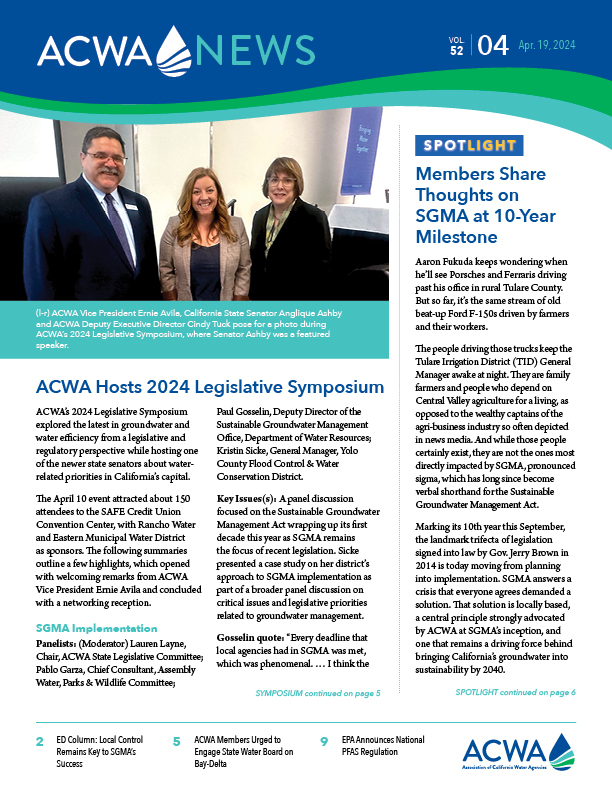 Read the Apr. 19 edition of ACWA News for informative articles about the association and water industry.
Articles include:
- ED Column, Spotlight Feature Look at SGMA after 10 Years
- Article Features Quotes and Highlights from ACWA Legislative Symposium
- EPA Sets National Maximum Contaminant Level for PFAS
- ACWA Board Extends Funding for QuenchCA, Partnership Opportunities Available